Newborn supernova spotted only hours after its explosive birth


Just hours after its birth, astronomers managed to glimpse the consequences of a nearby supernova. According to their study recently published in the journal Scientific advancestheir exceptional achievement through quick thinking and intense geometric calculations is already providing clues to long-standing questions about some of the most impressive and powerful events in the universe.
On April 10, 2024, astronomers began the rapid mission to capture the supernova SN 2024ggi. Study co-author Yi Yang of Tsinghua University in China initially learned of his sighting shortly after arriving in San Francisco following a transpacific flight. About 12 hours later, Yang wrote and sent an observation proposal to the European Space Observatory (ESO), which quickly approved his application. Managers of ESO’s Very Large Telescope (VLT) in Chile then turned their high-powered array toward the Hydra constellation to focus on the rapidly evolving situation about 22 million light-years from Earth. In total, it only took about 26 hours from the first detection to train the instruments on the supernova. What astronomers saw was a never-before-seen moment in the death of a red supergiant star.
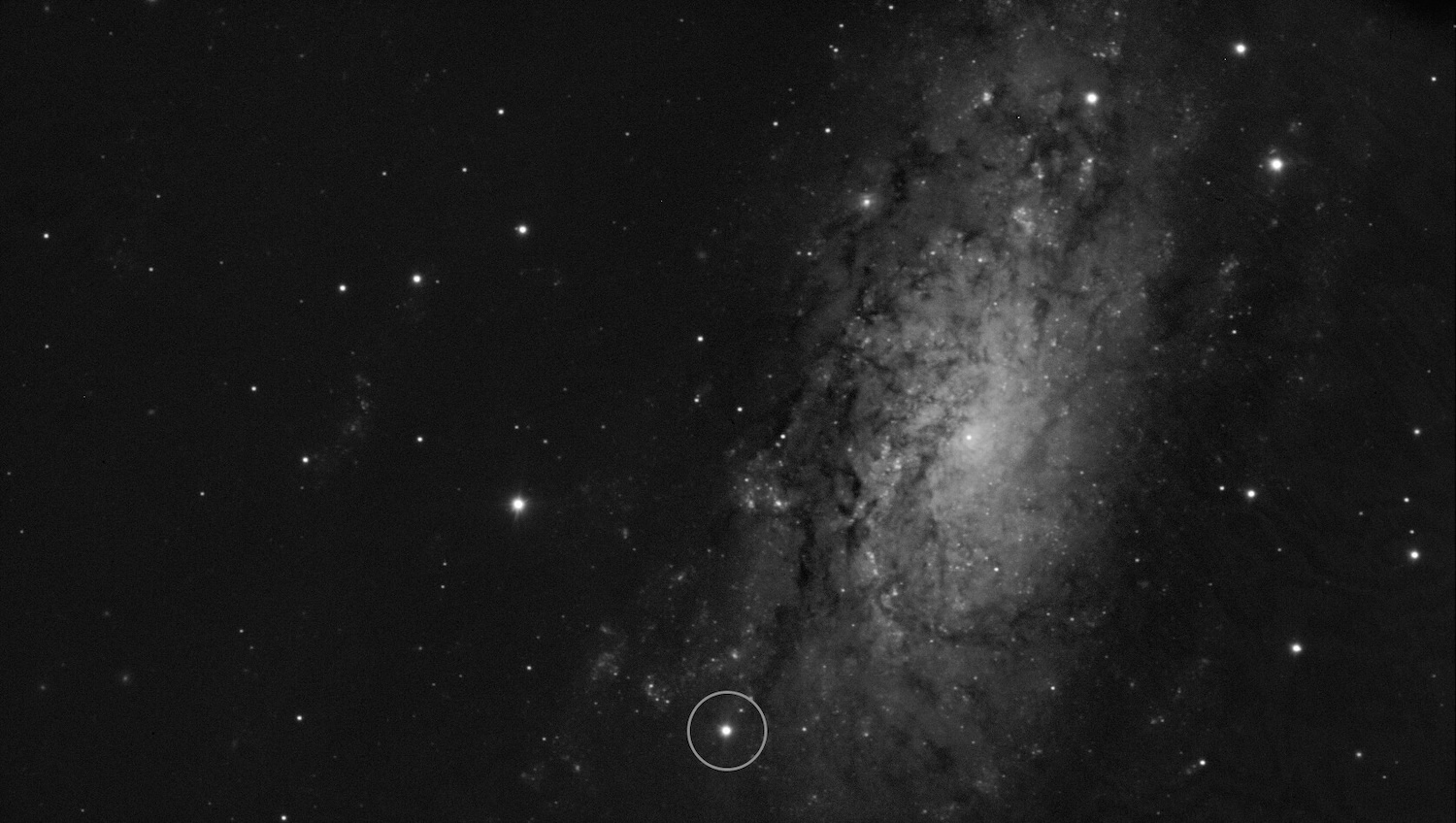
“The first VLT observations captured the phase when matter accelerated by the explosion near the center of the star passed through the star’s surface. For a few hours, the geometry of the star and its explosion could and were observed together,” ESO astronomer and study co-author Dietrich Baade said in a statement.
A star maintains its spherical shape for most of its lifespan due to a perfect balance maintained between the pressure of gravitational force and the pressure of its internal nuclear fusion reactions. However, once this stellar fuel runs out, things start to get unstable. In the case of a massive star, its core eventually collapses. For context, SN 2024ggi has a mass 12 to 15 times greater and 500 times larger than our sun. When a star of this size collapses, its massive shell then implodes before ricocheting outward. These shock waves further weaken the integrity of the dying star before finally passing through its surface layers. Only then does the star truly go supernova and release its massive, telltale waves of light energy.
Most examinations of supernovas begin after this initial phase, but SN 2024ggi was different. By rapidly training the VLT on the exploding star, astronomers were able to observe an initial form of breakout that forms before the supernova explosion begins to interact with surrounding matter. To properly assess the moment, the team relied on a method called spectropolarimetry.

“Spectropolarimetry provides information about the geometry of the explosion that other types of observation cannot provide because the angular scales are too small,” explained astronomer and study co-author Lifan Wang.
“The geometry of a supernova explosion provides fundamental information about stellar evolution and the physical processes leading to these cosmic fireworks,” Yang added.
In combination with other advanced observational tools, the researchers found that SN 2024ggi’s very first explosion formed an olive-shaped shape around the dying star. As the explosion grew larger and struck nearby matter, the shape began to flatten while the ejecta’s axis of symmetry remained stable.
“These findings suggest a common physical mechanism that drives the explosion of many massive stars, which manifests well-defined axial symmetry and acts on a large scale,” Yang said.
Yang and his colleagues are already using this new data to abandon some existing supernova models while improving others. It also allowed skilled astronomical artists to illustrate some of the most accurate depictions of the birth of a supernova.
“This discovery not only reshapes our understanding of stellar explosions, but also demonstrates what can be achieved when science transcends boundaries,” said Ferdinando Patat, ESO astronomer and co-author of the study.

Holiday Gift Guide 2025


