
Bull sharks (Carcharhinus leucas) have a really bad reputation. The ocean’s bad boys are responsible for at least 100 unprovoked attacks on humans, 27 of which have been fatal. However, the species may be responsible for more attacks. A bull shark was likely behind the real encounters that inspired the award-winning novel and film Jaws.
However, these 12-foot-long, solitary sharks appear to form important social bonds. A study published today in the journal Animal Behaviour finds that they create these relationships with only a few specific “friends.” Instead of mixing at random, they appear to actively choose who they spend time with and have preferences.
“As humans we cultivate a range of social relationships—from casual acquaintances to our best friends, but we also actively avoid certain people—and these bull sharks are doing similar things,” Natasha D. Marosi, a study co-author and founder of Fiji Shark Lab, said in a statement.
Over six years, a team from the University of Exeter and University of Lancaster in the U.K., the Fiji Shark Lab, and Beqa Adventure Divers observed this friend-choosing behavior at the Shark Reef Marine Reserve in Fiji.

Bull sharks in Fiji
“The Shark Reef Marine Reserve is a protected area where large numbers of sharks gather year round, giving us the ability to study individual sharks repeatedly over time,” Marosi explained.
Marosi and others monitored 184 bull sharks in three age categories: sub-adult (not yet sexually mature), adult, and advanced-adult (post-reproductive age). The team kept track of two different kinds of observable relationships. The first are called broad-scale associations and occur when individual sharks remain within one body length of each other. The second are fine-scale interactions, when one shark will lead while the other follows or when sharks swim parallel with one another.
The team found that social ties were common between adult sharks. Sharks were also most likely to interact with partners that were a similar size.
Related Shark Stories
“Contrary to commonly held perceptions of sharks, our study shows they have relatively rich and complex social lives,” added study co-author and University of Exeter behavioral ecologist Darren Croft. “We are only just beginning to really understand the social lives of many shark species. Just like other animals, they likely gain benefits from being social—this may include learning new skills, finding food and potential mates while avoiding confrontations.”
The team also found that sharks of both sexes preferred socializing with females. However, the males had more social connections on average than the females.
“Male bull sharks are physically smaller than females, thus one potential benefit they may gain is by being more socially integrated,” said Marosi. “They are buffered from aggressive confrontations with larger individuals.”
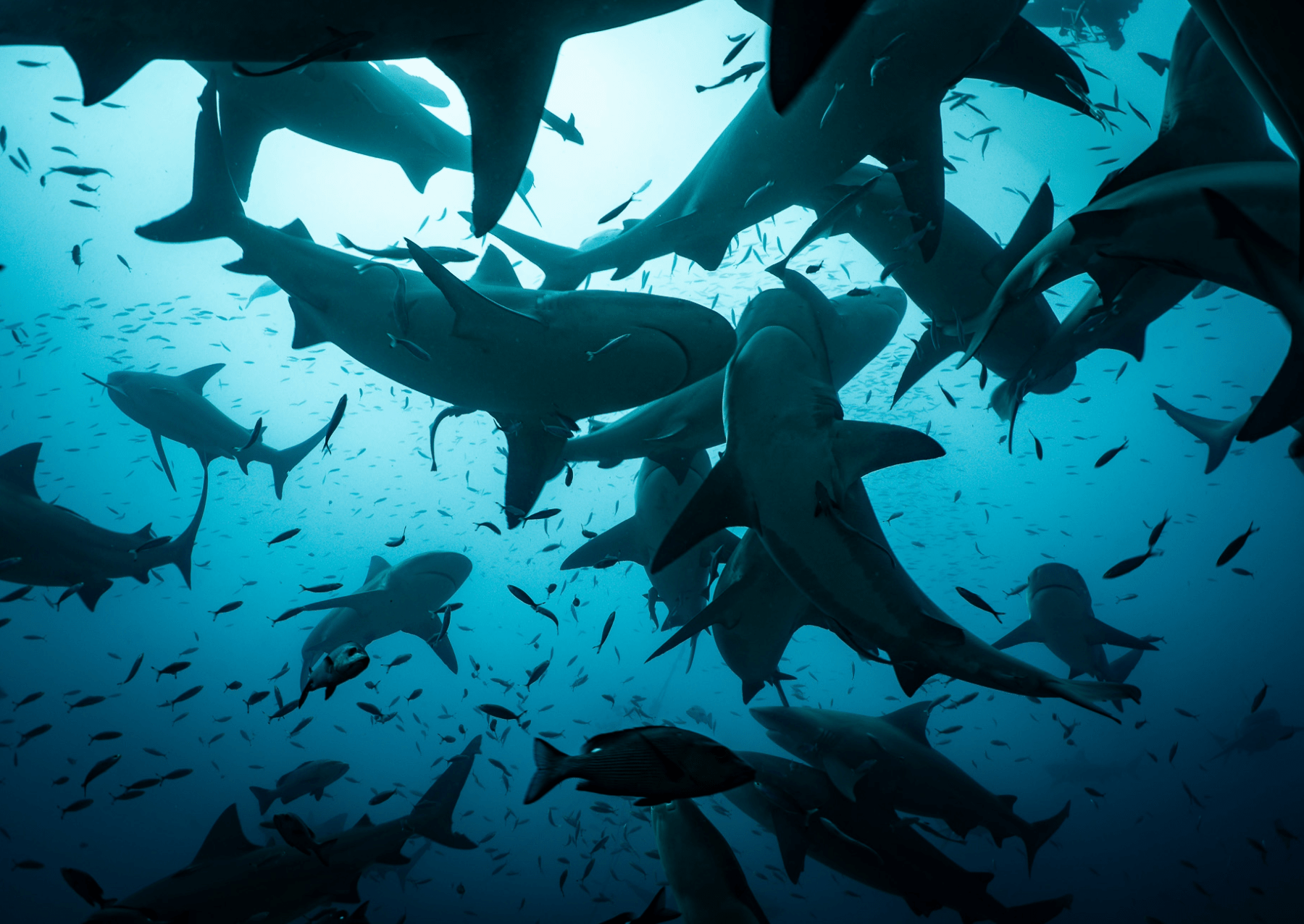
Among the age categories, adult sharks were at the heart of the shark social network. The advanced adult and sub-adult sharks were generally less socially connected.
“These older individuals have many years of experience honing their skill sets, hunting, and mating, and sociality may not be as integral to their survival as it is for an individual in their prime,” said Marosi. “Sub-adult bull sharks rarely visit the Reserve. Sub-adults usually occupy near-shore habitats, while juvenile bull sharks can be found in Fiji’s river and estuarine systems.”
In early life stages, sharks do not generally need to avoid predators, including threats from other adult bull sharks. However, the team says that they do have some bolder sub-adults at the Reserve.
These sub-adult individuals “have established social ties with some of the adult sharks,” said Marosi. “These older individuals may act as facilitators for inclusion within the social network, and also possibly provide pathways for social learning.” In other words, older adult sharks may be the gatekeepers to the shark social network.
Understanding how different shark species develop social bonds can help inform marine policy and conservation management. The Fiji Shark Lab is currently working alongside Fiji’s Ministry of Fisheries to use the study’s valuable information in joint conservation efforts. Just as bull sharks need their friends to survive in the big blue, they also need human friends to protect their home.

2025 PopSci Best of What’s New


