
Politics
/
September 24, 2025
What would a Democratic presidency armed with Trump’s limitless power look like?
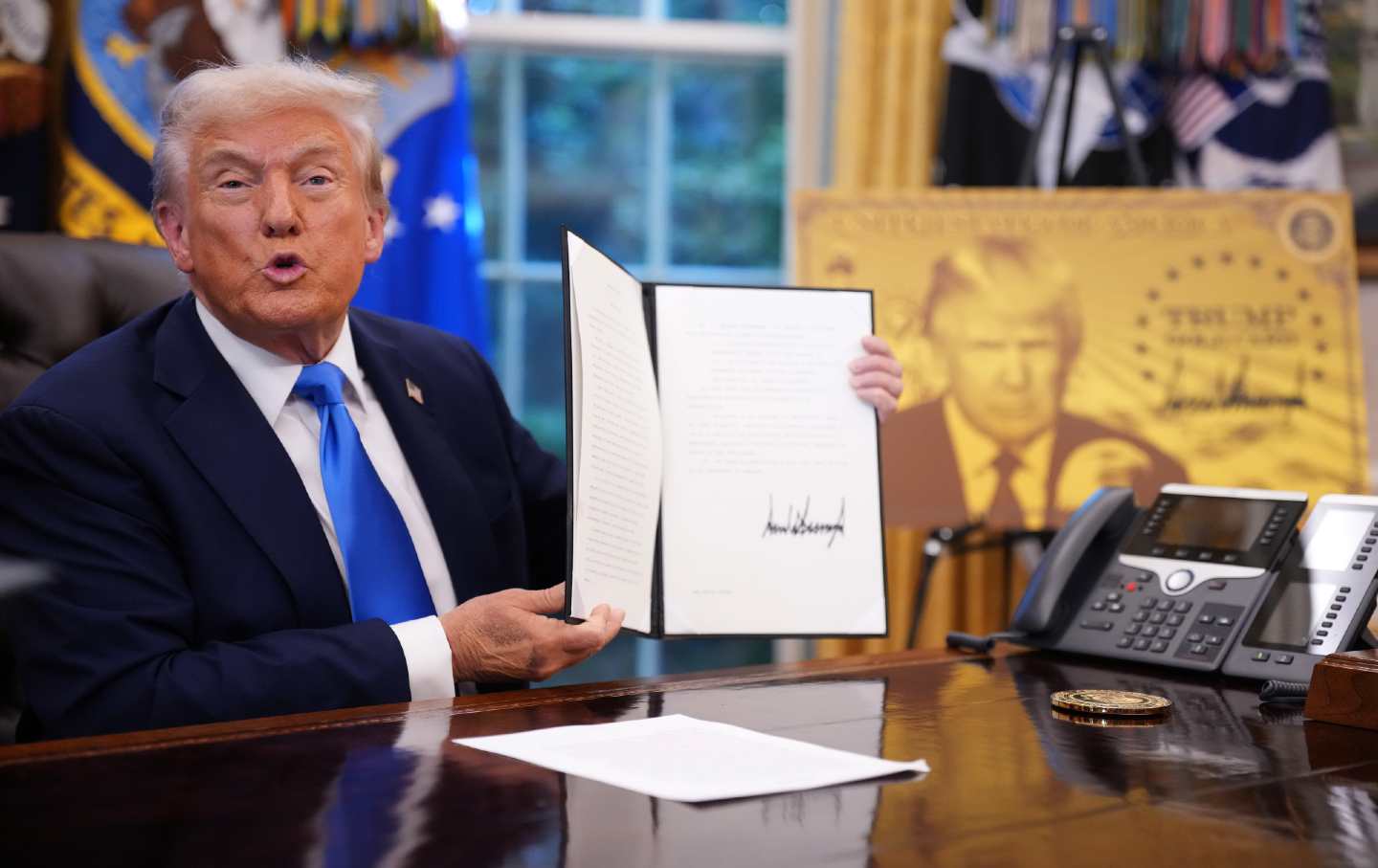
President Donald Trump displays his executive order establishing the Trump Card for HB-1 visa applicants at the Oval Office on September 19.
(Andrew Harnik / Getty Images)
For the past eight months, the Trump administration has been turning the executive branch into an elaborate partisan earth-scorching apparatus, one that the president and his allies clearly believe has no meaningful legal or moral limits. In some ways, you can’t blame Trump and his lieutenants. The Supreme Court has made legitimizing this lawlessness as quickly as possible its number-one priority, often setting aside the plain language of existing laws to fast-track affirmation of the president’s right to unlimited roughshod-riding. The most recent instance of this is the court’s ruling to uphold Trump’s illegal firing of a Democratic-appointed commissioner on the Federal Trade Commission while the court hears the legal challenge to Trump’s action, under a law that expressly forbids the regulatory firings that Trump’s White House has done.
Many on the left, with good reason, believe that the Supreme Court will suddenly rediscover some limits on presidential authority the next time a Democrat is elected president—if indeed that is ever again allowed to happen. But it’s also worth thinking about what it would look like if this earth-scorching apparatus falls cleanly into the hands of a Democrat acting under the license furnished by the court to use what are effectively dictatorial powers for a campaign of blue vengeance.
I’m advancing this thought experiment not because I in any way endorse this model of executive power—rather, I’m hoping to highlight the inherent insanity of what is currently unfolding. What could a Democrat who woke up every day determined to violate the Constitution as we understood it a few years ago do with that unaccountable power? And would your nearest MAGA friend or relative think that what you’re about to read sounds like a good time?
To envision this counteroffensive, we need to understand all the different ways that President Trump has turned the executive branch into a personal cudgel. To begin with, there are the wide-ranging campaigns of personal vengeance, vindictiveness, and lawfare—as wielded in the White House’s overlapping efforts to sue media organizations, issue executive orders targeting individual law firms, or in some cases even individuals, bully and blackmail universities to kowtow to the new Patriotic Correctness that rules Washington, and submit to the administration’s twisted interpretation of civil rights statutes. Next, there’s the disciplinary zeal of Trump’s administration to subjugate every agency and employee in the executive branch to Trump personally—making a commitment to the Trump agenda, personal loyalty to the Trump family and enterprises, and the willingness to engage in flagrantly corrupt conduct the litmus test for remaining in positions that were explicitly designed to be insulated from such pressures.
Then there’s the steamrolling of legal precedent, via executive orders that are plainly and incontrovertibly illegal under existing constitutional law, yet upheld provisionally by the court until some future date by winning emergency relief on the shadow docket. (See the aforementioned FTC ruling.) Next up is the wholesale cannibalization of Congress’s constitutional spending and war powers by unilaterally closing down or gutting federal agencies and impounding funds that the president wishes to spend elsewhere, as well as launching air strikes against Iran and seemingly random maritime vessels in the Caribbean without even a cursory effort to establish their necessity or justification under US law. Instead, the Trump regime is trying to get Congress to issue an open-ended authorization for the use of military force against drug cartels.
Last, but far from least, Trump has ushered in an era of what I’ve begun to call abusive federalism, choosing targets of ICE enforcement operations by virtue of how a state voted in the previous presidential election or the major-party affiliation of a city’s mayor, vindictively threatening to withhold federal disaster funds and otherwise browbeating states that don’t capitulate to whatever unreasonable policy demands the president happens to wake up with on any given day. This is to say nothing of the Trump administration’s extraordinarily open commitment to the most egregious corruption that has ever unfolded in American history, something that it is impossible to even imagine reproducing at scale, since it achieves nothing of even theoretical partisan or ideological value beyond enriching the Trump family and debasing the already tattered reputation of the United States of America.
Current Issue

Let’s just take this piece by piece. For the sake of argument, let’s say that the next president is now–Illinois Governor J.B Pritzker, whose concise and pointed warnings to Trump about sending the National Guard to Chicago appear to have caused the president to back down. It should go without saying that President Pritzker could fire, on day one, every person hired by President Trump to work for the federal government—political and nonpolitical appointees alike. Remember, the new rule in Washington, DC, is that you can fire anyone at any time, preexisting statutes to the contrary notwithstanding.
And under the theory of executive power advanced by Trump and accepted wholesale by the Republican Party, President Pritzker could cancel any research grants to universities and nonprofits that don’t comport with the new administration’s ideology. He could also aggressively target large companies like Amazon and Apple and force them to forfeit lavish pools of money to fund, for example, distressed public schools or universal basic income programs. Don’t worry about the details—just think of major American corporations as a collective ATM that the Pritzker administration could turn to whenever it is running short on funds or wants to humiliate and demean critics or rivals.
He could also instruct the Department of Justice (DOJ) to investigate leading Republican fundraising arms like WinRed and super PACs like Elon Musk’s America PAC as part of the effort to hound and harass opposition-affiliated organizations out of existence. He could force any law firm currently carrying water for or capitulating to Trump’s White House to pay large cash settlements to the government, order expansive and expensive investigations into leading GOP-aligned institutions like the Federalist Society, and pry open the records of dark-money donors to media organizations like One America News and advocacy groups like America First Policy Institute.
President Pritzker could also launch lawsuit after lawsuit against any conservative media outlet that runs even modestly negative coverage of the administration or edits an interview in a way that he doesn’t like. This brand of lawfare could be used to bring the right-wing media ecosystem to its knees by forcing far-right outlets like Newsmax to play whack-a-mole with one frivolous lawsuit after another. A Democratic commissioner of the Federal Communications Commission could, as Brendan Carr did last week, threaten to pull licenses from stations that carry criticism of the Pritzker administration or pretty much anyone prominent on the left. And while the FCC has limited jurisdiction over cable networks like Fox News, regulators could force cable vendors to allow people to opt out of individual channels, depriving cable news networks of aging audiences who supply them with vital revenue.
If the administration wanted to try to put something even more lasting in place, it could restore or even broaden the Fairness Doctrine—the long-dead FCC rule that required broadcast entities to air contrasting viewpoints—and apply it to cable, satellite, and even Internet or app-based media organizations. This move would have an instant and transformative impact on the ability of far-right media grifters to run what are in effect 24-7 propaganda operations on behalf of the MAGA movement. The president could also nationalize SpaceX, the entity formerly known as Twitter, and social media apps like TikTok, using whatever made-up interpretation of emergency powers he chooses.
Pritzker could use the awesome powers of the Roberts-sanctioned unitary executive interpretation of presidential prerogatives to try to reverse the growing threat of right-wing anti-vaccine sentiment. He could, for example, direct the Department of Health and Human Services (HHS) to allow insurance companies to engage in price discrimination or even termination of insurance policies against unvaccinated Americans. He could order the IRS to halt all audits of anyone making less than $500,000 a year and to heavily scrutinize anyone with a net worth of more than $1 million.
Pritzker could direct the National Highway Traffic Safety Administration to ban the sale of noncommercial passenger vehicles over a certain size—say, a threshold just below the Cybertruck’s dimensions. He could order HHS to halt all discretionary health spending to states with abortion bans in place. The DOJ could be tasked with investigating every single LLM-based AI service that has engaged in intellectual theft, and bankrupt them one by one. On the new Trump principle of issuing plainly illegal or unconstitutional executive orders and rushing to the Supreme Court when the lower courts rightly object, President Pritzker could repeal the Second Amendment by fiat and order states (in open defiance of the Constitution) to set aside voter ID statutes and other measures intended to diminish turnout in federal elections.
Would all of this stuff hold up in court? Who cares? The Trump administration moves quickly and breaks things, leaving someone else to pick up the pieces on the off chance that the Supreme Court will rule against it on the Merits Docket at some unspecified future date. And speaking of the Supreme Court, President Pritzker could simply defund it and direct its resources elsewhere, turning the Marble Temple into a wraparound services facility for recovering addicts and forcing SCOTUS justices to work in the basement of Comet Ping Pong.
President Pritzker could also cut off funding to federal agencies he dislikes. He could sign a day-one executive order to completely defund and disband ICE, impounding funds authorized by Congress for both internal immigration enforcement as well as agencies like the Department of Defense and using them however he sees fit. He could order the border wall to be dismantled and the materials used to build affordable housing for immigrants. Military funding levels, under the new regime created by the Roberts court, are no longer the domain of Congress. A new Department of Military Efficiency could turn the Department of Defense (now restored to its former name after Trump had rechristened it the Department of War) upside down and scrutinize every aspect of the Pentagon’s corrupt, bloated operations. Pritzker could also have the State Department designate certain European far-right parties as foreign terrorist organizations and authorize the military to blow planes carrying their leaders out of the sky.
Under the new rules of the imperial Roberts-Trump White House, the only thing Congress really can do now is determine the overall amount of money that could in theory be spent by the United States every year—providing, of course, that the president chooses to spend it. It’s less lawmaking as the Constitution envisioned it and more like a group of 535 people setting almost hypothetical budget targets with no meaningful authority to enforce them.
There will surely be a gigantic pot of unspent ICE funding waiting for the next Democratic president, and instead of thinking of that as money that should be used as Congress directed, it can instead be employed as a slush fund to achieve long-standing Democratic policy goals. It should go without saying that contracts for any ICE facilities that have not yet been completed will be canceled and existing facilities repurposed to fulfill the country’s actual social needs.
A commitment to abusive federalism could open a Pandora’s box that the Trump administration has barely even begun to explore. A Pritzker presidency could try to strong-arm states into undoing extreme partisan gerrymanders as a condition of receiving aid for the next hurricane or catastrophic flood—but only red states. Blue states can do whatever they want, up to and including drawing congressional districts as concentric circles emanating out of Chicago to give Democrats a 17–0 Democratic House delegation from Illinois.
Pritzker could invent a formula to ensure that states receive back the exact amount of federal funding that they supply via taxes, a maneuver that would disproportionately harm Trump-voting states and please the kind of liberal who gleefully reposts content about how red states are on the dole. Tariffs can be issued at will, and designed to harm importers and businesses in red states while benefiting those in purple or blue jurisdictions. Pritzker wouldn’t do this under the table but in full view of the media, crowing hourly about the damage he’s doing to the “evil, reactionary Republican fascists in backwards, hellhole red states full of un-American monsters and depraved sickos.” (The actual language can be crafted by the literally worst person you know on the left, following on the precedents set by Stephen Miller.)
Remember, the Trump administration seems very attuned, even subservient, to the preferences of extremely online right-wing influencers and content creators. Indeed, Trump and his White House enablers have put them in charge of executive branch social media accounts, where they have sent forth into the world a seemingly unending stream of Nazi-coded memes, partisan invective, and childish shitposting. There’s no reason that the next Democratic administration couldn’t hand over key government functions to left-wing influencers and appoint a cabinet full of MSNBC hosts and podcasters. I’m sure Attorney General Ben Meiselas, FBI Director Rachel Maddow, and OMB Director Andrei Cherny would be glad to carry out many of these plans.
Pritzker could close all the military bases sited in red states. and relocate them to places where their GOP-leaning voters would be swamped by Democrats. For example, there are 260,000 people at Fort Liberty in the battleground state of North Carolina; presumably, you could suck tens of thousands of Republican-leaning voters out of state just by shifting federal assets away. Pritzker could also order HHS to build a network of abortion and gender-affirming care clinics on federal land in all 50 states, using impounded funds.
Popular
“swipe left below to view more authors”Swipe →
A revitalized Department of Education could construct an enormous, free national university on federal land in Montana, again using funds impounded from ICE. There, a few hundred thousand students and faculty would probably be enough to flip two Senate seats. And of course, Pritzker could rename military bases after Barack Obama, Jimmy Carter, Earl Warren, Ruth Bader Ginsburg, and other beloved Democratic figures just for the contact high of making people angry and miserable—another animating principle of the Trump administration. Reagan National Airport could become George Floyd National Airport.
Are there some good ideas here that are worth defending on their own terms? Sure, and Democrats should absolutely use the executive branch to achieve good-faith progressive policy goals unless and until the Supreme Court sees fit to rein in the powers of the White House once and for all. ICE should be at the very top of the chopping block. Military spending can and should be heavily scrutinized and streamlined. The Fairness Doctrine, on the other hand, is probably unworkable except as something to be used as a partisan cudgel.
But the point is that most of this list consists of things that are plainly preposterous or executive actions that used to be and still should be illegal. I mean no disrespect to Rachel Maddow, for example, who exists on a different ethical and professional plane than an unqualified, toxic hack like Pete Hegseth. I simply don’t think she should be running a federal bureaucracy just because she makes good TV. This is a principle worth defending!
And if we don’t want our consciences weighed down by an elaborate internal gulag for the purpose of ethnically cleansing millions of immigrants, we would ideally elect people who will lawfully dismantle it. The best way to shore up democracy and restore genuine limitations on executive power would be for Congress to either enlarge the Supreme Court and put Brett Kavanaugh and his fellow GOP partisans masquerading as impartial umpires in the minority for as long as possible or strip the court of jurisdiction over certain areas of the law, as has been done successfully in the American past. The democratic experiment in the United States cannot survive if the president is an unapologetic tyrant whose autocratic and unconstitutional powers are greenlighted by a Supreme Court that simultaneously sets aside the plain language of the Fourth Amendment prohibiting unreasonable searches and seizures.
But the most important reason that the next Democratic president shouldn’t do most of these things is that it would achieve virtually nothing of lasting value. Governance-by-revenge might give livid leftists a feeling of vindication, but most of these moves would either be vulnerable to immediate reversal by the next Republican president or would inflict harm on innocent people in Trump-voting states for nothing more than the satisfaction of bloodlust. Escalation for the sake of escalation also invites—and I know this is hard to believe, but it is actually possible—a more capable and sane future Republican president to engage in far graver crimes than even Trump seems capable of. And it would probably make Pritzker’s administration as profoundly unpopular as the one in Washington today.
In this bleak model of power sharing among ruthless presidents high on their own unitary-executive impunity, politics has no meaningful public purpose. It exists almost entirely as a project of domination—a fulcrum allowing you to crush and humiliate your enemies, all while savoring the lamentations of their pet influencers. And if you’re a Republican and you’ve made it this far into the article thinking, “Wow, some of this stuff could start a civil war,” congratulations—you’re almost there!
Don’t let JD Vance silence our independent journalism
On September 15, Vice President JD Vance attacked The Nation while hosting The Charlie Kirk Show.
In a clip seen millions of times, Vance singled out The Nation in a dog whistle to his far-right followers. Predictably, a torrent of abuse followed.
Throughout our 160 years of publishing fierce, independent journalism, we’ve operated with the belief that dissent is the highest form of patriotism. We’ve been criticized by both Democratic and Republican officeholders—and we’re pleased that the White House is reading The Nation. As long as Vance is free to criticize us and we are free to criticize him, the American experiment will continue as it should.
To correct the record on Vance’s false claims about the source of our funding: The Nation is proudly reader-supported by progressives like you who support independent journalism and won’t be intimidated by those in power.
Vance and Trump administration officials also laid out their plans for widespread repression against progressive groups. Instead of calling for national healing, the administration is using Kirk’s death as pretext for a concerted attack on Trump’s enemies on the left.
Now we know The Nation is front and center on their minds.
Your support today will make our critical work possible in the months and years ahead. If you believe in the First Amendment right to maintain a free and independent press, please donate today.
With gratitude,
Bhaskar Sunkara
President, The Nation
More from The Nation
There can’t be true desegregation without ending discrimination in housing—which is precisely why the administration is rolling back enforcement of the FHA.
Elie Mystal

Lobbying groups like the Florida Chamber of Commerce, which represents Publix, blocked a Florida bill that would have guaranteed heat protections for outdoor workers.
OppArt
/
Motyko Morales

After the assassination of Charlie Kirk, the conservative movement has accelerated its war against trans people. And too many centrist Democrats have kept up their trans bashing.
Jack Mirkinson
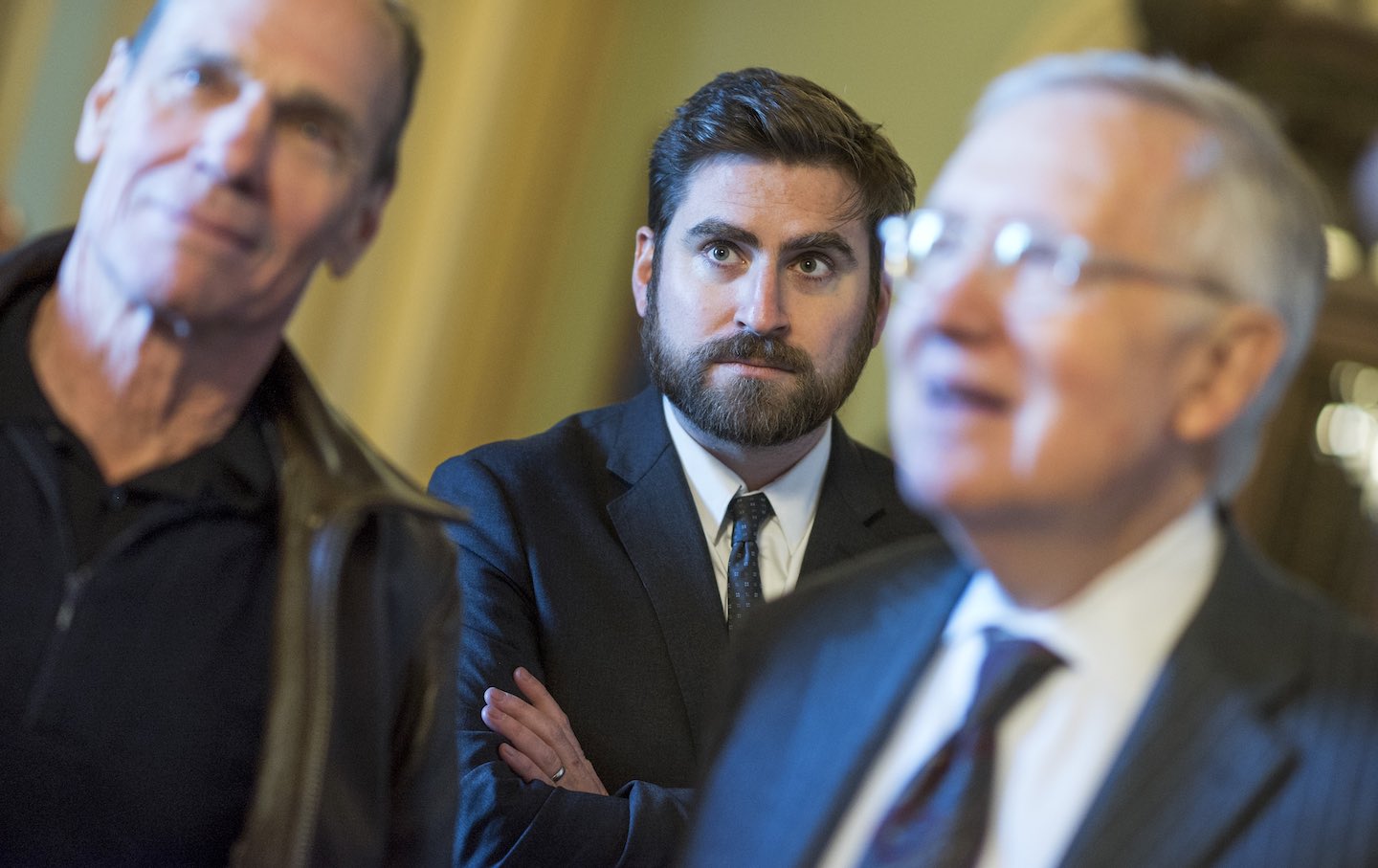
The Searchlight Institute, founded by former senate staffer Adam Jentelson, epitomizes the careerist tendencies of white-collar workers on the Hill.
Chris Lehmann
Quick: Name one clear triumph in a meaningful war for the United States since 1945.
William Astore


