Can Modi buck Gen Z rage in India’s youngest state?

Patna, India – As 20-year-old Ajay Kumar scrolled through social media on his mobile phone in Muzaffarpur district of the eastern Indian state of Bihar, he came across rumors that a crucial exam for a government job he had run for had been compromised.
Ajay is a Dalit, a community that sits at the bottom of India’s caste hierarchy and has suffered centuries of marginalization. He had pinned his hopes for the future on employment reserved for his community under the government’s affirmative action program.
But the leak of the exam paper in December last year dashed those hopes.
That’s when he came across a video of students as old as he was — and just as angry — protesting the paper leak in the state capital, Patna, about 75 kilometers away. He immediately jumped on a night bus and found himself among thousands of demonstrators the next morning.
Ajay spent the next 100 days in freezing cold, often protesting and sleeping in the open, huddled with hundreds of other students. Their demand was simple: a review. But in April this year, India’s Supreme Court rejected students’ petitions for a review.
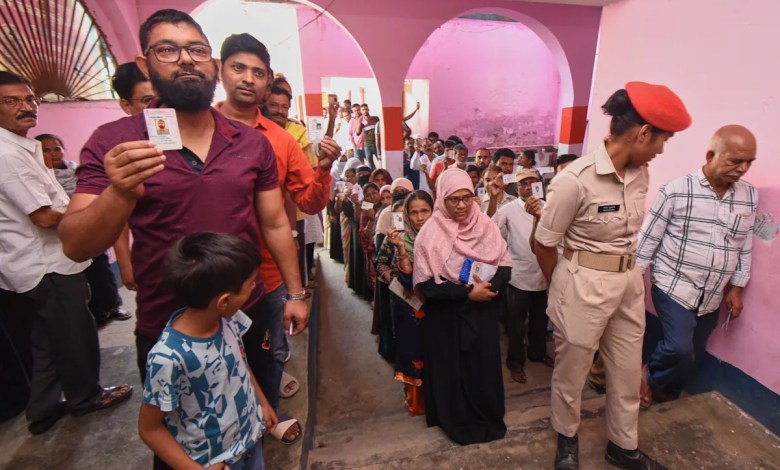
Ajay, furious, contained his anger for months. On November 6, while casting his vote in the first phase of a two-part election to choose the Bihar state legislature, Ajay forcefully pressed a button on the electronic voting machine, hoping his choice would avenge the struggle of students like him.
Where are Generation Z from Bihar heading?
As Generation Z protests toppling governments across South Asia, regional giant India – the largest and most populous of them all – was an exception. A Hindu majority government, led by Prime Minister Narendra Modi’s Bharatiya Janata Party (BJP), has been in power since 2014. In Bihar, a coalition of the BJP and its partners has governed for most of the past two decades, under the leadership of Chief Minister Nitish Kumar.
Yet Generation Z anger is palpable in Nepal’s neighbor Bihar, where young protesters overthrew the government in September, demanding an end to corruption and elite privilege.
Bihar has the youngest population among Indian states. Government data shows that 40 percent of the state’s 128 million residents are under 18, while about 23 percent are between 18 and 29.
At the same time, according to the World Bank, one in three Bihari families lives in extreme poverty, also making it India’s poorest state.
The anger of its youth meant that Bihar witnessed 400 student protests between 2018 and 2022, the highest in the country, according to national government data.
And many, like Ajay, are seeking to channel that anger into electoral change.
The two-phase elections in Bihar, held on November 6 and 11, saw over 74 million eligible voters elect their representatives for the 243-member regional assembly.
The results will be announced on November 14.
As more young people express their discontent with the ruling elite in South Asia, political observers believe the elections in Bihar will indicate whether Modi – who campaigned in the state – is still able to maintain his grip on India’s crucial population, home to the world’s largest youth population. Of India’s 1.45 billion people, 65 percent are under 35 years old.
Or will Modi’s main opponents – led by a much younger Tejashwi Yadav of the Bihar-based Rashtriya Janata Dal (RJD) party and Rahul Gandhi of the main opposition Congress party – be able to exploit the frustrations of Bihar’s youth?
Anger and despair over employment and education
Bihar languishes at the bottom of most of India’s multidimensional human development indices, which take into account factors such as nutrition, child mortality, years of schooling and maternal health, among others.
Pratham Kumar, 20, hails from Jehanabad district in south Bihar. He had to move to Patna, the state capital, because the colleges in his hometown offered “no education, only degrees”.
But studying is a struggle, even in Patna, he says. The college hostel has no drinking water, the Wi-Fi router hasn’t worked for months, and students like him often end up mowing the lawn in their cramped hostels because the hostel authorities don’t have adequate maintenance staff to do so.
“Across Bihar, the state of education is so bad that you just have to enroll in a college to get a degree on paper, but if you really want to learn, you have to enroll in private coaching classes at an additional cost,” he fumes.
Pratham is now looking to leave the state – the only alternative for millions of students and unemployed Biharis. A 2020 study by the Mumbai-based International Institute of Population Sciences (IIPS) found that more than half of households in the state depended on remittances from relatives who had migrated to other states or abroad.
Pratham’s friend Ishant Kumar hails from Darbhanga, another district in Bihar. He is angry at young people forced to emigrate in search of a better life and highlights cases of anti-migrant violence in parts of India, often targeting Biharis.
“Poverty here pushes young Biharis out, then they are insulted, attacked and have no dignity,” he told Al Jazeera. “From Calcutta to Maharashtra, only Biharis are attacked and mocked.”
Ishant is unhappy that successive state governments have not done enough to stem migration. “The cream of Bihar migrate and contribute to the development of other parts of the country. Instead, why can’t we create growth opportunities here?” he asks.
In Vaishali district, Komal Kumari, 23, estimates she has already lost two years of her life due to government inefficiency.
Komal, like Ajay, is a Dalit. Her family survives on a monthly allowance of 9,000 rupees (about $100) that her mother earns as an anganwadi (child care worker) employed by the government. Komal, like millions of girls across Bihar, was promised a cash transfer of 50,000 rupees ($565) in 2021 by the BJP government of Bihar, if she obtained a higher education degree.
Komal, who completed her Bachelor of Arts with honors in political science in 2023, has been waiting for the money for two years now.
She hopes to qualify for a teaching job, but for that she needs a two-year degree, a Bachelor of Education (B.Ed), which would cost her around $75,000 ($846). But she has no savings: she has already spent nearly 100,000 rupees ($1,128) on her first university degree and on the coaching centers she went to to improve her exam chances for several government jobs.
Now she cannot pursue B.Ed either. or coaching for government job exams.
And she’s angry. “I only spent so much money because the government promised a cash transfer. If they had been quick, I wouldn’t have wasted two years waiting.”
“Here, the students are constantly angry”
Ramanshu Mishra owns Ramanshu GS Classes, a popular coaching center in Patna for young Biharis keen to apply for government jobs. He says Ishant and Komal speak for most of the students in the state.
“Students are constantly angry here. When they study, they are angry at poor educational institutions. When they complete their studies, they are angry at the lack of job opportunities,” Mishra told Al Jazeera.
Government data shows that the unemployment rate in urban Bihar between 15 and 29 years old is 22 percent, much higher than the national average of 14.7 percent.
This is why Bihar is becoming a testing ground both for Modi’s BJP, which is one of the main partners of the current National Democratic Alliance (NDA) government in Bihar, and for its challenger, the opposition. Alliance INDIAled by the RJD and the Congress. The INDIA alliance has announced that RJD chief Yadav, 36, will be its main ministerial face, while the NDA is banking on Modi, 75, and outgoing chief minister Nitish Kumar, 74.
“The verdict will show whether India’s youngest state chooses young leadership [opposition alliance] or if he chooses to be with the former [NDA]” Nilanjan Mukhopadhyay, journalist and author of Modi’s biography, among other books, told Al Jazeera.
Both camps are trying to appeal to young people. In an election speech last month, Modi said his government’s policies allowed Biharis to earn money through social media “reels”. “I made sure that 1GB of data cost no more than a cup of tea,” he said.
The Modi-led NDA has pledged in its election manifesto to create 10 million jobs in Bihar, if returned to power, while India’s opposition bloc has a primary goal of ensuring one government job per family in Bihar within 20 days of coming to power.
Gandhi, 55, of the Congress party, has also repeatedly urged Gen Z voters to “stay vigilant” and put an end to voting malpractices that he said have occurred in several Indian elections in recent years. Gandhi alleged that the ruling BJP committed electoral fraud by adding ineligible and fake voters to the country’s electoral rolls. The opposition also criticized the country’s Electoral Commission for its complicity. The Election Commission had been criticized for a controversial revision of Bihar’s electoral rolls on the eve of the elections, which resulted in the removal of 3.04 million voters disproportionately in districts with large numbers of Muslim voters – who usually vote against the BJP.
“If the young opposition leaders lose, it will put Modi in a very advantageous situation,” Mukhopadhyay said. “Because it means that even though he is 75 years old, young people still support him.”
(Ajay Kumar’s name has been changed because he fears his participation in the protest could harm his career prospects.)


