China builds record-breaking floating wind turbine — it could change the face of renewable energy


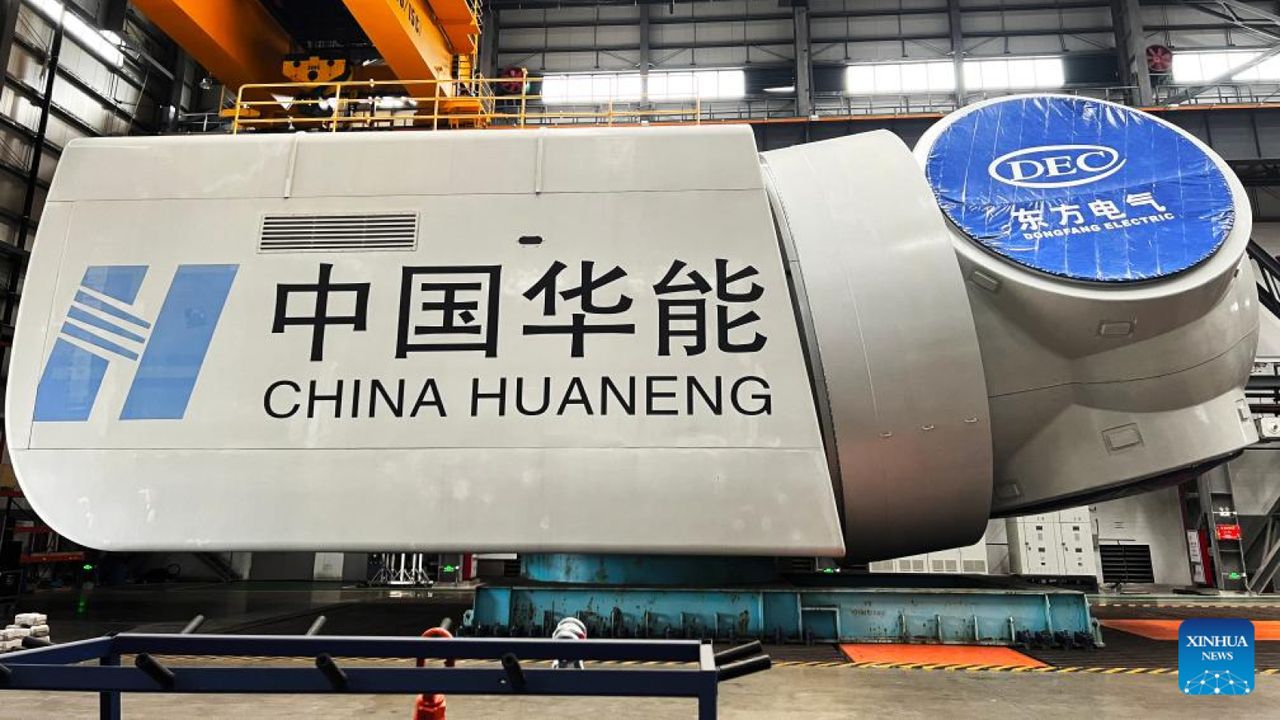
Chinese engineers have created a floating prototype wind The fact that they say broke electricity production records – potentially inaugurating a new generation of renewable energy production.
The turbine is the result of research of the Chinese energy giant China Huaneng Group and the electricity generator Dongfang Electric Corporation, which are both public enterprises.
Each turbine would be able to generate 17 megawatts (MW) of clean electricity, or 68 million kilowatt hours (kWh) during a year. This is enough to supply approximately 6,300 American households per American data from the energy administration.
To generate this power, the nacelle – the central component in a wind turbine which contains the real generator – is at the top of a tower of 489 feet high (152 meters), with blades which represent a diameter of 860 feet (262 m).
Each “scanning” or 360 -degree rotation of the blades includes an area of 53,000 square meters, that is to say almost eight football fields.
Increasing the amount of electricity that a single turbine can generate is important to encourage greater adoption of wind energy, as it reduces the overall number of turbines that must be installed in each wind farm. This lowers the cost and reduces time before turbines start to generate power.
Of course, the more the marine turbines are, the more extremely the most extreme wind conditions may be forced to resist. The Chinese group Huaneng said that the test turbine can withstand waves over 78 feet (24 m) high, as well as typhoon speed winds – those More than 64 knots (73 miles per hour).
The manufacturers will test the turbine off the ribs of Yangjiang, China, in the coming months.
The floating wind extends the rules of the game
Although offshore wind farms are more expensive to build And produce more expensive energy per unit That their onshore counterparts, putting wind turbines at sea exposes them to more constant and intense winds – so much the better for a production of massive energy with less stop time.
Most offshore wind turbines are “Fixed Bottom” devices, which means that they are moored at the bottom of the ocean. It is a profitable way to install wind farms in shallow waters – like the North Sea, which has an average depth of only 295 feet (90 m).
Current fixed offshore wind turbines such as Ge Vernova Haliadiad-X turbines used in the United Kingdom Dogger Bank Wind Farm are assessed at 13 MW, while Dongfang Electric publicly tested A turbine at a fixed bottom at 26 MW in June 2025. The best rated turbines in American waters are 12 MW Siemens Gamesa 11.0-200 DD, which are part of the South Fork wind farm and produce 11 MW each.
But a large part of the world’s oceans are not suitable for fixed bottom turbines, with a global average depth of 3,682 m (12,080 feet), according to the Oceanic and atmospheric national administration (NOAA). The deepest offshore wind turbine foundation was installed As part of the Seagreen de SSE wind farm, in waters of 58.6 m off the coast of Scotland.
But this is exceptionally deep for the offshore wind, with the Energy Sector Management Assistance Program (ESMAP) notation All the waters of 50 m deeper as unsuitable for turbines with a fixed bottom.
Meanwhile, the Global Wind Energy Council (GWEC) has estimated This 80% of the generation of offshore wind generation in the world is in the water deeper than 195 feet (60 m), too deep for the turbines with a fixed bottom.
As the use of floating wind turbines develops, energy companies and nation states could massively increase the amount of energy produced by the wind by putting turbines in deeper waters.
For example, countries like Japan, which have not been able to use a large part of its deep territorial waters for wind energy, could use floating turbines as a source of renewable energy. Japan has set an ambitious target To reach 30 to 45 GW of wind energy production by 2040, with floating wind turbines which should play a major role.


