Chinese are divided over whether to seek global dominance : NPR


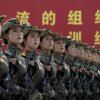
People use smartphones to film planes fly in training during a military parade to commemorate the 80th anniversary of the end of the Second World War in Beijing on Wednesday.
RAFIQ MAQBOOL / AP
hide
tilting legend
RAFIQ MAQBOOL / AP
TAIPIEI, TAIWAN – A new study on the opinions of Chinese citizens on Foreign Affairs has revealed that a majority of people do not consider the United States as a friend, but also promote a nuanced approach to Washington.
The survey, published this week by the Chicago Council on Global Affairs Think Tank in partnership with the Carter Center, also reveals that the two main threats perceived against China both involve the United States.
The majority of people interviewed from the Chinese believe that American economic competition and the “possible conflict” with Washington on Taiwan present major threats to their nation, while opinion is divided on the role that Beijing should play on the world scene.
The Chinese interviewed prefer Russia and North Korea, not the United States, like their friend
The study offers a unique overview of the views of daily Chinese citizens on international relations.
This occurs while Chinese President Xi Jinping welcomed the leaders of North Korea, Russia and two dozen Beijing countries this week for a military parade drawn up to commemorate the 80th anniversary of the end of the Second World War, in a message in the United States and its Democratic allies, according to analysts.
The survey shows that only 17% of those questioned in China considered the United States as a friend of their country, the lowest percentage of all the nations interviewed.
Meanwhile, 55% said economic competition with the United States was a major threat to China.
Less than two weeks after taking office earlier this year, President Trump has imposed new prices on China, causing an increase in climbing and reciprocal imports between Washington and Beijing which was only provided by the start of commercial negotiations in May.

But despite not considering Washington as a friend, faced with an unstable transpacific relationship, 61% of those questioned said that China should balance its approach in Washington, cooperate in a friendly way or limit American power if necessary.
The Chinese who consider Washington to be economically stronger are more likely to promote friendly cooperation. Those who consider that Beijing as stronger is more likely to promote the active limitation of American power, indicates the report.
On the other hand, the vast majorities in China consider Russia (83%) and North Korea (76%) as the friend of their country, and a majority did not consider the American regional allies of the South, Japan or the Philippines as friends of China, which reflects the opinions of the Beijing government.
Chinese leaders are trying to capitalize on current instability in international order
While Washington hits friends and enemies around the world with prices, Beijing leaders tried to capitalize on unleashed instability on the international system.

“China would like to position itself as a defender of more international institutionalism and free trade,” said Ja Ian Chong, associate professor of political science at the National University of Singapore.
During a recent meeting of leaders of non -aligned nations with the West, Chinese chief Xi Jinping stressed the importance of multilateralism and trade. “We must protect the unlike international system and support the multilateral trading system with the [World Trade Organization] Basically, ” XI said.
The feelings are taken up by the Chinese population. According to the study, 73% thought that international trade was good for the overall economy of China and the standard of living, while 60% preferred a global free trade policy.
But analysts like Chong say that China’s rhetoric on free trade and multilateralism has exceeded its substantial actions.
“”[China] speaks a language of liberalism because it can because it is gaining ground in this way, but its behavior is late on its language, “said Chong.
The attitudes of Chinese citizens in the exchange of trade in American national surveys, also carried out by the Chicago Council on Global Affairs, suggesting that some 55% of Americans now also want the United States to continue a global free trade program, despite Trump’s prices on many American trade partners in recent times.
The majority of the Chinese interviewed think that the US conflict on Taiwan is a major threat
Researchers also found that 57% of respondents listed the American-Chinese conflict on Taiwan as a major threat to their country.
The United States does not recognize Taiwan as a sovereign country, but sells weapons in Taipei and maintains an intentionally vague policy of “strategic ambiguity” on the question of whether it would answer militarily in the event of Chinese attack.

Beijing considers Taiwan as its own territory and has never given up the use of force to put Taipei under its control. In recent years, China has increased pressure on democratic island and its government.
Faced with Chinese threats, Taiwan launched his greatest military shooting exercises live in July. The exercises included newly acquired Abrams tanks and high mobility artillery rocket systems, known as Himars, both bought in the United States
The researchers found that the Chinese strongly considered the Taiwanese. 91% said they thought the Taiwanese population was friendly. However, only 44% saw the government in Taipei in the same way.
Chinese promotes Beijing’s participation in global affairs, but not knowing if it has to dominate the world
The study revealed that 90% of Chinese supported their country’s participation in global affairs. This contrasts with American national opinion.
The research published by the Pew Research Center in May suggests that less than 50% of Americans think that it is preferable that the future of the United States is active in global affairs.
While Washington has withdrawn from several multilateral organizationsIn recent years, China has strengthened its presence in these entities and has worked to create other initiatives.
For example, in 2013, Beijing began to put pressure on commitment with countries around the world thanks to its Belt and Road (BRI) initiative. BRI is a major infrastructure, investment and economic cooperation strategy that has seen Chinese companies engage in business and construction in a large part of the globe.
In July 2025, some 150 countries had signed cooperation agreements with China as part of the BRI frame.

With China increasingly engaged in international affairs, the study revealed that 97% of its population thought that the country was now in at least a somewhat strong position in the world.
“We see a high degree of confidence in China, in the Chinese public, in their country and the direction that the government has its country,” said Dina Smeltz, vice-president of public opinion and foreign policy at Chicago Council on Global Affairs.
But what to do with this new force is not clear, she added.
“There are mixed opinions on certain things on leadership: whether it is a common role or if China should have a dominant role in global affairs,” said Smeltz.
While 48% thought that China should assume a role of leadership shared in the international system, 41% said it should assume a dominant role.


