Chinese astronauts are back on Earth after suspected ‘space junk’ strike left them stranded in space


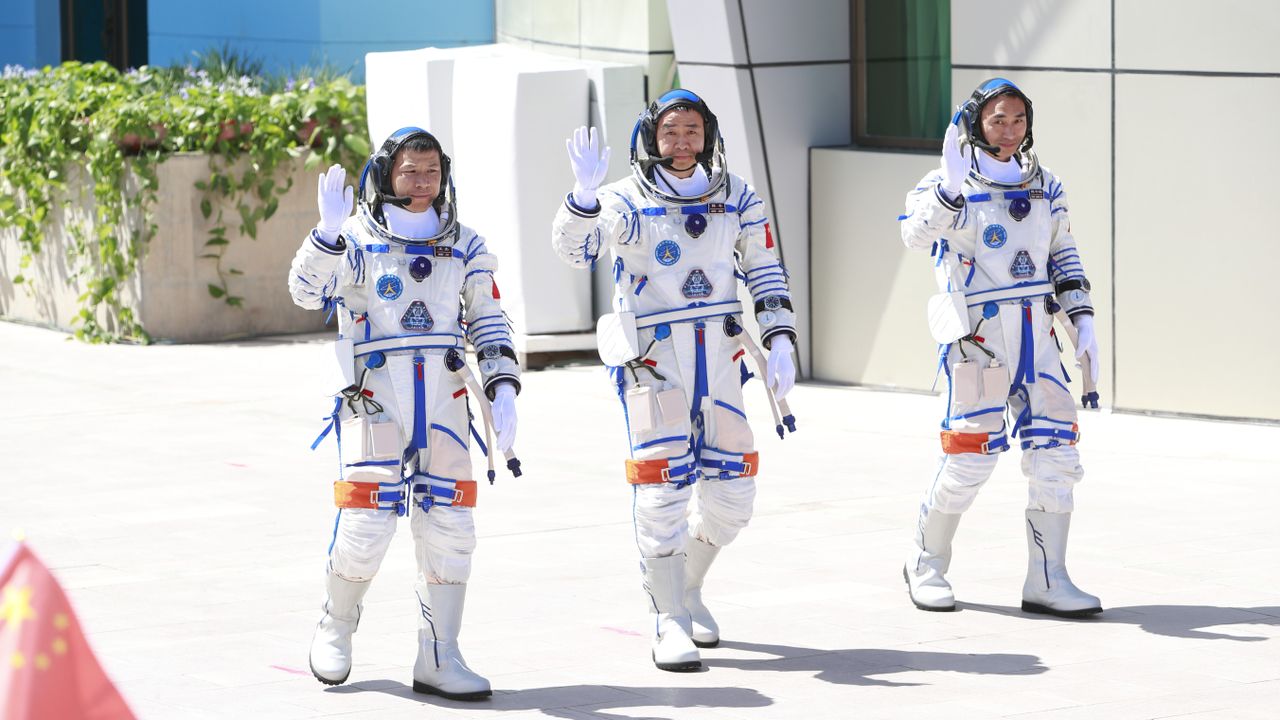
Three Chinese astronauts returned to Earth after a suspected piece of space debris left them stranded on China’s Tiangong space station, officials said.
Chen Dong, Wang Jie and Chen Zhongrui – the crew of China’s Shenzhou-20 mission – left the space station in a return capsule and landed in north China’s Inner Mongolia Autonomous Region on Friday (November 14), according to China’s official news agency. China reported. The crew spent 204 days in orbit, a new record for a crew of taikonauts (Chinese astronauts).
The trio of taikonauts began their record-breaking stay at the Tiangong space station – Mandarin for “heavenly palace” – in April. They were originally scheduled to return to Earth on November 5, but were forced to extend their stay in space after their original return capsule was struck by an object, believed to be space debris, just hours before departure.
Earlier this week, representatives of the China Human Space Mission Agency (CMSA) said that engineers were carrying out tests on an escape capsule to bring the stranded taikonauts home. The Shenzhou-20 crew has now returned in the return capsule of the Shenzhou-21 spacecraft, which carried its replacement crew to the space station.
The Shenzhou-21 spacecraft detached from the Tiangong space station on Friday at 11:14 a.m. Beijing time (10:14 p.m. ET on Thursday, November 13). Then, the return capsule containing the taikonauts separated from the Shenzhou-21 orbital capsule at 2:49 p.m. Beijing time (1:49 a.m. ET), before landing on Earth at 4:40 p.m. Beijing time (3:40 a.m. ET), Xinhua reported.
There is still uncertainty as to what exactly happened to the original return capsule. However, the amount of space junk around Earth is increasingwith items such as rocket boosters and other abandoned space travel objects cluttering the place and increasing the risk of collision with crewed spacecraft.
The Shenzhou-20 crew members are said to be in good health after their eventful stay, according to Xinhua. Their 204 days in orbit may be a record for Chinese crews, but it is far from the case. the longest time humans have spent in space. NASA astronauts Butch Wilmore and Sunita Williams spent 286 consecutive days aboard the International Space Station (ISS) between 2024 and 2025 due to problems with Boeing’s Starlinerwho returned to Earth without any passengers. The astronauts were finally returned home aboard a SpaceX spacecraft, 272 days after their planned return to Earth.
However, astronauts often have long stays on the ISS. Frank Rubio sets American record after accidentally spending 371 days there between 2022 and 2023.
Cosmonaut Valeri Polyakov holds the world record – or unusual record – for the most consecutive days spent in space, having worked on the former Russian space station Mir for 437 days between 1994 and 1995.
Spending extended periods of time in space can have a variety of health impactsbut any changes in the body usually return to normal within six months of returning to Earth. That said, researchers still have much to learn about how space travel affects human health.


