Study: Flavanol-Rich Foods Protect Vascular Health in Men from Harmful Effects of Prolonged Sitting


Prolonged sitting temporarily impairs vascular function and blood pressure. Dietary strategies while sitting may improve or worsen the effects of sitting on vascular health. In a new study, dietary flavanols from cocoa consumed just before 2 hours of uninterrupted sitting were found to be effective in preventing sitting-induced reductions in vascular function in healthy young men. Flavanols have been shown to be equally effective in preserving vascular function in individuals with high and low cardiorespiratory fitness while seated. Good cardiorespiratory fitness of individuals does not protect against decline in vascular function and blood pressure while sitting.
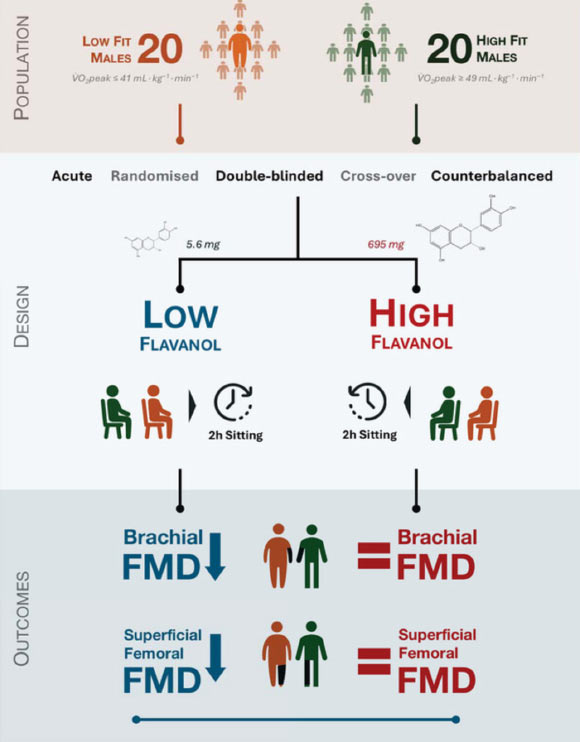
Consumption of flavanol-rich foods during sedentary periods may be used alone or in combination with other strategies (e.g., breaking up sitting) to reduce the impact of inactivity on the vascular system. Image credit: Daniele and others., doi: 10.1113/JP289038.
Sedentary behavior is extremely common in modern societies.
Over the past two decades, the prevalence of sedentary behaviors – particularly time spent sitting – is estimated to have increased by 5.5 to 6.5 hours per day (equivalent to 18.2%) among young adults in the United States.
Sitting is a very common type of sedentary behavior that includes leisure activities such as watching TV and playing video games, as well as occupational sitting and commuting.
Previous studies have shown that a 1% reduction in vascular function, as measured by brachial flow-mediated dilation (FMD), which measures the elasticity of the arteries, leads to a 13% increase in the risk of cardiovascular diseases, such as heart disease, stroke and heart attack.
Catarina Rendeiro, a researcher at the University of Birmingham, and colleagues wanted to explore whether there was a way in which diet, particularly foods rich in flavanols, could help protect against the risks to our vascular systems associated with periods of uninterrupted sitting.
Flavanols are a type of polyphenol compound found naturally in certain fruits, tea, nuts and cocoa beans.
They have been shown to provide benefits for cardiovascular health, such as protecting the vascular system during times of mental stress.
“Whether we’re sitting at a desk, driving a car, on a train, or on the couch reading a book or watching TV, we all spend a lot of time sitting,” Dr. Rendeiro said.
“Even if we don’t move our body, we still put it under stress. »
“Finding ways to mitigate the impact of sitting for uninterrupted periods on our vascular system could help us reduce the risk of developing cardiovascular disease.”
The researchers tested whether consuming flavanols just before two hours of sitting could preserve the function of blood vessels in the arms and legs.
Forty healthy young men, 20 with a higher fitness level and 20 with a lower fitness level, consumed either a high-flavanol cocoa drink (695 mg total flavanols per drink) or a low-flavanol cocoa drink (5.6 mg total flavanols per drink), before completing a two-hour seated trial.
The study was not done in women because it is suspected that changes in estrogen levels during the menstrual cycle affect the impact of flavanols on vascular health while sitting. This should be the subject of another future trial.
The team took a series of vascular measurements before and after sitting, including: (i) FMD in the superficial femoral artery and brachial artery, (ii) resting arterial shear rate and blood flow, (iii) systolic and diastolic blood pressure, and (iv) leg muscle oxygenation.
Both the lower and higher fitness groups who consumed low-flavanol cocoa before sitting experienced a decrease in FMD in the arteries of the arms and legs.
This suggests that higher fitness levels do not offer protection against sitting.
It also significantly increased diastolic blood pressure, decreased shear rate and blood flow in both arteries, and led to decreased muscle oxygenation in both fitness groups.
However, the scientists found that the groups who consumed the flavanol-rich cocoa drink, again in both fitness groups, did not experience a reduction in FMD in the arteries of the arms or legs.
This is the first time that flavanols have been shown to be effective in preventing sitting-induced vascular dysfunction in healthy young men.
“Our experience indicates that higher fitness levels do not prevent the temporary impairment of vascular function induced by sitting when drinking only low-flavanol cocoa,” said Professor Sam Lucas from the University of Birmingham.
“Importantly, after the flavanol-rich drink, both the fittest and least fit participants retained their FMD as it was before sitting for two hours.”
The study is also the first to demonstrate that baseline levels of cardiorespiratory fitness do not modify the vascular effects of flavanol consumption.
This means that individuals can benefit from flavanol intake regardless of their fitness level.
“It’s actually quite easy to add flavanol-rich foods to your diet,” said Alessio Daniele, a doctoral student at the University of Birmingham.
“There are cocoa products available in supermarkets and health stores that are processed using methods that preserve flavanol levels.”
“If cocoa isn’t your thing, fruits like apples, plums and berries, nuts, and black and green tea are all common kitchen staples and are readily available.”
“Our research shows that consuming foods and drinks rich in flavanols during periods spent sitting is a good way to reduce some of the impact of inactivity on the vascular system,” said Dr. Rendeiro.
“Given the prevalence of sedentary lifestyles and the increased risk this may pose to vascular health, consuming foods and drinks rich in flavanols, particularly in combination with breaking up periods of inactivity by taking a short walk or getting up, could be a good way to improve long-term health, regardless of the individual’s fitness level.”
The study was published in October 2025 in the Journal of Physiology.
_____
Alessio Daniele and others. Dietary flavanols preserve upper and lower limb endothelial function during sitting in healthy, physically fit and unhealthy young men. Journal of Physiologypublished online October 29, 2025; doi:10.1113/JP289038