Climate change pushing winemakers to blend different years


Business Reporter, BBC News

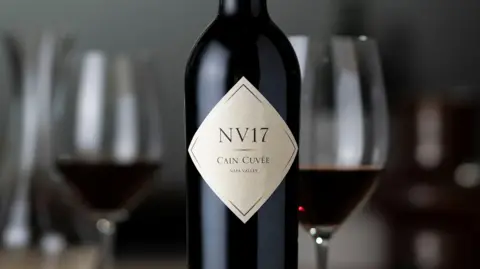 Cain
CainIn the world of wine, the vintage is king. If you buy a bottle of red, white or rosé, the specific year of the grape harvest is almost always written on the label.
On the other hand, the immobile wine non -vintage – which does by mixing two years or more – is considered a very cheap, something cheap and not cheerful. And it is much rarer.
However, with the striking climate change of vineyards around the world with more extreme weather conditions, a small but increasing number of vineyards concerned with quality publish non -vintage bottles so that they can make a more coherent wine.
Chris Howell is the Cain Vineyard and Winery winemaker in the famous Napa Valley region of California, 80 kilometers (80 km) northeast of San Francisco. He has been in work since 1991, and he says that summers have become significantly warmer.
“Time is a complicated thing,” he said. “The problem that people focus on most of Napa are dramatic heat spells, heat waves that usually come throughout the summer, especially at the end of the summer.
“They have existed for as long as I have been here, but advanced temperatures are higher. The heat can be intense. You can reach 50 ° C, something nearby.”
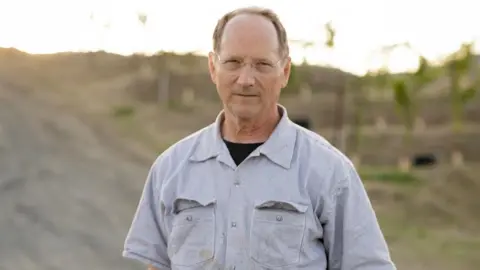 Meg Smith
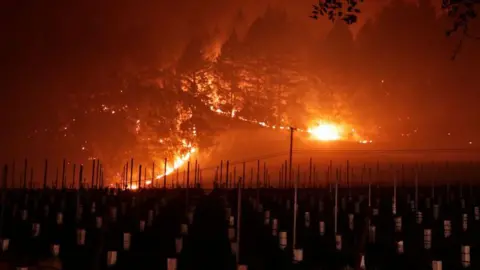
With higher temperatures, the increased risk of forest fires. This was the case in 2017, when he said that “extremely intense fires” broke out in Napa in the middle of the grape harvest.
That year, Howell decided to use only Cain vineyard grapes which had been harvested before the start of fires, about half of the total, to prevent the risk of smell – and taste – smoke in the air from contacting the following wines.
He says he is more “relaxed” than many winegrowers would not concern such a disaster, because he has long made a non -vintage red mixture called Cain Cuvée. “Thus, part of the wine we were able to make in 2017 was retained to be mixed with that of 2018.”
Mr. Howell adds that “even without fire, we are now subject to more modifiable vintages. The chances are therefore better if you use two different vintage to create the desired style for a particular wine.”
 Getty images
Although the world’s fixed wines remain mainly vintage, there is a type of wine where non -vintage mixtures really dominate – sparkling wine.
This is led by Champagnes de la France, where the vast majority of products produced have always been non -vintage.
Historically, it was a necessity, because champagne is the most northern wine region in France, and good sums were rare. Thus, champagne manufacturers had no choice but to mix wines of different years to create a coherent quality product.
However, thanks to climate change which brings hotter summers in the north of France, there is now more vintage champagne produced than ever.
The owner of the Italian cellar, Riccardo Pasqua, said that he appreciated the best non -vintage champagnes who inspired him to make the first white wine still during the year of Italy.
Located north of the city of Verona, in the Vinification region of Veneto, its family activity Pasqua Vigneti e canteine produced non -vintage wine since 2019, mixing it from five different years.
He explains that the idea was to produce the best possible wine from a single vineyard, removing the reality of vintage, good and bad weather variations.
“I offered it to my family and my board, and they told me” you are crazy, it’s a big risk! You go against the wine bible, the vintage is the vintage “”, he says.
“But I decided to stick to the plan, and we have advanced. It is a question of obtaining the best expression of the vineyard. It’s like a book, using more than one vintage gives more chapters to wine.”
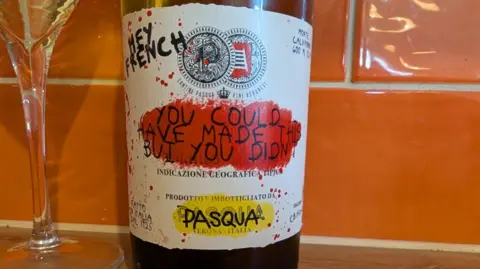
The resulting wine is called Hey French, you could have done it but you did not do it. The unusual name is a nod to the rivalry of the wine in Italy with France.
Climate change now striking Italian winegrowers with everything, more droughts to the largest hailstorms, Mr. Pasqua says that other vineyards now take the non -vintage course, or at least considering.
“I must say that in Italy, several vineyards follow the idea. In Italy, the events of the extreme weather went from the extraordinary to the ordinary.
“Like frost in April or early May, or hailstorms are becoming more and more usual. Or heat waves at very high temperatures now year after year.”
Back in the Napa Valley in California, Chris Howell admits that more work must be done to eliminate the stigma with which non -vintage wines are still confronted.
“Why are we so obsessed with unique vintages? We must change the drinkers’ perceptions. Non-vintage wines can be delicious.”
Dawn Davies is a wine master, a holder of the global qualification of the wine industry. She says that there are three types of wine buyers, two of which will accommodate more non-vintage wines.
“The general consumer will not notice it,” she said. “The drinkers who buy a bottle to the £ 15 mark, they just pick up a bottle of Sauvignon Blanc. They don’t think” Oh 2021, it was a good year “.
“And, in the end, people have engaged in the wine industry or more informed, they know what is happening with more difficult vintages. And they welcome the increased flexibility and consistency that non -vintage wines can offer to the winemaker.
“Then you have drinkers in the middle who cry out with different vintages. There will always be this group of people who will not accept the change of wine, such as the introduction of screw caps.
“But most of the wine, the vast majority, is a mixture, as you rarely get a wine of a single barrel. Instead, the wines are mixed from vineyards or different plots. So what is the difference if you mix from different years?”


