Orange-Colored Lichens Helping Paleontologists Discover Dinosaur Fossils


Lichens are symbioses between fungi and algae (and/or cyanobacteria) which play important ecological roles and colonize numerous substrates, notably fossils. According to new research, they can serve as biological indicators of fossils in western North America and can be identified through remote sensing.
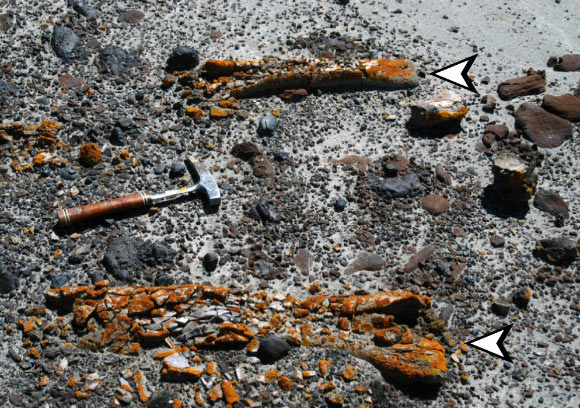
Preferential colonization of dinosaur bones by lichens. Image credit: Pickles and others., doi: 10.1016/j.cub.2025.09.036.
“This research shows how modern organisms can help us find ancient organisms,” said Dr Brian Pickles, a researcher at the University of Reading.
“It is remarkable to consider that these lichens, essentially miniature ecosystems, are based on the remains of dinosaurs that died more than 75 million years ago.”
“Using drone technology to detect spectral signatures of lichens could potentially revolutionize the way paleontologists search for fossils.”
In the study, Dr. Pickles and his colleagues found that two species of lichens: Rusavskia elegans And Xanthomendoza trachyphylla — colonized up to 50% of exposed fossil bones but less than 1% of surrounding rock fragments.
This is probably because dinosaur bones provide the alkaline, calcareous and porous substrates favored by these lichens.
“This pattern of preferential lichen growth on fossil bones has been observed for decades, but has never been quantified until now,” said Dr Caleb Brown, a researcher at the Royal Tyrrell Museum of Paleontology.
“When we first encounter high concentrations of exposed fossil bones, such as bone beds, it is often the orange lichen ‘meadow’ that is noticed first, not the bones themselves.”
Using drones with specialized sensors, the authors identified fossils colonized by lichens from aerial images with a pixel resolution of 2.5 cm.
Lichens exhibit distinct spectral properties, showing lower reflectance in blue wavelengths and higher reflectance in infrared regions.
The method can offer significant advantages for paleontological prospecting, particularly in remote terrains where traditional field studies are difficult.
This approach could accelerate fossil discovery while reducing land costs and environmental impact.
The research draws on decades of anecdotal observations by paleontologists.
In 1980, paleontologist Darren H. Tanke hypothesized that the orange pigmentation of lichen on Centrosaurus bones could be detectable by satellites – a prediction that seems closer than ever now that they can be found using airborne drone technology.
“This drone study lays the foundation for mapping much larger areas using aircraft and satellites,” said Dr. Derek Peddle, a researcher at the University of Lethbridge.
“The new lichen indicators we have developed will help us find fossils across large landscapes.”
“It’s exciting to combine our imaging technology with the expertise of this international team to advance the discovery of dinosaurs through remote sensing of lichens.”
The team’s paper was published this week in the journal Current biology.
_____
Brian J. Pickles and others. 2025. Remote sensing of lichens with drones to detect dinosaur bones. Current biology 35 (21): R1044-R1045; doi: 10.1016/j.cub.2025.09.036


:max_bytes(150000):strip_icc()/Health-GettyImages-484087186-a80cbd04b41343b3972e4d99b19ca781.jpg?w=390&resize=390,220&ssl=1 "16 Healthiest Stone Fruits To Eat This Summer, According to a Dietitian")
