Colugo: The ‘flying lemur’ that doesn’t fly and isn’t a lemur


Rapid facts
Name: Colugo, or Sunday Flying Lémur (Galeopterus variririegatus). Also known as Lémur Malays
Where he lives: Tropical tropical forests in Southeast Asia
What he eats: Flowers, buds, shoots, leaves, sap and nectar
Why it’s great: The Colugos are commonly known as “flying lemurs”, but the name is misleading. These nocturnal mammals look a bit like lemurs, with small fur faces which are dominated by a pair of huge front -oriented eyes. However, the Colugos are not lemurs, who are part of the Primate Order. Colugos are rather the only members of the dermoptera order and are the living parents closest to modern primates.
The Colugos do not steal exactly either. Unlike bats – the only mammals capable of a propelled flight – Colugos has no wings. Instead, they have a fur membrane called Patagium which is only suitable to slide.
This thin veil is made of skin stretching from the animal’s neck to its fingers, and its fingers to its toes and its tail. When they are completely extended, their “wingspan” measures approximately 28 inches (70 centimeters) wide and the animal looks like a living kite. Their feet are webbed, with curved claws for the captivating tree bark.
The Colugos are entirely arboreal, spending all their time in the summits, where they embark on a slide by jumping branches. They navigate distances greater than 328 feet (100 meters) while losing very little altitude, sliding at speeds of approximately 22 miles per hour (35 kilometers per hour). A Colugo woman with Young will slide with her offspring hung on her belly.
The flying lemurs of Sunday are slightly larger than the only other species of flying lemurs: Cynocephalus Volansfound in the southern parts of the Philippines.
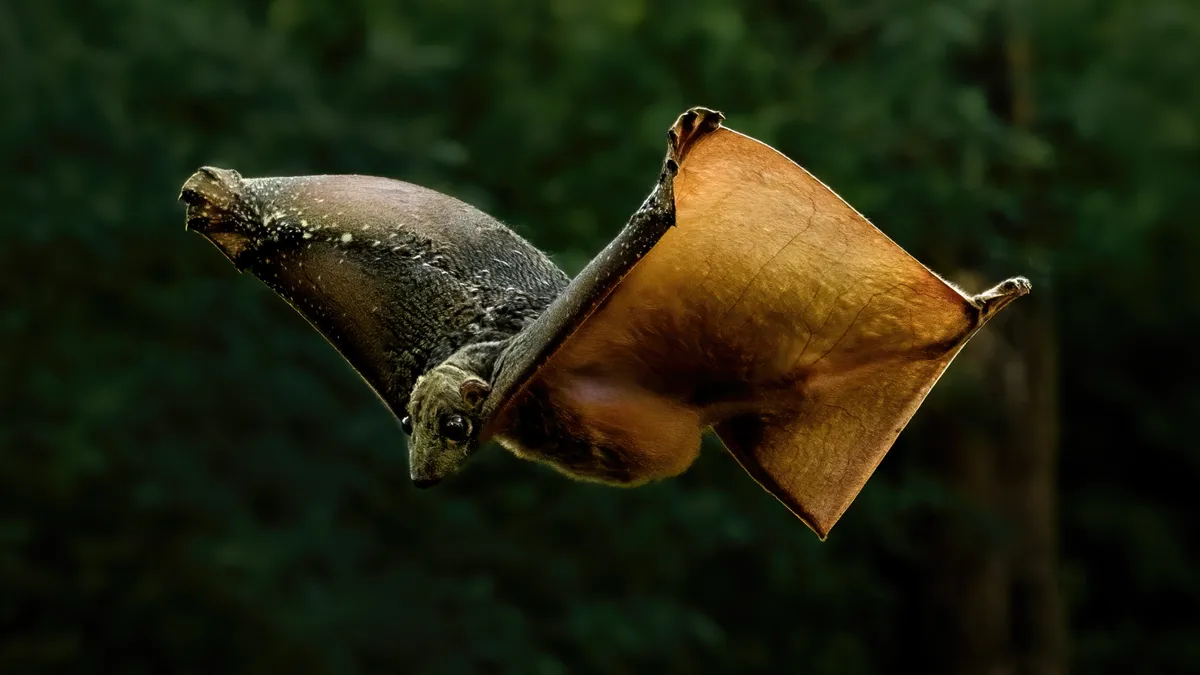
The body of the sunda species measures up to 16.5 inches (42 centimeters) long; Their tails measure up to 10.6 inches (27 cm) long and weigh up to 4.5 pounds (0.9 to 2 kilograms). Their dense fur can be black, gray, red or white, with dark and marbled patterns on the back that resemble lichen on tropical forest trees. This camouflage hides predators’ neckugos.
The lower incisors of Colugos are also unique – they are in the shape of a comb with up to 20 dents per tooth, and they help grooming and eliminating the parasites of Colugos fur. Colugos can also use these unusual teeth to filter fruit fluids or to scrape the sap of the plants.


