Astronomers discover chemicals that could seed life in the core of a developing star

When you purchase through links on our articles, Future and its syndication partners may earn a commission.

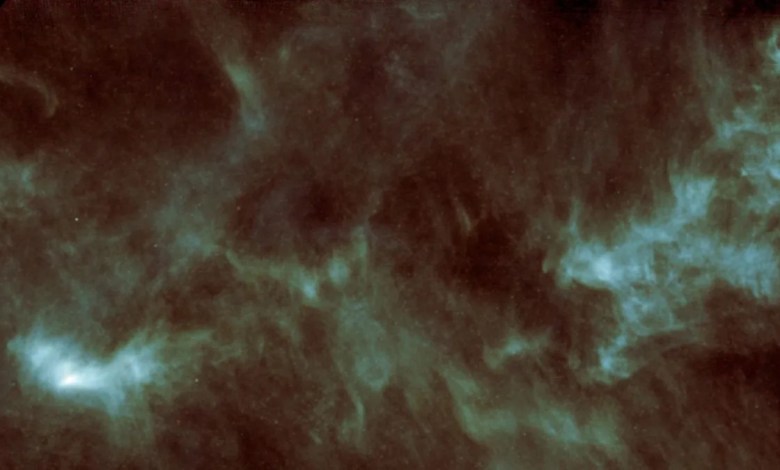
An infrared view of part of the Taurus molecular cloud, inside which the bright and cold prestellar cloud L1544 can be seen at lower left. | Credit: ESA/Herschel/SPIRE
Astronomers recently studied the gas cloud of a yet-to-be-born star in search of a chemical that could seed future planets with the basic ingredients of life.
Astronomer Yuxin Lin and colleagues discovered an organic molecule called methanimine dispersed in a dense cluster of gas and dust 554 light years away. The cloud, called L1544 and found in the Taurus Molecular Cloud, will eventually become a star with a system of planets, and if Lin and his colleagues are correct, these exoplanets can form with a “starter kit” of organic molecules like methanimine – thanks to chemical reactions currently taking place in the cold, dormant molecular cloud.
Astronomers have spotted methanimine in a surprising range of places in the universe, from very hot and turbulent places like the cores of newborn stars to icy grains of ice drifting in interstellar space. One of the most interesting places where methanimine has been discovered is what astronomers call a prestellar core: a dense knot of gas and dust, about to collapse under its own gravity to form a newborn star. Think of a prestellar core – like L1544, located 554 light years away – as all the ingredients of a star system, with some assembly required.
Organic Chemistry Starter Kit
Methanimine (CH2NH2), not to be confused with anything in “Breaking Bad,” is a fairly simple molecule, as organic chemistry goes. It lies halfway in the chain of chemical reactions that lies between a handful of stray atoms and an amino acid (one of the largest organic molecules that combine to form proteins). And even if you break down a molecule of methanimine, you still have a handful of key ingredients in the chemistry of life: carbon, hydrogen, and nitrogen.
Understanding how molecules like methanimine form in prestellar cores like L1544 could shed new light on how planetary systems obtain their “starter kits” of ingredients for organic chemistry, from raw elements to complex molecules. like amino acids.
Potentially habitable worlds, some assembly required
For what is essentially the embryonic form of a massive star, L1544 is a remarkably quiet place. It is part of the Taurus Molecular Cloud, where other dense clumps of matter like L1544 collapse under their own gravity to form new stars, each hundreds of thousands of times the mass of the star. the sun.
But for now, L1544 is a quiet backwater. Material falls gradually inward from the warmer edges of the clump toward the cold, dense center, but it is a very slow rain, something like the calm before the thermonuclear storm of star formation.
The other layers of the cloud, where the material is less dense but temperatures are warmer, are where most of the methanimine appears to form. As material from these outer layers falls toward the center, methanimine becomes distributed throughout most of the prestellar core. So it’s likely that methanimine will continue to form until it collapses – and some of it will likely remain in the outer part of what will, one day, be a planetary disk orbiting a brand new star.

A wide-field view of part of the Taurus molecular cloud, in which L1544 is located. Its relative proximity makes it an ideal place to study star formation, according to the European Southern Observatory. | Credit: Digitized Sky Survey 2. Thanks: Davide De Martin
As planets gradually merge out of the disk, many of them may contain the basic ingredients of cooked amino acids – and if any of them are habitable, these molecules could eventually give rise to life.
“This demonstrates that the key prebiotic chemistry of nitrogen and carbon remains active even in the cold, quiet phase before collapse, ensuring that organic precursors such as CH2N2 can be inherited by the next generation of forming stars and planets,” Lin and colleagues wrote in their recent paper.
Lin and colleagues published their findings in Letters from the astrophysical journal.


![[INSERT BANNER HEADLINE ON TRUMP RETRIBUTION HERE]](https://i3.wp.com/talkingpointsmemo.com/wp-content/uploads/2025/07/GettyImages-600629506_9debd7.jpg?w=804&w=390&resize=390,220&ssl=1 "[INSERT BANNER HEADLINE ON TRUMP RETRIBUTION HERE]")
