If ChatGPT can be fooled by this simple optical illusion, why should I trust it with anything else?


Read OPENAI marketing or listen to a quote from the CEO of the company, Sam Altman, and you would be forgiven to think that Chatgpt is the most powerful, effective and impressive technology we have ever seen.
Do not get me wrong, Chatgpt and other AI chatbots such as Gemini and perplexity are really impressive, but untangle the diapers like an onion and you start to realize that they are not as capable of sorting every life problem as their creators believe it.
Recently, I conversed with chatgpt more and more, using it as a resonance fund for ideas, tested prompts and trying to integrate it more into my life outside of work (as a writer of Senior of Techradar, all I do is test the products of the general public).
But as I use chatgpt more and more, I started to realize that it is not quite song and dance, and in fact, it is somewhat useless (I will come back later). If I have your attention, keep reading – I have an excellent example to present my argument.
Viral failure
By browsing Reddit earlier this week, I came across a thread where a user had asked a simple question linked to an image. Chatgpt, however, could not understand that the purpose of the question was to catch up with him.
The image was a screenshot of a famous optical illusion called Ebbinghaus illusion, which, in practice, makes you believe in your eyes two matching circles are in fact not the same size.
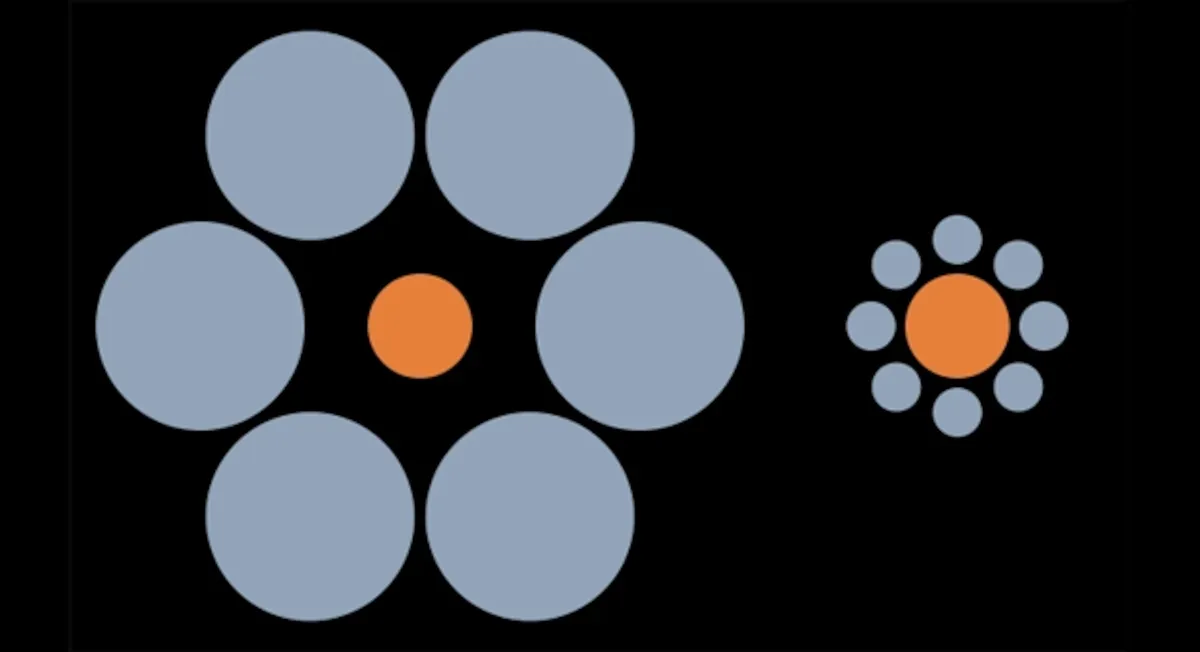
However, while a human looking at the image above for an extended period is capable of determining that the two orange circles are the same size, a simple image manipulation completely confuses AI.
The image used by the initial author of the Thread Reddit is modified so that a circle is clearly smaller than the other. The problem is: Chatgpt Reverse Images and uses the Internet to find an answer, and he does not think for himself.
What does this mean in practice? Well, Chatgpt finds images of the Ebbinghaus illusion online and automatically determines that the photo he is questioned about the others he found. The problem? Well, that’s not at all.

After checking the images in the internet, Chatgpt determines exactly the same size. “”
You can read the original Reddit wire below to see how Chatgpt reacts to others, but in my tests, even after giving it the opportunity to return its answer, the chatbot is absolutely convinced that my modified image is the same as the Ebbinghaus illusion.
Yeah, they are the same size of R / OPENAI
The problem with the whole AI
So, I perplexed the Chatppt with a modified image, so what? Do not get me wrong, just like the person who had this original idea, obviously tried to catch up with AI, but the problem is that this example is only the tip of the iceberg.
You see, I argued and I argued with Chatgpt to try to do it right in itself and decide that the orange circle on the left was actually larger than the one on the right. However, despite the test for about 15 minutes, I could not move the Chatppt; It was convinced that it was good, despite the fact that it is so bad.
What makes me think, in its current state, what is the interest of this magic AI? If this cannot be correct at 100% of the time, is it actually a useful tool? If I need to check the information I ask him and check his answers, do I really use this technology?
The fact is that if the AI is right 99% of the time (which is not), then it is not good enough to work convincingly for its objective. If deep research tools must still be verified to make sure that there are no mistakes, you would better comply the research yourself.
And this is my problem with AI. Until it can be 100% 100% of time, it’s just a fanciful tool that can do certain things and other things. Make no mistake, I think Chatgpt and other AI tools are effective and can do certain tasks. However, to become the revolutionary technology that Altman and Co want you to think they are, these tools must completely erase errors – and frankly, we are far from this reality.
You might also love