Curiosity Blog, Sols 4825-4831: Exploring the Borderlands


3 minutes of reading
Curiosity Blog, Sols 4825-4831: Exploring the border regions

Written by William Farrand, Senior Research Scientist, Space Science Institute
Date of earthworks: Friday March 6, 2026
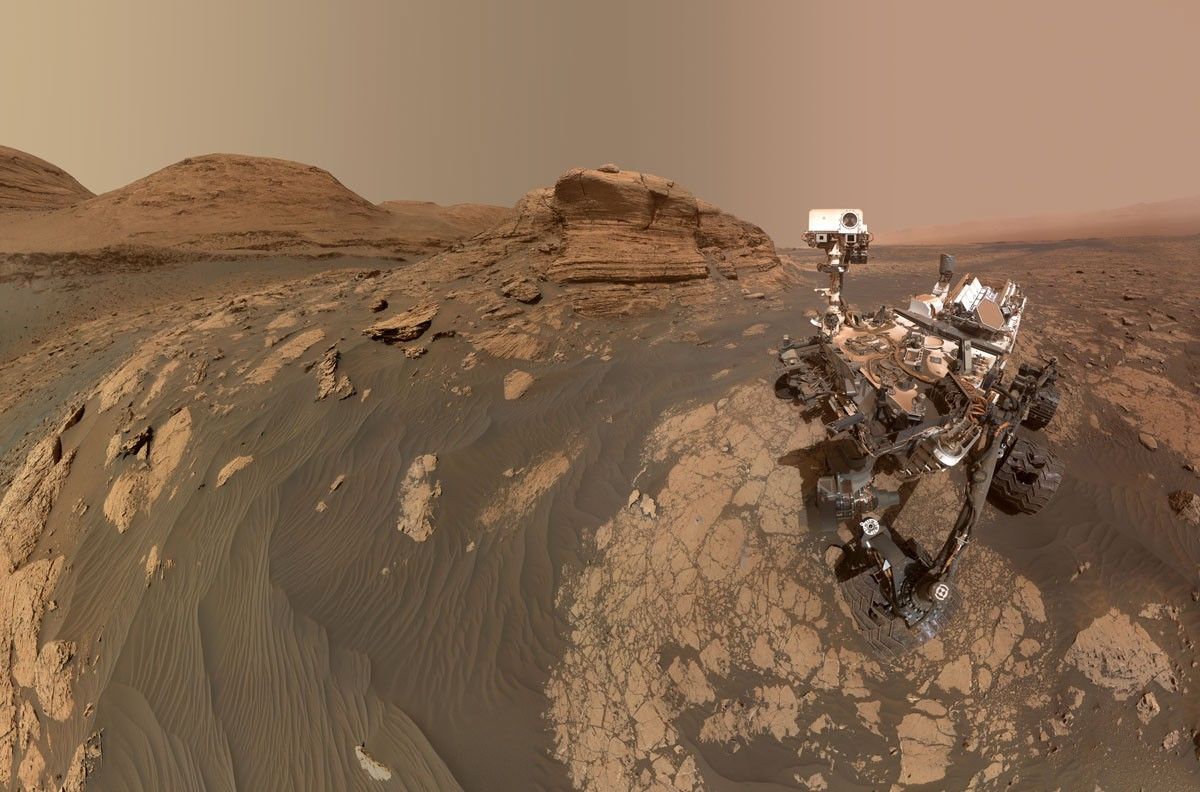
Curiosity is in the final stages of its exploration of the cobweb-shaped box unit. This step consists of exploring the eastern and southern limits of this land. Two multi-ground plans were assembled this week. The previous plan placed Curiosity at a site in the eastern extent of the caisson unit with bedrock that allowed on-site brushing and measurements with APXS and MAHLI of the “Infiernillo” bedrock target. The ChemCam also took a chemical LIBS measurement of this target as well as a piece of nodule-rich bedrock named “Humahuaca”. MAHLI was tasked with imaging a pitted vertical rock face that was nicknamed “Timboy Chaco” (part of which is shown in the MAHLI color image accompanying this report). Mastcam color mosaics and ChemCam Remote Micro-Imager (RMI) mosaics were also collected to characterize the nearby terrain, including a knoll to the south and the geologic contact between the boxed terrain and the adjacent light-toned layered unit.
A midweek trip brought the rover even closer to the east edge of the caisson unit and set it up for two or more trips to the south edge of the caisson. The workspace present for Friday’s planning included bedrock exposures and a dark-toned floating rock. The floating rock was large enough to be observed in situ by APXS, and it was also targeted for up-close imaging by MAHLI and measurement by ChemCam to observe its reflectance properties. Some other dark floating rocks observed by Curiosity over the past year have been assumed to be stony meteorites (chondrites). Measuring the chemistry and reflectance of this dark rock, named “Thola,” will allow the team to determine whether it originated on Mars or is a meteorite from beyond. Friday’s plan also included ChemCam remote chemical measurements of the smooth bedrock target “Valle Fertil” and a nodular bedrock target “Norte Grande.” The plan also included Mastcam mosaics of light-toned bedrock across the eastern contact of the caisson unit to assess sedimentary structures and determine stratigraphic relationships, observations of smaller troughs in the regolith and other nearby ridge mosaics as well as a two-frame mosaic of the dark Thola float rock and another dark-toned pebble.
The plan ends with a walk to the southern boundary of the caisson unit. Since this southern contact is about 100 meters (about 109 yards) away, it will probably take two trips.
-
Want to read more articles from the Curiosity team?
Visit Mission Updates
-
Want to learn more about Curiosity’s scientific instruments?
Visit the Scientific Instruments page
Share
Details
Related terms
Explore more

Curiosity Blog, Sols 4818-4824: Thinking off the beaten track
Curiosity Blog, Sols 4812-4817: Return to the hollows
Curiosity Blog Soils 4804-4811: final phase of Boxwork exploration launched
Discover more NASA topics