Darlington nurses penalised for trans complaint, says lawyer



 PA Media
NHS bosses “penalized” nurses who complained about a transgender woman using their changing room, an employment tribunal has been told.
Eight nurses are challenging a policy that allows the single-sex ward at Darlington Memorial Hospital to be used by Rose Henderson, a biological male who identifies as a woman.
In his closing submissions, the nurses’ lawyer said they had suffered indirect discrimination, harassment and victimization as a result of County Durham and Darlington NHS Trust’s workplace transition policy.
The trust said nurses had “demonized” Rose and the policy was in line with guidelines and laws at the time.
Speaking to the BBC afterwards, the nurses said it had been “very stressful” but they had still gone to work because the patients were “most important”.
Newcastle Crown Court heard that Rose, a practitioner in the operating department, had been using the changing room since 2019 before complaints were first made by nurses in the day surgery unit (DSU) in August 2023.
The trust’s policy allowed a person to use the single-sex space consistent with their gender identity, and anyone of that gender who objected could change elsewhere.
Some 26 nurses signed a letter complaining about Rose’s use and conduct in the changing room, with Rose telling the court the allegations, including watching women undress, were “false”.

In his closing argument to the court, the nurses’ lawyer Niazi Fetto KC said the policy was “unjustifiably treated as sacrosanct” by managers and “prescribed disadvantageous treatment for biological females”.
He said the claimants’ complaints about “adverse effects” had been “dismissed and ignored” before nurses were “penalized and buried” in an “oppressive and ineffective investigation process” carried out by the trust.
Mr Fetto said the policy allowed people to access single-sex spaces “based solely on self-declared gender identity” and there had been no consultation with staff over its implementation.
The trust prioritized trans rights over “women’s rights not to have to change in front of a member of the opposite sex”, Mr Fetto said.
The trust converted a storage room adjoining a meeting area into a changing room for women who did not want to share the women’s space with Rose, but this was “totally inadequate and unsafe”, Mr Fetto said.
 PA Media
He said there was “no legal right” for someone with the “protected characteristic of gender reassignment to use a single-sex changing room corresponding to their adopted gender”.
Mr Fetto also said the words “men” and “women” mentioned in the regulations were based on biological sex, as confirmed by the UK Supreme Court earlier this year.
He said several women had complained about Rose’s behavior in the locker room and that it “beyond belief” that each complainant had “mistaken, lied or fabricated”, adding there was a “high level of corroboration” from “various sources”.
The trust’s response was “determined not to address the substance” of the complaints while “trivializing them and stigmatizing those who raised them”, Mr Fetto said.
 David Robinson / Geographer
Simon Cheetham KC, for the trust, said the nurses’ “central issue” was that Rose was using the changing room, which meant they had “chosen to interpret” everything Rose or the trust did “in a negative way” and through a “negative prism”.
“Their single-mindedness on this issue clouded their judgement,” Mr Cheetham said, adding that “Rose’s very presence was seen as provocative”.
He also said the nurses’ decision to speak to the media was “unappealing” and that they had made repeated allegations without “compelling evidence” or revelations about Rose’s private life, leading to Rose being publicly portrayed as a “highly predatory character.”
Mr Cheetham said the nurses’ treatment of Rose had been “nasty and unjustified”, with their allegations of conduct “exaggerated”.
The nurses had unnecessarily “demonized” Rose and were waging a “public campaign” over the policy and “the trust’s treatment of them as a group of women”, Mr Cheetham said.
He said staff only had access to single-sex spaces if they “reported living their lives fully in that gender”, which was a “higher threshold” than nurses claimed.
Mr Cheetham said the policy was also “consistent with relevant legislation and guidance at the time”.
He said the trust had some 8,000 employees and had to balance the “competing” rights of those with “protected characteristics” of biological sex and gender reassignment.
Mr Cheetham said the “reality” the trust faced at the time was that there were different sets of guidelines which were “not consistent” with each other.
Court judges will deliver their judgment at a later date, but said it was unlikely to be handed down before Christmas.

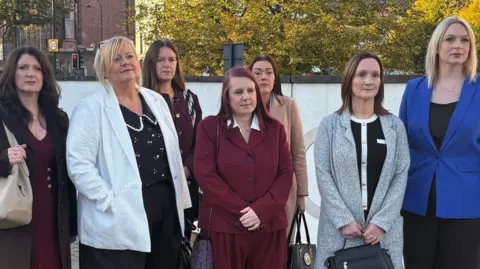
After court, nurses Lisa Lockey, Bethany Hutchison and Karen Danson said it had been “very stressful” and “all-consuming” but they hoped the judges would rule in their favor.
Ms Lockey said the nurses had felt “totally ostracized” since making their complaint, adding that the trust’s policy “just seemed completely unreasonable”.
She said it was “frustrating” to wait for national guidelines to be confirmed, adding: “We’re sort of in limbo.”
Ms Lockey said they had continued to work, which was “uncomfortable” at times, not knowing who was supporting them, but they had to “maintain a professional attitude with everyone” and “do their job”.
She said nurses were there to help patients and were “the most important.”
Ms Hutchison said she hoped more people would “stand up” against the ideology behind the policy, adding: “Now is the time for people to raise their heads over the parapet and speak out against this.”
Rose was contacted for comment through the NHS Trust, but did not wish to speak.