Darwin’s pet food tests positive for Listeria and Salmonella


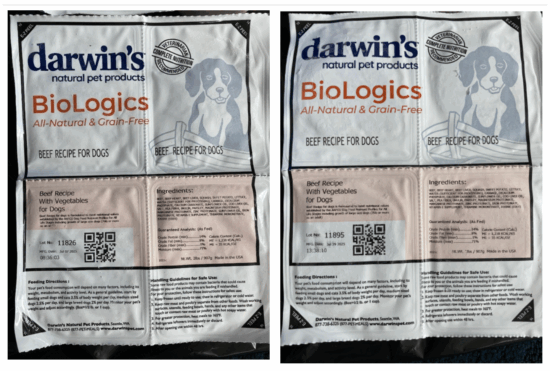
The FDA has again found bacterial contamination in Darwin natural pet dog products and the production company, Arrow Reliance, again refuses to recall its products.
The products involved proved to be contaminated by Salmonella and Listeria Monocytogenes after the samples of the Food and Drug Administration following a consumer complaint.
Arrow Reliance has failed to issue reminders of its products in similar circumstances in the past.
The products affected this time are sold online via a subscription service in icy packages of 2 pounds and consist of some heavy of the Darwin organic beef for dogs.
“The FDA recommended that Arrow Reliance, Inc. can remember the two prizes of affected products. The company would have sent a letter to customers informed of the two lots that were testing positive for L. Mono, but the letter did not inform customers of the presence of Salmonella in a lot”, according to a consumption warning issued by the FDA.
“Although Arrow is on Arrow may have informed its customers that he withdraws the two lots for L. Mono, the company has not yet provided sufficient documentation to the FDA to show that this action has removed the product affected on the market and customer freezers. Consumers may want to verify Darwin’s biologicals ”.
- If consumers have pet food on the list below, it is advisable to throw it into a secure container. Do not feed it with pets. Do not give food.
- Clean and disinfect all pet supplies and surfaces with which food or pet had contact.
- Salmonella and L. Mono can affect people and animals. People with symptoms of Salmonella or L. Mono Infection should consult their health care providers. Consult a veterinarian if your animal has symptoms of Salmonella or L. Mono infection. See the information from the symptoms below.
Product information
Lots of affected dog food is in white and transparent plastic packages of 2 pounds with “Biologics All-Natural and without grains” in orange lettering. Each package is divided into four distinct half-pound units. Lot codes are printed at the front of the lower left corner of the 2 pound package. The varieties and affected lot codes are:
- Darwin’s Natural Pet Products Biologics Completely natural beef recipe without dogs for dogs
- Lot 11895, date of MFG: Jul 29 2025
- Darwin’s Natural Pet Products Biologics Completely natural beef recipe without dogs for dogs
- Lot 11826, date of MFG: July 07, 2025
If you have one of Darwin’s organic pet food products listed above, stop nourishing the product to your pets and throw it into a secure container where other animals, including fauna, cannot access it. Do not give food.
The product batch codes are printed at the front of the lower left corner of the 2 pound food package. If you no longer have the package or cannot read the lot code, throw the food.
Consumers who have had the products listed above in their homes should clean and disinfect all pet supplies, including all storage containers, bowls, utensils, food preparation surfaces, pet bedding, litter, toys, floors and any other surface with which food or pet may have contact with, including your refrigerator or your refrigerator or your refrigerator or your refrigerator or freezer. Clean animal excrement in places where people or other animals can be exposed. Consumers must carefully wash their hands after handling the product or cleaning items and potentially contaminated areas.
Pet food contaminated by Salmonella and L. Mono are of particular importance in public health because they can affect human and animal health. Pets can fall ill from Salmonella and can also carry the bacteria and transmit it to their human companions without seeming.
People who think their pets have fallen ill after consuming contaminated pet food should contact their veterinarians. Animal owners who develop symptoms of infection in Salmonella or Listeria must contact their doctors. See the symptoms below.
The FDA encourages consumers to report complaints regarding pet food products by electronic means through the security report portal. In addition, consumers can visit the SmartThub – Safety – Safety Portal (FDA.GOV) to obtain electronic assistance to submit a report.
On Listeria infections
Foods contaminated by Listeria Monocytogenes may not seem, feel or spoil the taste but can always cause serious and sometimes fatal infections. Anyone who has fed one of the products involved in his pets and has developed symptoms of Listeria infection should request medical treatment and talk to their doctors of the possible exposure to Listeria.
In addition, anyone who has been exposed to the products involved should watch out for symptoms in the coming weeks, as it can take up to 70 days after exposure to Listeria for listeriosis symptoms.
Symptoms of Listeria infection may include vomiting, nausea, persistent fever, muscle pain, severe headache and stiff neck. Specific laboratory tests are necessary to diagnose Listeria infections, which can imitate other diseases.
Pregnant women, the elderly, young children and people such as cancer patients who weaken immune systems are particularly at risk of serious illnesses, fatal infections, other complications and death. Although infected pregnant women can only feel light and pseudo-grapple symptoms, their infections can lead to premature delivery, newborns or even mortinity infection.
On Salmonella infections
Foods contaminated by Salmonella bacteria do not look, do not feel, nor the spoiled taste. Anyone can become sick of a salmonella infection. Infants, children, the elderly and people with weakened immune systems are more at risk of serious illness because their immune system is fragile, according to the CDC.
Anyone who has fed one of the foods involved in his pets and has developed symptoms of salmonella infection should consult a doctor. Patients should inform their doctors of the possible exposure to salmonella bacteria, as special tests are necessary to diagnose salmonellosis. Salmonella infection symptoms can imitate other diseases, frequently leading to an erroneous diagnosis.
Symptoms of salmonella infection may include diarrhea, abdominal cramps and fever within 12 to 72 hours after eating contaminated foods. Otherwise, healthy adults are generally sick for four to seven days. In some cases, however, diarrhea can be so serious that patients need hospitalization.
Older adults, children, pregnant women and people with weakened immune systems, such as cancer patients, are more likely to develop serious disease and serious, sometimes fatal conditions.
Some people are infected without falling ill or obviously symptoms. However, they can still disseminate infections to others.
(To register for a free subscription to Food Safety News, click here)