Decapitated fish fossils depict Late Jurassic food chain


An unusual type of fossilized fish can be found in the limestone of present-day Germany. The Late Jurassic conditions exposed at the famous Solnhofen deposits have preserved the remains of several marlin-like marine predators known as Aspidorhynchus.
But these carnivorous remains are not complete specimens: they are decapitated heads still attached to the gastrointestinal tracts. According to a study published in the journal Fossil recordthe graphic remains often offer insight into each fish’s final moments, as well as its final meals.
The Solnhofen limestone deposit is one of the world’s best sources of fossilized species from the Late Jurassic period (about 161.5 to 143.1 million years ago). This is particularly the case for many sea creatures, including Aspidorhynchuswho swam in the prehistoric Tethys ocean. Resembling today’s swordfish or marlin, Aspidorhynchus regularly grew to over three feet long and featured a long, spear-shaped upper jaw. They made up about four percent of all known fish swimming in the Solnhofen Archipelago at the time, resulting in many fossilized examples to study.
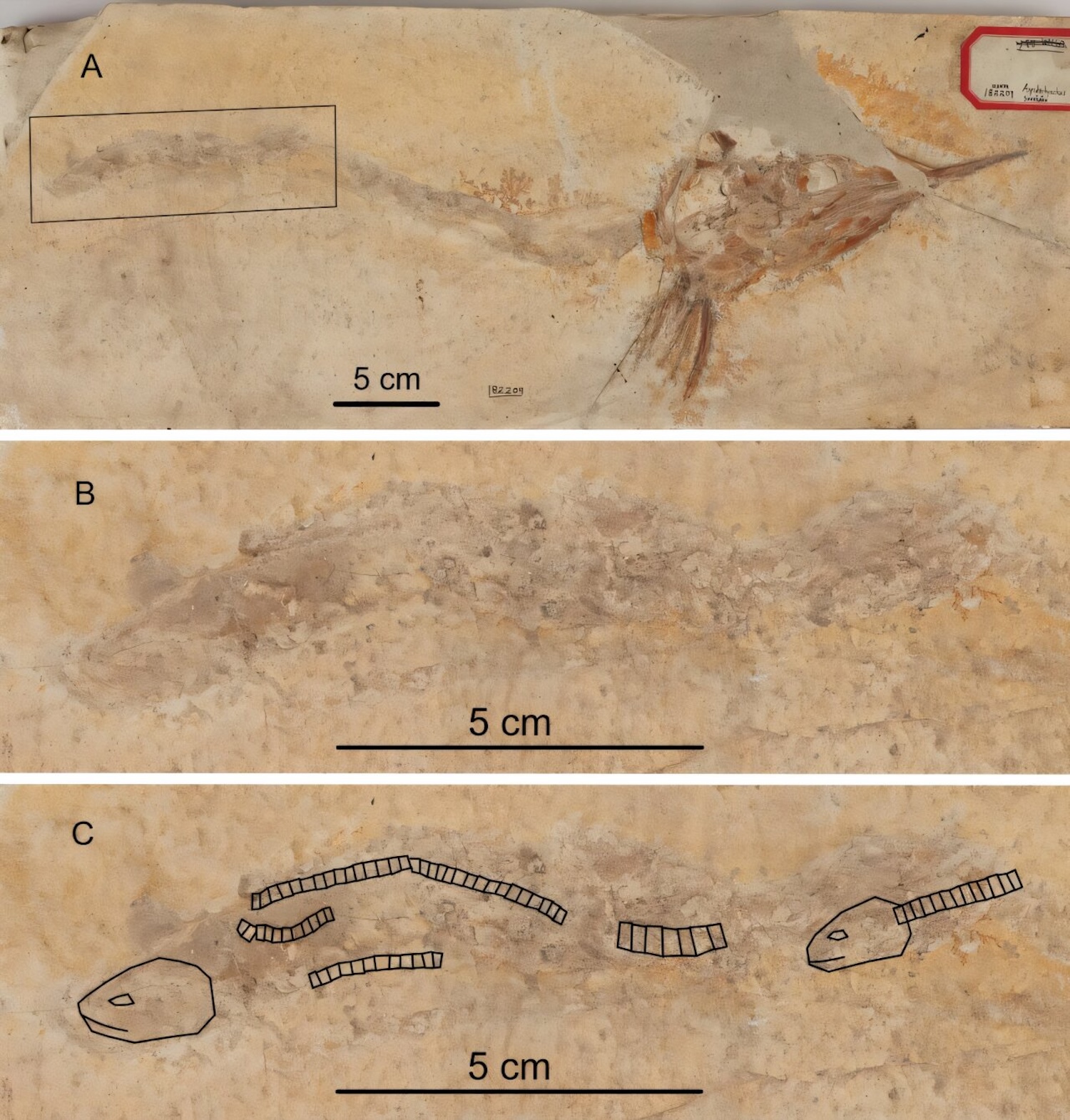
Paleontologists Martin Ebert and Martina Kölbl-Ebert recently examined 343 Aspidorhynchus fossils from the area, noting that 16 percent of them were just decapitated heads and attached guts. In addition to presenting such a strange and unique conservation status, the examples allowed the pair to analyze the predator’s prey choices.
“Judging by the shape of their bodies and the morphology of their fins, it is very likely that Aspidorhynchus was a pursuit predator. From the contents of its stomach, we know that it mainly fed on small teleosts (Orthogonicleithridae),” Martin Ebert said in an accompanying statement.
Teleosts are the group encompassing almost all of today’s bony ray-finned fishes.
“There is evidence that Orthogonicleithridae were schools of fish, and it is assumed that Aspidorhynchuswith its long upper jaw, may have used a hunting technique similar to that of the modern swordfish,” he added.
Multiple Aspidorhynchus fossils showed that predators often swallowed juvenile teleosts whole, but sometimes fed on much larger prey. In one case, an object approximately 22 inches long Aspidorhynchus successfully devoured a 6.3 inch long fish. Another example revealed the presence of a small fish stuck in his mouth, essentially causing him to drown.
But why this beheading? The Headless Aspidorhynchus‘ was not struck by bad luck. Instead, the partial remains likely provide evidence of how each predator eventually fell victim to the prehistoric food chain. The study authors hypothesize that these fish were each chased by a larger predator. While Aspidorhynchus Usually swallowing their meals in one gulp, other hunters would often bite off their target’s tail before violently tearing it apart while shaking their heads. The bit detaches the head, leaving the more nutritious and easily digestible bodies to eat.
The authors believe this easily explains the plethora of separated skulls and intestines, while also noting the range of possible suspects behind the decapitations.
“In the Solnhofen archipelago, we know [6.5–13 ft long] Ichthyosaurs, saltwater crocodiles and even larger pliosaurs, for whom it was certainly no problem,” Ebert said.

Holiday Gift Guide 2025


