Astronomers Discover New Planetary Nebula in Large Magellanic Cloud


During a spectroscopic study of stars in the massive young globular cluster NGC 1866 in a satellite galaxy of the Milky Way called the Large Magellanic Cloud, astronomers discovered a faint planetary nebula. Named Ka LMC 1, the nebula resides near the center of NGC 1866.
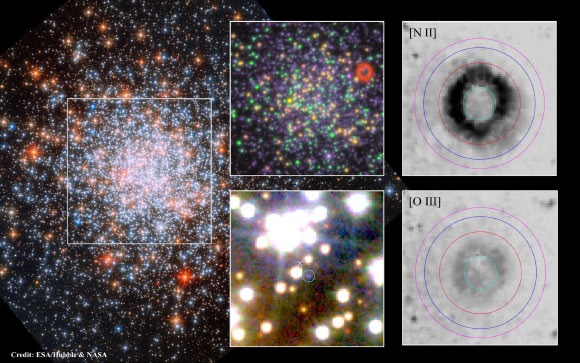
The image shows NGC 1866 superimposed on a false-color image from the MUSE data cube, where the ionized shell of the Ka planetary nebula LMC 1 is seen as a red ring. The grayscale boxes illustrate the different sizes of the ionized shells of simply ionized nitrogen [N II] and doubly ionized oxygen [O III]. The enlarged Hubble image near the center of the ring reveals the presence of a pale blue star – most likely the hot central star of Ka LMC 1. Image credit: AIP / MM Roth / NASA / ESA / Hubble.
NGC 1866 is located on the edge of the Large Magellanic Cloud, approximately 160,000 light years from Earth.
Also known as ESO 85-52 and LW 163, the cluster was discovered on August 3, 1826 by Scottish astronomer James Dunlop.
NGC 1866 is a surprisingly young globular cluster, located close enough to us that its stars can be studied individually.
In a new spectroscopic study of the NGC 1866 stars, astronomers analyzed spectra obtained with the MUSE integral-field spectrograph on ESO’s Very Large Telescope.
They made an unexpected and enigmatic discovery: the ionized shell of a planetary nebula.
In a follow-up study, they investigated the nature of this object, named Ka LMC 1, with images from the NASA/ESA Hubble Space Telescope.
“Planetary nebulae represent a late stage of stellar evolution, when a star has consumed its fuel (hydrogen) for nucleosynthesis, grows as a red giant with shell burning processes, and finally loses much of its mass in a huge, expanding detached shell, before the remaining core contracts, becomes very hot, and dims to become a white dwarf,” said first author Dr. Howard Bond, an astronomer at Penn State University. and at the Space Telescope Science Institute, and colleagues.
“When the core becomes hotter than 35,000 degrees, it ionizes the shell, which becomes visible in emission lines at selected wavelengths.”
According to the team, their Hubble images revealed the hot central star of the Ka nebula LMC 1.
“Ka LMC 1 is really a puzzle: for a young cluster that is 200 million years old, we need the progenitor star to be quite massive,” said Professor Martin Roth, an astronomer at the Leibniz Institute for Astrophysics in Potsdam, the Institute of Physics and Astronomy at the University of Potsdam and the Deutsches Zentrum für Astrophysik.
“But such a star would evolve very quickly toward the cooling track of a white dwarf.”
“We had difficulty reconciling the age of the expanding shell of the planetary nebula with the theoretical trajectories of the evolution of the central star.”
“The object clearly deserves more detailed observations to discover its nature.”
“This is one of the rare occasions where stellar evolution can be caught red-handed: typically, timescales are millions or even billions of years.”
“The massive evolution of the central star, however, is only a matter of thousands of years – and it can be calibrated against the timeline of the nebula’s expansion.”
The study was published on November 7, 2025 in the Publications of the Astronomical Society of the Pacific.
_____
Howard E. Bond and others. 2025. Chance discovery of a faint planetary nebula in the young and massive cluster LMC NGC 1866. PASP 137, 114202; doi: 10.1088/1538-3873/ae1664