Denmark holds elections spurred by Trump’s Greenland threats : NPR

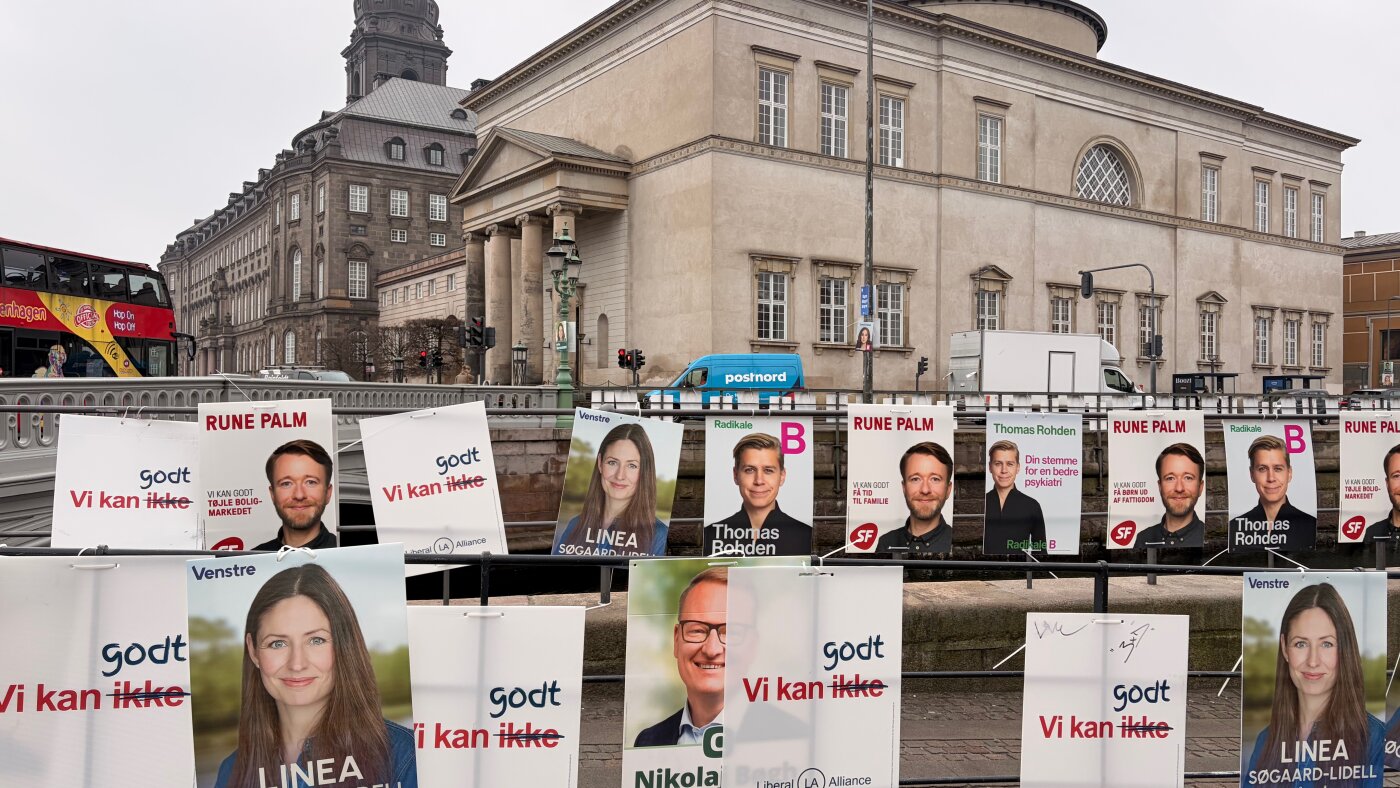

Parliamentary election campaign posters line the streets leading to the Parliament building in Copenhagen, Denmark.
Rob Schmitz/NPR
hide caption
toggle caption
Rob Schmitz/NPR
COPENHAGEN, Denmark — These days, everywhere you walk in the Danish capital, you encounter smiling faces. Not so much from locals – they are still complaining about one of the coldest winters in recent memory – but from campaign posters covering city walls, parks and lamp posts. The happy headshots are of the candidates vying for Tuesday’s parliamentary elections.
Perhaps the biggest smile this election season belongs to Danish Prime Minister Mette Frederiksen, whose center-left social democratic party soared in opinion polls after standing up to President Trump earlier this year when he threatened to take Greenland.


As the war in Iran enters its fourth week, it might be easy to forget Trump’s threats to seize the Danish territory of Greenland. He then backed down from his threats. But the Danes have not forgotten. Frederiksen called early elections to capitalize on his popularity, analysts say.
“The whole situation around Greenland certainly helped her a little bit in the polls, so it seemed to them, I think, like the best time to do it,” says Peter Thisted Dinesen, a political science professor at the University of Copenhagen.
At a recent campaign event in that city, Social Democratic lawmaker Ida Auken said she believed that thanks to Trump’s antagonism, Frederiksen had become one of Europe’s most popular leaders.

Ida Auken, a member of the Danish Parliament with the Social Democrats, calls Danish Prime Minister Mette Frederiksen “strong” and one of Europe’s most popular leaders after repelling President Trump’s threats to take over Greenland.
Rob Schmitz/NPR
hide caption
toggle caption
Rob Schmitz/NPR
“One thing that is very clear to many Danes is that Mette Frederiksen was very strong,” says Auken. “She was strong on the Greenland issue, but she was also very smart, I think, in uniting Europe around these issues.”
Frederiksen also united Denmark with its most important territory, says fellow parliamentarian Aaja Chemnitz. “I think in many ways Greenland and Denmark are much closer to each other than ever before in history,” says Chemnitz, who chose not to run for office this year.

Chemnitz represents Inuit Ataqatigiit, a democratic socialist party in Greenland. She and U.S. Senator Lisa Murkowski were nominated for the Nobel Peace Prize for their role in de-escalating tensions between the United States and Greenland.
“Just getting this nomination is an honor, but we wouldn’t give it away. I’m pretty sure of it,” she says with a smile, referring to this year’s winner, Venezuelan opposition leader María Corina Machado, who presented her award to President Trump.

Parliamentarian Aaja Chemnitz stands in front of a row of photos from her native Greenland. As one of the only Greenlandic parliamentarians in the Danish Parliament, Chemnitz hopes that Trump’s threats will not distract from the real domestic problems her Greenlandic constituents face on a daily basis. Chemnitz, along with U.S. Senator Lisa Murkowski, was nominated for the Nobel Peace Prize for their efforts to ease tensions between the United States and Greenland.
Rob Schmitz/NPR
hide caption
toggle caption
Rob Schmitz/NPR
Chemnitz says his biggest hope is that Trump’s threats don’t distract voters. “I think it is important for us to always remain focused in order to ensure that Greenland and Denmark [are] do their job to make sure there’s not much to criticize,” she says.
Chemnitz says she hopes Denmark will focus on improving health care and education in Greenland, and she notes that over the past year the Danish government has increased its spending in Greenland tenfold, a surprise advantage over Trump’s threats.
On the streets of Copenhagen, voters like Dani Mueller say Denmark’s moment on the world stage may have motivated the election, but it’s not the focus of voters like him. As a father of four children, he would like to reduce taxes. “Just more family friendly, you know? Keep it for little people, not just corporations,” he says.

Parliamentary campaign posters line the streets of Copenhagen, Denmark’s capital.
Rob Schmitz/NPR
hide caption
toggle caption
Rob Schmitz/NPR
Mueller, who is unemployed, suffers from post-traumatic stress disorder after participating in the U.S.-led war in Iraq 20 years ago. Asked if he regrets that service after Trump, in an interview, questioned the loyalty of NATO soldiers like him in U.S.-led wars, he said simply: “I’m proud of my service.”
Back at Auken’s campaign event at a local bar, the candidate said a fading transatlantic alliance could mean a bright future for Europe. “A lot of good things are happening in the sense that Europe is getting its act together,” Auken says. “We are starting to get back on our feet, investing in our own businesses, not playing little brother, but just becoming the continent we should be.”

At a campaign event for Danish Social Democratic MP Ida Auken, Copenhagen residents sing the “high school songbook,” a collection of 19th-century national anthems that connect Danes with their culture and singing tradition.
Rob Schmitz/NPR
hide caption
toggle caption
Rob Schmitz/NPR
The cozy bar is filled with Danes eager to express this spirit through song. Each of them holds a navy blue hardcover book open to the same page. It’s what the Danes call the “high school songbook,” a 19th-century volume from their school years filled with old songs reflecting the country’s history and singing tradition.
Bar patrons sing hymn 281, “The Blue Anemone,” a poem set to music by Kaj Munk, a priest who wrote it to protest the Nazi occupation of Denmark during World War II.
After writing it, Munk was arrested by the German Gestapo and murdered. Munk’s song speaks of a flower “as blue as the sea,” the first to bloom in spring, growing on the cold, dead earth of winter, a sign of hope and resilience for a land under siege.
Esme Nicholson contributed reporting from Berlin.