China is racing NASA to put astronauts on the Moon by 2030

The new space race is no longer science fiction – and China is moving quickly to challenge NASA for the next giant leap. As crews continue to launch toward the Tiangong space station, Beijing is quietly building the technology, experience and confidence needed to land astronauts on the Moon by 2030. With ambitious deadlines, advanced spacecraft in development and growing international attention, China’s moon push could reshape the future of space exploration and reignite a global competition not seen since the Apollo era.
China sends new crew to Tiangong space station
China successfully sent three astronauts to the Tiangong space station on Sunday, marking another major milestone in the country’s ambitious efforts toward long-term human spaceflight and its planned moon landing by 2030.
The crew took off aboard the Shenzhou-23 spacecraft at 11:08 a.m. Eastern Time on May 24 from the Jiuquan Satellite Launch Center, located in the Gobi Desert. The mission was launched atop a Long March 2F rocket, one of China’s most reliable vehicles for crewed space missions.
Just over three and a half hours later, the spacecraft successfully docked with the Tianhe core module of the Tiangong space station.
Meet the astronauts aboard Shenzhou-23
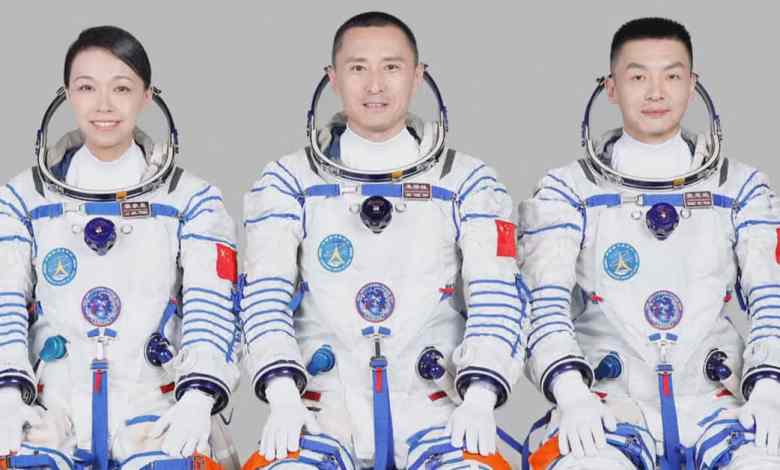
The mission is led by Commander Zhu Yangzhu, joined by astronauts Zhang Zhiyuan and Lai Ka-ying. Lai made history as the first Hong Kong astronaut to go into orbit. Before joining China’s astronaut program, he served in the Hong Kong Police Force as a payload specialist.
Zhu is already familiar with life in space after participating in the Shenzhou-16 mission in 2023. Meanwhile, Zhang is a former fighter pilot with the Chinese People’s Liberation Army Air Force.
The trio’s arrival means the Tiangong space station will soon transition to a new crew as current astronauts prepare to return to Earth later this month.
China prepares for its first one-year stay in orbit
One of the highlights of the Shenzhou-23 mission is China’s plan to keep an astronaut permanently in space for an entire year – a first for the country’s human spaceflight program.
The China Manned Space Engineering Office (CMSEO) confirmed the plan in a press conference on May 23, but did not reveal whether Zhu or Zhang would complete the one-year mission.
To make this possible, one of the two Pakistani astronaut candidates currently training in Beijing will join the upcoming Shenzhou-24 mission later this year. After arriving at Tiangong and spending a few days aboard the station, the visiting astronaut will take Zhu or Zhang’s seat for the return trip to Earth.
The mission will also mark another milestone for Tiangong, as it will be the first time an international astronaut will visit the Chinese-built space station since its completion in 2022.
The newly arrived astronauts were welcomed on board by the current Shenzhou-21 crew: Zhang Lu, Zhang Hongzhang and Wu Fei. Over the next few days, the outgoing crew will transfer control of the station before returning to Earth on May 29.
Upcoming science experiments and spacewalks
During their stay aboard Tiangong, Shenzhou-23 astronauts will carry out a wide range of scientific experiments involving medicine, human physiology, microgravity physics and advanced technologies.
Some of the planned studies include research into the lipid metabolism of liver cells, the growth cycles of rice plants in space, and tests involving two different types of perovskite solar cell materials.
The crew will also conduct several spacewalks and help install, maintain and repair equipment inside and outside the station, as China continues to expand its long-term presence in space.
Tiangong space station as a springboard to the Moon
China has revealed more details about its future human spaceflight and lunar exploration plans, as officials confirmed the country’s goal of landing two astronauts on the Moon before 2030. The update was shared at a May 23 press conference by CMSEO, offering a clearer overview of how the country intends to close the gap toward a new era of lunar exploration.
According to Zhang Jingbo, spokesperson for CMSEO, China’s Tiangong space station plays a central role in preparing for future crewed lunar missions. He explained that the station supports lunar ambitions in three main ways.
First, it provides astronauts with a long-duration spaceflight experience. Second, it serves as a testing ground for critical technologies needed for moon landings. This includes experiments such as a liquid sloshing test in a microgravity surface tension tank, which was launched aboard the Tianzhou-10 robotic resupply mission and is designed to help improve the spacecraft’s stability during landing operations.
Testing next-generation rockets and spacecraft
The third pillar of Chinese strategy concerns a new generation of space equipment. Over the next two years, the Long March 10A rocket and the Mengzhou crew spacecraft are expected to conduct several test flights to Tiangong. These missions will help verify the systems needed for future Moon landings.
China is also developing the Long March 10 rocket, which will eventually launch the Mengzhou spacecraft with the Lanyue lunar lander. This combined system is intended to transport astronauts from Earth orbit to the lunar surface.
Zhang noted that key test flights for the Long March 10 rocket, Mengzhou spacecraft and Lanyue lander were planned, although no specific timetable was provided. Meanwhile, NASA Administrator Jared Isaacman suggested that China could conduct a crewed lunar flyby as early as 2027, underscoring the growing pace of global lunar competition.
Progress on robotic lunar missions
Alongside its human spaceflight plans, China is also advancing its robotics program on the Moon. The Chang’e-7 mission, which arrived at the Wenchang spaceport in April, is currently undergoing final preparations for launch in the second half of the year.
Zhang said the mission was progressing smoothly and on schedule.
Now overseen by CMSEO, China’s lunar exploration program has been reorganized to consolidate robotic and human lunar missions under a single management structure, streamlining development efforts.
Chang’e-7 targets the lunar south pole
Chang’e-7 is designed to land near the Moon’s south pole, one of the most scientifically valuable regions due to the possibility of water ice in areas of permanent shadow. The mission will include an orbiter, a lander, a rover and a small flying probe designed to search for ice deposits.
This mission is also seen as an important precursor to China’s long-term goal of building an International Lunar Research Station (ILRS), which would serve as a sustainable human and robotic presence on the Moon in the years to come.
Source: SpaceNews
Read the original article on GEEKSPIN.
Affiliate links on GEEKSPIN may earn us and our partners a commission.