Astronauts enter the ‘lunar sphere of influence’

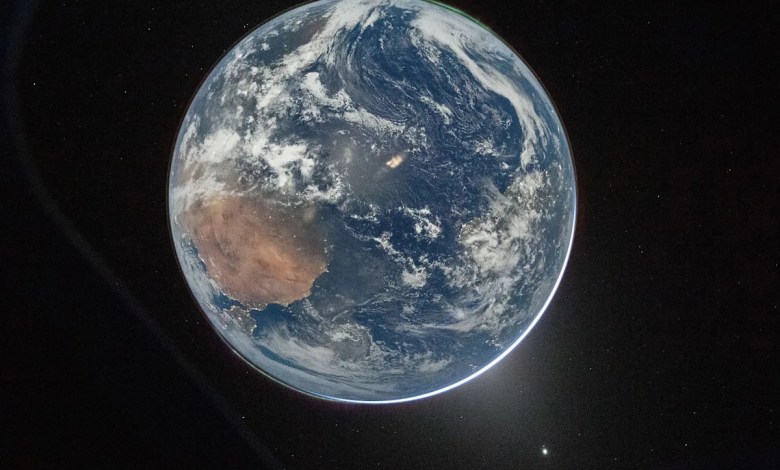
It’s official: the Artemis II astronauts have arrived in the cosmic neighborhood of the Moon.
The crew’s Orion capsule entered what’s known as the lunar sphere of influence around 12:41 a.m. ET Monday, passing through the region of space where the Moon’s gravitational pull is stronger than Earth’s.
“This is an important milestone in our mission,” NASA Flight Director Rick Henfling said during a press briefing on Sunday.
The lunar sphere of influence is not a physical or tangible boundary. Rather, it is a mathematical limit that means the astronauts are close to the Moon.
Crossing this threshold is a major achievement for NASA. This is the first time astronauts have entered the lunar sphere of influence in more than half a century, since the Apollo 17 mission in 1972.
On Sunday, astronauts sent back a photo showing “one last look at Earth before reaching the Moon.” The image shows the planet as a distant crescent framed through the window of the Orion spacecraft.
The Artemis II crew — NASA astronauts Reid Wiseman, Christina Koch and Victor Glover and Canadian astronaut Jeremy Hansen — began their day Sunday with a wake-up message from Apollo 16 astronaut Charlie Duke.
“John Young and I landed on the Moon in 1972 in a lunar module we named Orion,” Duke said in the recorded message. “I’m happy to see a different kind of Orion help bring humans back to the Moon as America sets a course for the lunar surface.”

Artemis II crew members, from left, Jeremy Hansen, Reid Wiseman, Christina Koch and Victor Glover answer questions from reporters Thursday. (NASA)
(NASA)
Later, Wiseman, Koch, Glover and Hansen spent time testing their spacesuits, newly designed for this flight.
Astronauts wear the orange spacesuits during launch and reentry, but the suits can also be worn in an emergency to provide crew members with a breathable atmosphere for up to six days if the Orion capsule loses pressurization, according to NASA.
The Orion spacecraft also performed a 14-second engine burn on Sunday to keep the capsule on course around the Moon. Although more such corrections have been planned for other days, Henfling said this is the first time such a correction has actually been necessary since the astronauts left Earth’s orbit.
“We found that Orion was on such a precise trajectory that we didn’t need to perform the first two correction maneuvers,” he said.
Astronauts are expected to circle the Moon later Monday, reaching an estimated distance of 252,760 miles from Earth — the furthest any humans have ventured from our home planet. They are expected to break the Apollo 13 crew’s distance record of 248,655 miles.
During Monday’s lunar flyby, Wiseman, Koch, Glover and Hansen will conduct observations of the moon and take photos for about seven hours, starting at 2:45 p.m. ET. The observations will include parts of the moon’s surface that have never before been seen by the human eye.
NASA will provide live coverage of the flyby starting at 1 p.m. ET.
According to NASA estimates, at the Orion spacecraft’s closest approach to the moon, around 7 p.m. ET, it will be 4,070 miles from the moon’s surface.
The astronauts plan to take photos with two Nikon D5 cameras and one Nikon Z9 camera, NASA officials said.
Among the 30 science targets set for the mission, astronauts will focus on the Orientale Basin, a 3.8 billion-year-old crater that formed when a large object crashed into the Moon’s surface. The nearly 600-mile-wide basin, which stretches across the Moon’s near and far sides, still has geological features distinct from those of the ancient collision, according to NASA.
The crew will also study the Hertzsprung Basin on the far side of the Moon, northwest of Orientale. Unlike the more pristine Orientale Basin, the features of this 400-mile-wide crater were degraded by subsequent lunar impacts, NASA said. Observing the two targets will give the crew and scientists on Earth the opportunity to compare how the Moon’s topography has changed over time.
A software tool will guide the crew’s observations of scientific targets.
Kelsey Young, Artemis II’s head of lunar science, said the schedule was “busy.” Still, it’s possible to improvise, she said: “They’re the scientists on the ground, and they’re encouraged to think outside the box if what they see in front of them really compels them.” »
Towards the end of their lunar observing period, the astronauts will witness a solar eclipse lasting about an hour from space. The sun will begin to pass behind the moon at 8:35 p.m. ET, blocking its light from the Orion capsule’s view.
During this time, the moon will appear mostly dark, giving astronauts the opportunity to observe the solar corona and look for flashes of light from rocky objects hitting the moon.
Astronauts will also have the opportunity to take photos of other planets that might be visible during the eclipse, including Mercury, Venus, Mars and Saturn, Young said.
She pointed out that the crew has a unique opportunity as the first humans to see the moon from these vantage points.
“It’s exploration,” Young said. “And while we have amazing images and data from orbiting spacecraft, it’s those nuanced observations that we’re missing. And so that’s a discovery, right? And we’re asking questions that we don’t always know the answers to.”
This article was originally published on NBCNews.com


