Who are the frontrunners for the top job?


Danielle KayeEconomic journalist

 Reuters
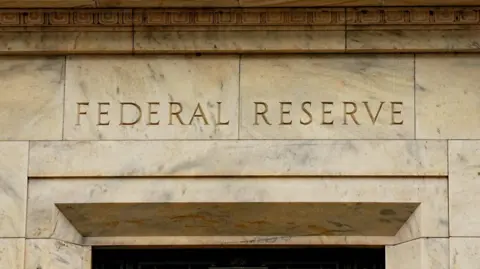
The high-stakes search for a new leader for the U.S. central bank is drawing to a close.
US President Donald Trump is expected to name in the coming weeks someone to replace Jerome Powell, whose term as head of the Federal Reserve will end in May.
This person will take on this role at a delicate time.
The bank faces both political pressure and internal disagreements over how it should set interest rates in the coming months.
Credibility issues could make the task even more difficult. Trump has made clear he wants to lower borrowing costs and put unusual pressure on the Fed, raising questions about whether whoever wins the job will act independently.
Trump’s nominee would then go to the Senate for confirmation. Here’s what you need to know about the pioneers.
Kevin Hassett, a Trump loyalist
 Reuters
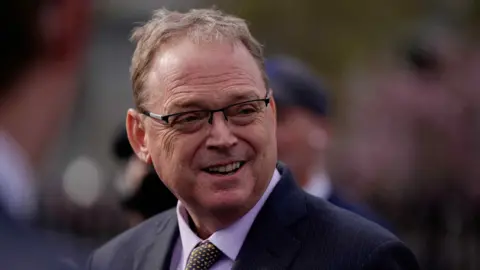
Kevin Hassett, a longtime conservative economist and Trump’s top economic adviser, is considered a leading contender to succeed Powell.
A Trump loyalist, Hassett, 63, served as chairman of the White House Council of Economic Advisers during Trump’s first term and now heads the National Economic Council.
Hassett has been a staunch defender of Trump’s economic policies, downplaying data showing signs of weakness in the U.S. economy and repeating allegations of bias from the Bureau of Labor Statistics.
Once considered the favorite, he has since seen his chances in the betting markets plummet, especially after Trump, in a recent public appearance, told Hassett that he was such a good representative in a television interview that “I really want to keep you where you are.”
Hassett’s allegiance to the chairman also sparked questions from analysts about whether he would act independently at the Fed and how much influence he would have over other board members.
In a research note, Deutsche Bank economists wrote that Hassett may have difficulty, at least initially, convincing other policymakers to put aside their concerns about inflation and cut rates significantly.
“Other officials might be skeptical of forward-looking arguments that rely heavily on the administration’s policies bringing inflation closer to target,” they write.
Even some within the Trump administration reportedly questioned whether Hassett had the skills needed to effectively lead the central bank.
Hassett answered these questions in a CNBC interview this month: saying the Fed’s independence was “really, really important,” while reiterating that interest rates still had room to fall.
“How you should drive interest rate movements is based on consensus based on facts and data,” he said.
Kevin Warsh, critic of the Fed
 Bloomberg via Getty Images
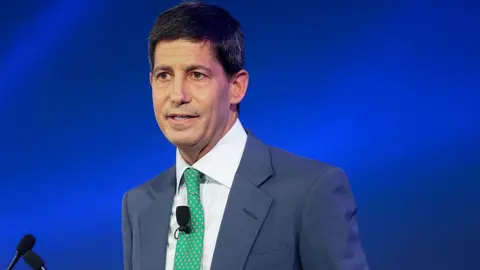
Kevin Warsh, who served as Fed governor from 2006 to 2011, has re-emerged in recent weeks as another potential choice.
The 55-year-old economist and fellow at the right-wing Hoover Institution, who sits on the board of UPS, was also tapped for the Fed presidency during Trump’s first term. It briefly overtook Hassett in prediction markets this month before falling back to second place.
“I think both Kevins are great,” Trump told the Wall Street Journal this month.
Warsh has been a vocal critic of the Fed, lambasting everything from the central bank’s heavy reliance on data to its use of assets on its balance sheet. He has ramped up his rhetoric since becoming a candidate for the Fed’s top job this year, calling for “regime change.”
Warsh had a relatively “hawkish” reputation as Fed governor, meaning he tended to favor higher interest rates and focus on concerns about inflation.
But he is now seen as a voice in favor of lowering short-term rates. He argued that the Fed should shrink its balance sheet in order to lower short-term interest rates, although some have questioned that logic.
“He thinks interest rates should be lowered,” Trump told the Journal. “And so did everyone I talked to.”
Warsh also has close family ties to the Trump orbit. His father-in-law, billionaire businessman Ronald Lauder, is a longtime Trump donor and ally.
Christopher Waller, a Fed insider
 Bloomberg via Getty Images
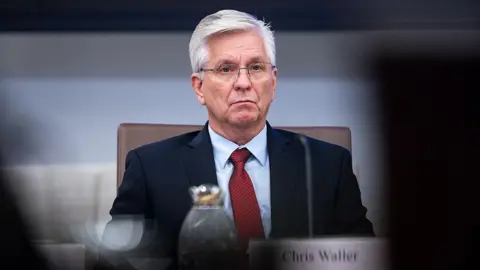
Christopher Waller, the current Fed governor, recently met with Trump for an interview, increasing his chances of getting the job in prediction markets.
He was appointed to the Fed board by Trump in 2020 and recently emphasized that the Fed has the ability to lower interest rates even further.
Waller, 66, lacks the personal ties that could help propel Hassett and Warsh to the top of Trump’s list. Wall Street, however, has welcomed his relative distance from the White House.
Trump, when asked about Waller after their meeting, called him “great,” adding that “this is a man who’s been around a long time.”
Although both Kevins remain the favorites, Waller emerges as “the smarter choice,” said Skyler Weinand, chief investment officer at Regan Capital.
He noted that Waller’s choice could open up two spots on the Fed board that Trump could fill next year, since Fed Governor Stephen Miran’s term is about to end.
It remains to be seen who will satisfy the president. Other names being bandied about include BlackRock executive Rick Reider and even Treasury Secretary Scott Bessent.
Ultimately, whoever wins this contest, it may be Wall Street that will be the final judge of its success.


