Dogs with Large Vocabularies Can Understand Category Words, Not Just Names


September 18, 2025
2 Min read
Some dogs can learn categories like all-small human
These dogs can extend words to new objects depending on the function like children do in the learning of early languages
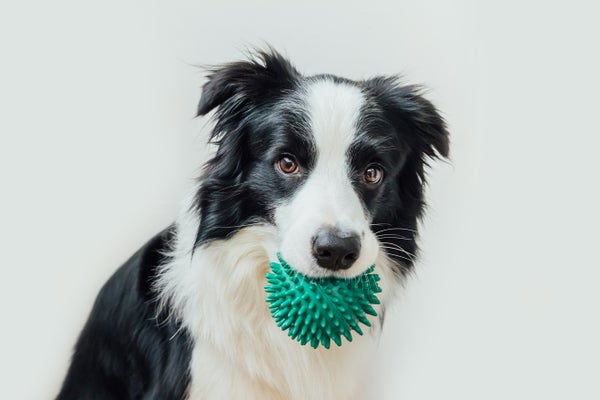
Researchers have discovered that some dogs can learn terms for functional categories, such as “sweater” and “launch” toys.
IULIIA Zavalishina / Getty images
Arya, a six -year border in Italy, can learn the name of a new toy from one or two mentions. Its owners say that she even knows the names of her favorite foods; When the pizza is on the menu, the word should be whispered. Arya’s gift made her natural for a new Current biology Study showing that some dogs with unusually important vocabularies can go beyond the simple memorization of names.
For the study, the owners of 10 talented dogs – mainly border necks – taught them words for two categories: tug toys, called sweaters and toys, called throws. All toys were different in size, fit and color, so appearance could not guide learning.

Arya was one of the 10 dogs -learning of gifted words – eight border collia, a blue heel, a Labrador Retriever and a Welsh Corgi Pembroke – to participate in the new experience.
On the support of scientific journalism
If you appreciate this article, plan to support our award -winning journalism by subscription. By buying a subscription, you help to ensure the future of striking stories about discoveries and ideas that shape our world today.
After four weeks of training, new toys that were nothing like typical traces or throws were introduced. This time, dogs only knew the function of each toy (drawing or recovering) during the game; They have not learned words for any of them. After a week of play, when he was asked to recover a traction or a throw, the dogs chose the right toy two thirds of the time – well above the 12.5% expected by chance. “These dogs on the words-gifted learnings are not only able to memorize the labels of many different objects, but can also extend a familiar word to new objects that share the same function, even if they seem very different,” explains the main author of the study, Claudia Fugazza, ethologist at Eötvös Loránd University.
Fugazza stresses that these animals are exceptional; Most family dogs never build such vocabulary. She says that the ease and flexibility of dogs applying words by function, similar to the way in which human children are starting to extend their vocabulary, was surprising.

Elika Bergelson, a language scientist from Harvard University who was not part of the new study, says that human infants “mainly count on the appearance of things. But at 14 months, they can also use a role or a function – for example, saying that pursues dogs and which is prosecuted in a scenario – to extend words “to new things, just like study dogs. In daily life, function and appearance generally go together: all cups share a basic form because they make them well to hold the liquid. “Unlike the real world, where the strings seem worthy and that the bullets seem disposable, this study isolates the function,” explains Bergelson. “Deleting visual signals is a proper way to probe how categories could form through species.”
Back home, Arya is occupied by her favorite research games and her play on words, unconscious of her superpower. “Because these dogs live in families and naturally collect the words,” says Fugazza, “their parallel to learning the first children could offer scientists unique possibilities to explore how language -related capacities could have evolved – and how they can emerge in a non -linguistic species.”

It’s time to defend science
If you enjoyed this article, I would like to ask for your support. American scientist has been a defender of science and industry for 180 years, and at the moment can be the most critical moment of this two -centuries story.
I was a American scientist The subscriber since the age of 12, and that helped shape my way of looking at the world. Sciam Educates me and always delights me, and inspires a feeling of fear for our vast and magnificent universe. I hope that does this for you too.
If you subscribe to American scientistYou help make sure that our cover is focused on significant research and discoveries; that we have the resources necessary to report the decisions that threaten laboratories in the United States; And that we support the budding scientists who work at a time when the value of science itself does not become often again.
In return, you get essential news, Captivating podcasts, brilliant infographics, Maybe not miss newsletters, videos to watch, Difficult games and the best writings and reports in the scientific world. You can even Give someone a subscription.
There has never been more time for us to get up and show why science counts. I hope you will support us in this mission.


