
Politics
/
August 18, 2025
Anything is possible in the coming days and weeks, but it’s difficult not to feel like we are veering toward escalating violence.
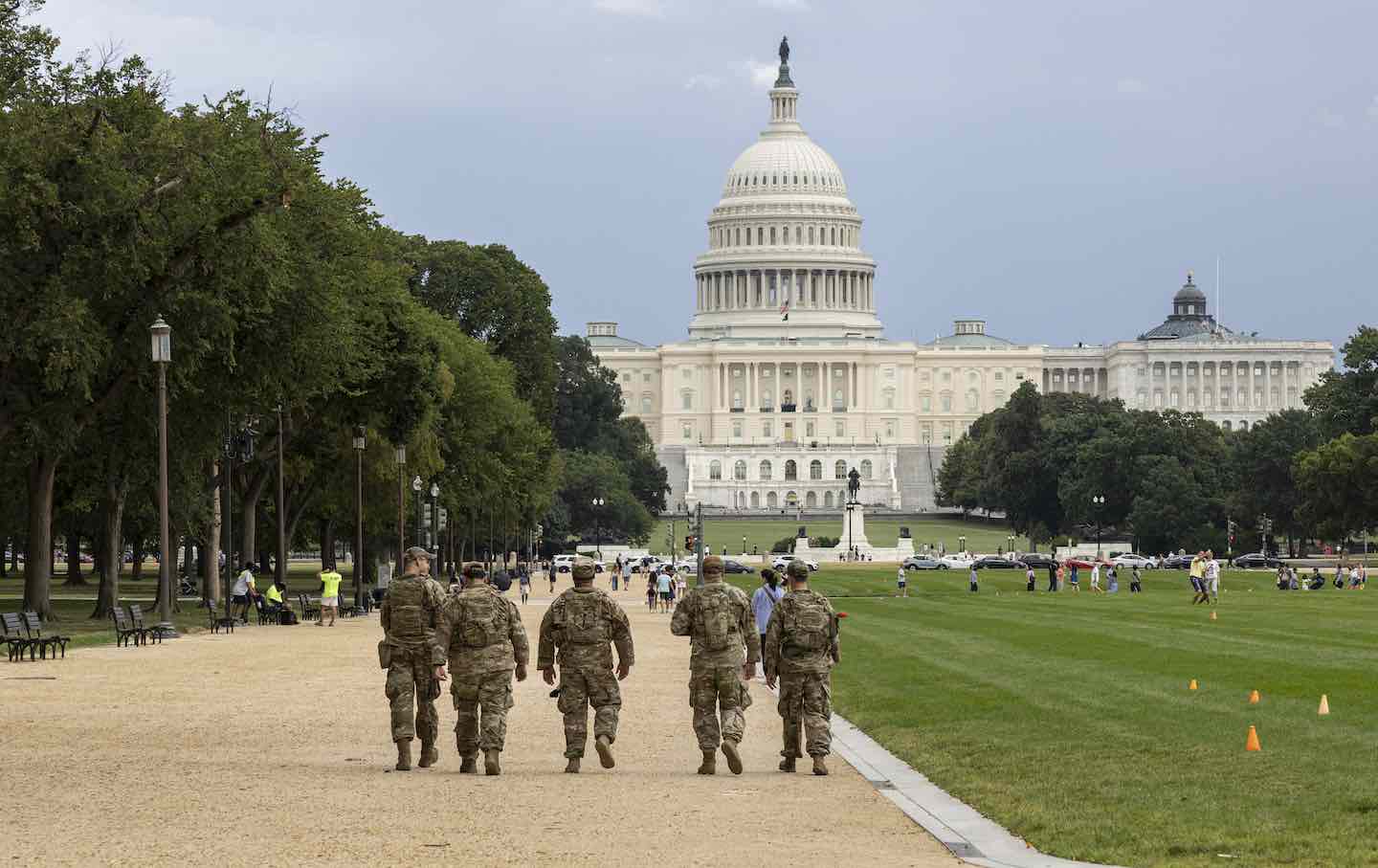
Members of the National Guard walk on the National Mall on August 14, 2025, in Washington, DC, following President Donald Trump’s deployment of federal forces and takeover of the city’s police department.
(Mehmet Eser / Middle East Images via AFP)
What exactly is Donald Trump doing with the 800 National Guard soldiers, plus ICE officers, Drug Enforcement Authority officials, and US Park Police, he deployed to patrol the streets of Washington, DC, almost two weeks ago? Attorney General Pam Bondi boasts that they arrested 68 people on Saturday night, but the Metropolitan Police Department averages 68 arrests a day. In less than two weeks, Bondi claims, they’ve arrested 300 individuals on charges ranging from drug dealing to traffic violations. But based on its daily average, the MPD would have made almost 900 arrests on its own in the same period.
Although Trump justified his moves by citing the District’s allegedly escalating crime rate—crime of every sort is actually down dramatically in Washington—for better or worse, they’re not policing any of the District’s high-crime areas, residents complain. I say it might be better, because if they descended on Anacostia or other overly policed areas, they likely would criminalize and brutalize indiscriminately. Remember, these troops haven’t been trained in urban policing (not that such training always prevents brutal behavior). But it’s also quite bizarre, if Trump’s genuine focus were crime reduction. But it’s not. It’s intimidation.
Trump’s troops have mostly shown up in touristy places and lively neighborhoods, in what is largely a show of farce. They’re writing people up for public drinking, smoking weed, and broken taillights. They’ve succeeded in reducing business at bars and restaurants by almost a third compared to the same period in August 2024. So much for the pro-business GOP.
Even though it’s so far been a waste of federal resources, GOP leaders are helping to escalate tensions in DC. Over the weekend, the Republican governors of South Carolina, West Virginia, and Ohio promised to send up to 750 of their own National Guard soldiers to the nation’s capital. Some red state governors briefly deployed National Guard troops, at Trump’s behest, during large-scale but peaceful George Floyd protests in June of 2020, but the news mostly flew under the radar. This time, Trump wants headlines about the red-state invasion. (As I write, Mississippi announced that it would send 200 soldiers. Good Ole Miss.) Military sources also told NBC that some Guard troops, who currently don’t carry weapons, might now be armed.
More than one observer on social media noted the somewhat chilling irony that it was South Carolina’s secession and attack on federal forces at Charleston’s Fort Sumter that started the Civil War. We should also remember that it was Ohio National Guard troops who fired on peaceful students at Kent State University in 1970, killing four.
I think a lot about writer Jeff Sharlet’s conception of a “slow civil war” unraveling the United States, especially since the January 6 insurrection. On Bluesky he wrote: “I’m gonna say armed troops from red states descending on a blue city is just a few inches—or maybe one exchange of gunfire—short of a civil war’s opening stages.”
Anjali Dayal, an international politics professor at Fordham University, took issue with Sharlet’s post—at least the way she read it: “I respect Jeff’s work but we should be careful about what we forecast & how inevitable we make it seem. We are not close to a civil war, but I worry we are perilously close to a mass casualty event because of the undisciplined nature of irregular security forces & an extremely armed civil society.”
In an e-mail to me, Sharlet made clear that he essentially agrees with Dayal. Civil war is not “an inevitability,” he said, adding, “I agree that ‘mass casualty event’ is the next big risk, and that the ‘grey and the blue’ is not a risk, but I’d argue that the simmer that we see, our years of lead, are a 21st century American slow civil war.”
It’s clear: The addition of 1,000 red-state National Guard troops to the 800 already in DC, all untrained in urban policing, raises the odds of a “mass casualty event,” at minimum. We used to say people who described Trumpism as “fascism” were exaggerating, though now even mainstream media regularly uses the F-word. Right now, we should be wary of talking blithely about “civil war.” But these moves on the capital by Trump and his red-state cronies seem like an acceleration of danger to democracy, meant to familiarize Americans with the sight of federal forces patrolling blue American cities, as Trump has already said is coming.
Add the dangers posed by armed right-wing civilians and militias, along with the nearly 1,600 January 6 felons freed from jail or prison by Trump on Inauguration Day, and it feels like we’ve veered toward escalating violence.
In this moment of crisis, we need a unified, progressive opposition to Donald Trump.
We’re starting to see one take shape in the streets and at ballot boxes across the country: from New York City mayoral candidate Zohran Mamdani’s campaign focused on affordability, to communities protecting their neighbors from ICE, to the senators opposing arms shipments to Israel.
The Democratic Party has an urgent choice to make: Will it embrace a politics that is principled and popular, or will it continue to insist on losing elections with the out-of-touch elites and consultants that got us here?
At The Nation, we know which side we’re on. Every day, we make the case for a more democratic and equal world by championing progressive leaders, lifting up movements fighting for justice, and exposing the oligarchs and corporations profiting at the expense of us all. Our independent journalism informs and empowers progressives across the country and helps bring this politics to new readers ready to join the fight.
We need your help to continue this work. Will you donate to support The Nation’s independent journalism? Every contribution goes to our award-winning reporting, analysis, and commentary.
Thank you for helping us take on Trump and build the just society we know is possible.
Sincerely,
Bhaskar Sunkara
President, The Nation


