‘Dracula’s Chivito’ looks stunning in this tasty Christmas photo from the Hubble Telescope

When you purchase through links on our articles, Future and its syndication partners may earn a commission.

Credits: NASA, ESA, STScI, Kristina Monsch (CfA); Image processing: Joseph DePasquale (STScI)
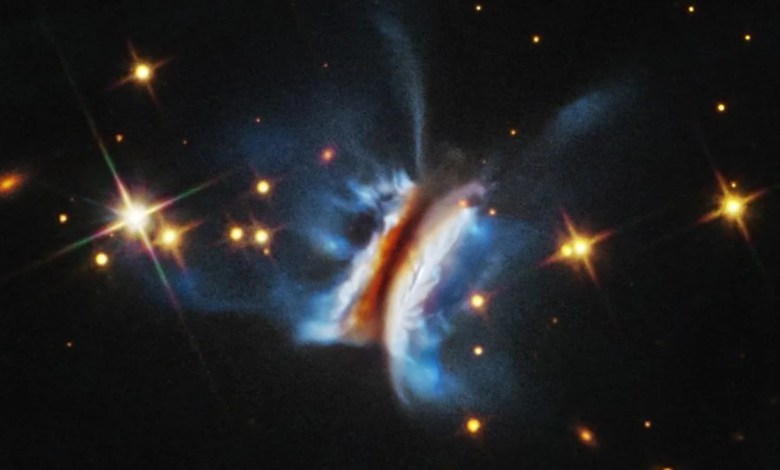
Using the Hubble Space Telescopeastronomers have photographed the largest and most chaotic planetary birth site humanity has ever seen.
Appearing like a superb cosmic bat, this protoplanetary disklocated about 1,000 light years away, spans about 400 billion years, about 40 times the size of our planet. solar systemto the ring of cometary bodies known as the Kuiper Belt.
This protoplanetary disk with a nascent star at its heart bears the official designation IRAS 23077+6707, but also carries the incredible nickname “Dracula’s Chivito”. But it’s not just its staggering size and unique nickname that make IRAS 23077+6707 so remarkable.

A Hubble image of Dracula’s Chivito, the largest protoplanetary disk ever seen | Credits: NASA, ESA, STScI, Kristina Monsch (CfA); Image processing: Joseph DePasquale (STScI)
“The level of detail we see is rare in imaging protoplanetary disks, and these new Hubble images show that planet nurseries can be much more active and chaotic than expected,” said Kristina Monsch, team leader of the Center for Astrophysics | Harvard and Smithsonian (CfA) said in a statement. “We see this disk almost edge-on, and its wispy upper layers and asymmetrical features are particularly striking.”
Monsch added that Hubble and the James Webb Space Telescope (JWST) have seen similar structures on other disks, but Dracula’s Chivito offers astronomers an exceptional perspective that allows them to trace its substructures in visible light with an unprecedented level of detail.
“This makes the system a unique new laboratory for studying planet formation and the environments in which it occurs,” Monsch continued.

The full Hubble image of IRAS 23077+6707, looking like a cosmic steak sandwich | Credits: NASA, ESA, STScI, Kristina Monsch (CfA); Image processing: Joseph DePasquale (STScI)
The asymmetrical appearance of the gas and dust pathways in Dracula’s Chivito in this stunning Hubble The image indicates that dynamic processes are occurring within the disc as its morphology is progressively shaped by interactions with its environment.
“We were amazed at how asymmetrical this disk is,” said team member Joshua Bennett Lovell, also an astronomer at CfA. “Hubble has given us a front-row seat to observe the chaotic processes that shape disks as they build new planets – processes that we don’t yet fully understand but can now study in a whole new way.”
Not only does this give scientists a better picture of how planets were born, but Dracula’s Chivito also offers a glimpse into what the solar system may have looked like when it was forming planets. 4.6 billion years ago, albeit on a much larger scale.
“In theory, IRAS 23077+6707 could host a large planetary system,” Monsch said. “Even though planet formation may differ in such massive environments, the underlying processes are likely similar.
“Right now we have more questions than answers, but these new images provide a starting point for understanding how planets form over time and in different environments.”
By the way, in case you’re wondering, the “Dracula” element of this protoplanetary disk’s nickname is a playful reference to the Transvanian heritage of one of the team members behind this research. Meanwhile, a “Chivito” is a huge steak sandwich, an iconic national dish of Uruguay, home of another member of the team of scientists.
Don’t panic, Drac, it’s “steak”, not “stake”.


