Drones can’t replace tanks, experts warn

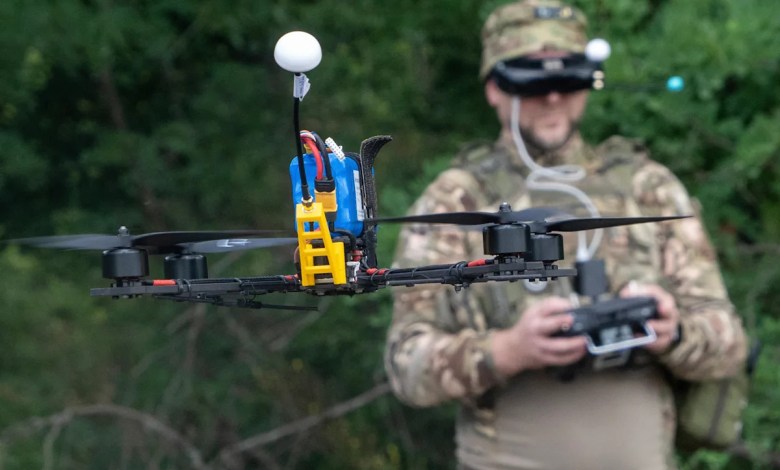
While the armies rush to learn the lessons of the Russian-Ukraine war, a question is especially looming: have drones replaced traditional weapons such as tanks and artillery?
For NATO, the implications are more than tactical. While the Alliance is struggling to rebuild its armies in the long term, it faces difficult decisions for the allocation of rare money and industrial capacity. If robots are the future, then does it not make sense to build drones of $ 500 instead of $ 5 million in tanks?
Not so fast, warn some experts. Replacing the old -fashioned firepower with a purely drone force would be a mistake.
“There are several reasons why it would be a mistake for NATO forces to count strongly on the small UAS en masse [unmanned aerial systems] and long -range Owa [one-way attack] Drones to replace traditional weapons systems looking for an improvement in lethality and therefore deterrent against the future Russian aggression, “says Justin Bronk, researcher at Think Think Tank Royal United Services Institute, in a recent test.
Europeans precipitate the fogs of radar based on drone in efforts to supplant American technology
Rather than exploiting the weaknesses of Russia, a NATO centered on the drone could play the forces of Russia.
According to Bronk, Russian Russian forces fuel the most formidable counter-Uas capacities in the world. In addition to the jammers, modified infantry weapons and short-range air defense systems, Russian forces have used to use anti-line measures such as the net to divert unmanned air vehicles and armored cages to protect vehicles.
“In most cases, only a small fraction of the enormous volumes of drones launched by Ukrainian forces reaches their targets, and an even smaller proportion reaches decisive damage when they do,” wrote Bronk.
Indeed, one of the reasons why Ukrainian drones have succeeded in success is the presence of an inherited firepower which limits the ability of Russia to maneuver and to concentrate assets against UAS.
“This attrition of the UAS occurred in the context of a Russian force which is still limited by the mines fields and forced to disperse by Ukrainian artillery, GMLRS [Guided Multiple Launch Rocket Systems] and atacms [Army Tactical Missile Systems]Storm Shadow / Salvepa cruise missiles and slippery bombs, said Bronk. “If the NATO forces were to continue the UAS mass at the expense of the reconstruction of the stocks of these traditional fires, the Russian forces would find much easier to alleviate the lethality of the UAS than they have in Ukraine.”

Ukrainian soldiers from an air defense unit of the 59th Fire Brigade in Russian Strike Drones in the Dnipropetrovsk, Ukraine, August 10 (Evgeniy Maloletka / AP) region)
The impact of drones in Ukraine has been contradictory. On the one hand, they dominate the battlefield, with omnipresent hordes of attacks and recognition drones paralyzing the maneuver and forcing troops and vehicles to stay in coverage and fortification. More recently, the waves of drone views in the first incomparable Russian person guided by fiber optic cables have devastated the Ukrainian supply lines.
However, despite enormous efforts to innovate and make drones, Ukraine has only been able to limit Russian advances – but not stop them. Advancing behind saturation bombings by artillery, slippery bombs and drones, Russian offensives succeed in capturing land. The gains are thin and the cost is amazing. But the Kremlin does not care about losses, and Ukraine simply lacks sufficient amounts of workforce and traditional weapons to defeat the attackers.
“Ukraine has obtained very impressive defensive results against the larger Russian forces, but has failed to keep the strategic initiative or the operational momentum despite the deployment of millions of AUs which are constantly developed iteratively by a system perfected by several years of desperate fighting,” wrote Bronk.
The best proof is that Ukraine demands inherited weapons such as Atacms and the artillery rocket system with high mobility, or Himars, rocket launcher, guided artillery and anti-work guided missiles.
“When available, high -end ATGS [Anti-Tank Guided Missiles]The anti -tank bonus artillery rounds and regular artillery are still appreciated by many Ukrainian commanders to counter Russian attempts to unravel the fronts, because they are much more reactive and more reliable in eliminating vehicles and eliminating mass infantry than FPV drones, “wrote Bronk.
While drones have made significant victims to Russian forces (like Russian drones on Ukrainian troops), Bronk sees the most precious drones as catalysts for traditional forms of firepower.
For example, cheap or suicide -off drones can saturate air defense radars and force the defender to spend interceptors who would otherwise target missiles and rockets.
NATO tests drones of the Baltic Sea to follow the Russian warships, the Cargos
Bronk promotes NATO development on the slides to slide. Although much more expensive than drones, they are much cheaper than guided missiles: an ammunition of common direct attack, or JDDD, costs around $ 25,000 compared to an Atacms rocket of a million dollars. Glide bombs “destroy armored vehicles, combat positions, supplies of supplies, warehouses, factories and command posts. They are easy to make on a large scale with existing factories and several bombs can be delivered by a single jet with a targeting pod on each output. ”
Beyond their value on the battlefield, Bronk considers sliding bombs as a means of deterrence against Russian aggression. By threatening the Russian aerial defenses, they present in Moscow the prospect of operating at the mercy of NATO air power.
Rather than catching up with the catch -up of Russia and Ukraine in Drone Warfare, NATO should use drones to increase its existing forces, a main researcher in the Endowment for International Peace told Defense News. These include higher precision strike capacities, better formed staff and the ability to carry out joint operations.
“These are the advantages that can be much more important than being second or third in drone fight,” said Kofman.
In the end, nations which can integrate drones into conventional weapons will have the advantage over those based on masses of drones to the detriment of traditional fire power.
“Basically, it is by far technically and tactically easier to counter a force which is mainly based on FPV and Owa cheap and cheap drones for its main lethality than to counter the well -used air power, long -range fires, armor, artillery and mortars within a joint professional force,” concluded Bronk.


