Earliest known writing dates back over 40,000 years


New evidence published today in the journal Proceedings of the National Academy of Sciences indicates that humans experimented with symbolic writing 40,000 years ago. If true, these findings significantly recontextualize the history of communication, given that the earliest known written languages are Mesopotamian proto-cuneiform dating back to around 3000 BCE.
“The artifacts date back tens of thousands of years before the first writing systems, to when Homo sapiens left Africa, settled in Europe and met Neanderthals,” explained Ewa Dutkiewicz, co-author of the study and archaeologist at the Museum of Prehistory and Ancient History in Berlin.
Dutkiewicz and his colleagues spent years analyzing 260 relics recovered from Stone Age caves in the Swabian Alb, a remote mountain range in southwest Germany. These include a small mammoth figurine carved from the extinct animal’s tusk as well as the Adorant, a famous ivory sculpture that appears to depict a human-lion figure with outstretched arms. These artifacts and many others like them also feature frequently repeated sequences of lines, crosses, dots, and notches.
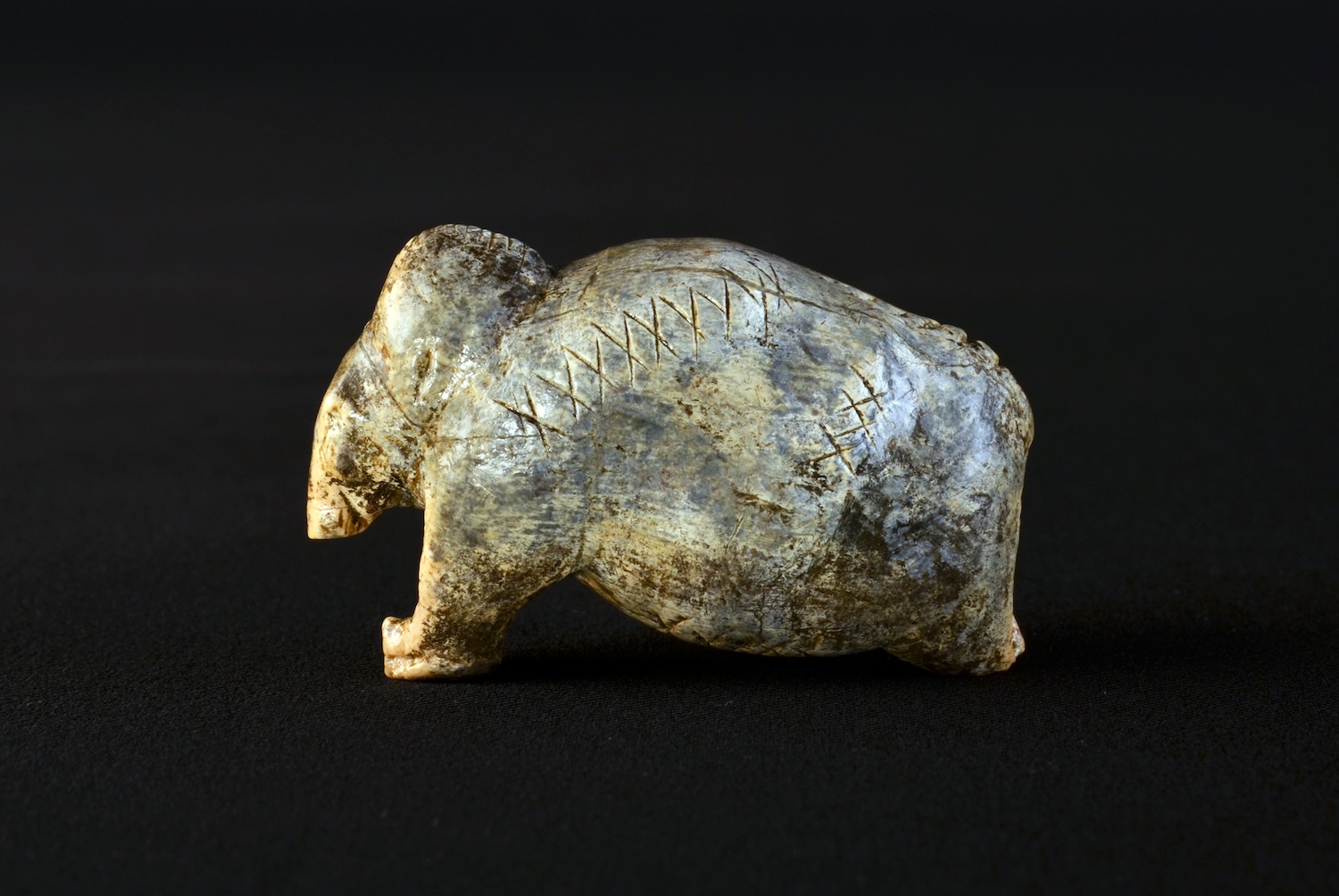
The team then entered more than 3,000 geometric engravings into a database of Stone Age signs and examined them using various computer analysis tools. They did not expect to translate any of the messages, but instead used analysis to compare and contrast their attributes with writing systems developed later.
“There are many theories, but so far very little empirical work has been done on the fundamental, measurable characteristics of signs,” added Christian Bentz, co-author of the study at Germany’s Saarland University.
Bentz explained that using methods such as quantitative linguistics and statistical modeling allowed them to compare symbols found on Paleolithic artifacts to early cuneiform writing formats as well as modern writing formats. With this approach, they could estimate how much information could be contained in the engraved symbols.
“The human ability to encode information in signs and symbols developed over several thousand years. Writing is only one specific form in a long series of sign systems,” he said. “We continue to develop new systems for coding information. Coding is also the basis of computer systems.”
The results surprised the researchers. Although they initially hypothesized that Proto-Cuneiform would share more similarities with today’s writing systems, it appears that the Mesopotamian method of communication more closely resembles its Stone Age ancestors. This means that writing may have changed very little over tens of thousands of years. Although the exact meaning of the artifacts from Paleolithic Germany remains a mystery, the team is convinced that this is the case. not represent any spoken language.
“Signs on archaeological objects are frequently repeated: cross, cross, cross, line, line, line. This type of repetition is not a feature found in spoken language,” Bentz said.
The team can also now begin to narrow down the scope of possible interpretations. The findings also highlight that in terms of cognitive abilities, Stone Age humans had already achieved a similar capacity to their current descendants.
“There are many sign sequences on the artifacts. We’ve only scratched the surface,” Dutkiewicz said.

The best new PopSci 2025 releases


