Early galaxy looked like lumpy ‘cosmic grapes’


A group of “cosmic grapes” calls into question the current theoretical models on the way in which galaxies were formed during the first eons of the universe. After combining observations of the large / submillimetric (ALMA) (ALMA) and the James Webb space telescope, astronomers now have an unprecedented overview of approximately 15 piles of gargantuan star formation inside a single rotary disc which formed only 900 million years after the Big Bang.
“The first galaxies are formed through dark matter and gas assembly, evolving towards dynamically hot chaotic structures motivated by mergers and comments,” said the international research team in their Natural astronomy Study published on August 7. “On the other hand, remarkably smooth rotary discs are observed in massive galaxies only 1.4 billion years after Big Bang, which implies a rapid dynamic evolution.”
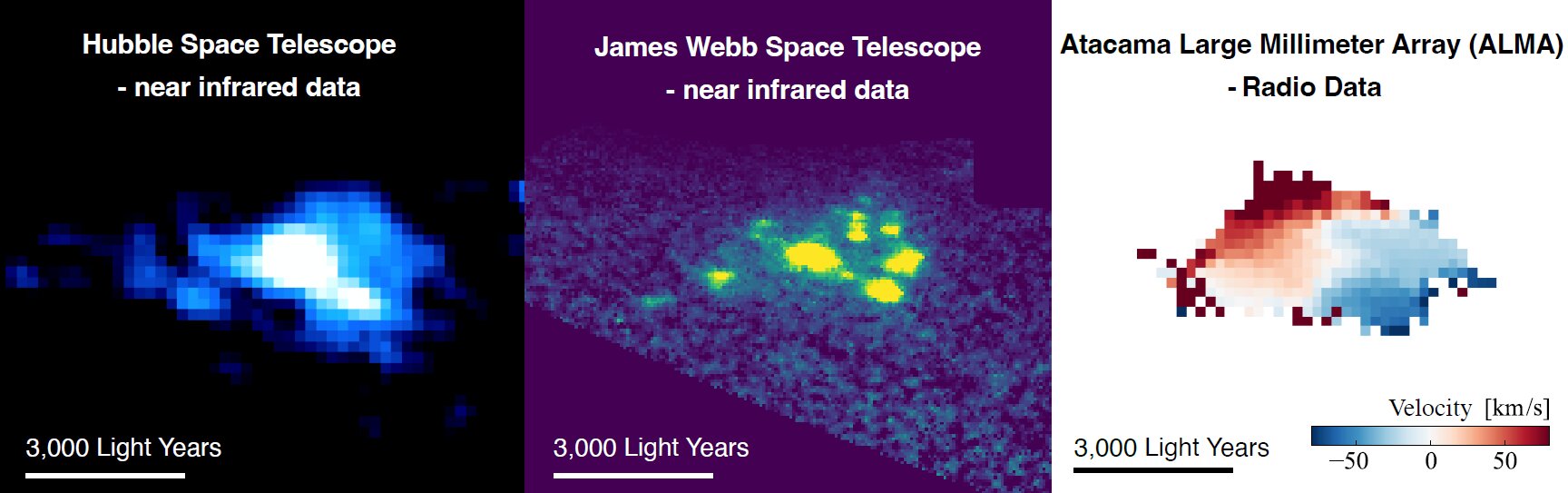
Understanding how this cosmic evolution took place requires the ability to study young galaxies, which previously made it difficult by the limits of sensitivity and spatial resolution of observation tools. Even with the revolutionary capacities of the Hubble space telescope, the “Cosmic Grapes” galaxy only appeared as a smooth and singular disc form. By using more recent and advanced projects like JWST and Alma, astronomers were able to refocus on the mystery target with the help of a cosmic neighbor.
According to an announcement of the study of the National Radio-Astronomy Observatory, the structure of cosmic grapes “proved perfectly amplified by a cluster of leading galaxy by their gravitational lens”. The opportunity allowed researchers to devote more than 100 hours of quality telescope time to the individual system, making it one of the most analyzed galaxies in the early universe.
Instead of the individual disc seen in the images of Hubble, the exponentially larger resolution of JWST and Alma presented a completely different situation – a rotary galaxy filled with giant stellar and lumpy formations resembling the fruit of the vineyard. The revelation is also the first time that astronomers have successfully linked the small internal structures of a first galaxy to their greater collective rotation. The data were so detailed that they even managed to reach a spatial resolution of 10 parsecs, around 30 light years.
What is particularly striking is that cosmic grapes are not a bizarre or extreme example given what astronomers understand galactic evolution. Instead, it exists on the standard main sequence of galaxies with regard to attributes such as stars, mass, chemical composition and size. This suggests that many of the era galaxies that have been previously documented as smooth can look more like the lumpy dynamic structure observed via JWST and Alma.
“Because existing simulations do not reproduce such a large number of tufts in rotary galaxies at first, this discovery raises key questions about how galaxies are formed and evolving,” explained the announcement of the National Radio-Astronomy Observatory. “This suggests that our understanding of feedback processes and structural training in young galaxies may require significant revision.”

More offers, reviews and purchasing guides