Early Miocene Fossil Fills Gap in Ape Family Tree


Paleontologists have identified a new genus and species of fossil ape that lived about 17 to 18 million years ago in northern Egypt. The discovery suggests that the ancestors of modern apes – and humans – may have arisen not in East Africa, but at a crossroads between Africa and Eurasia.
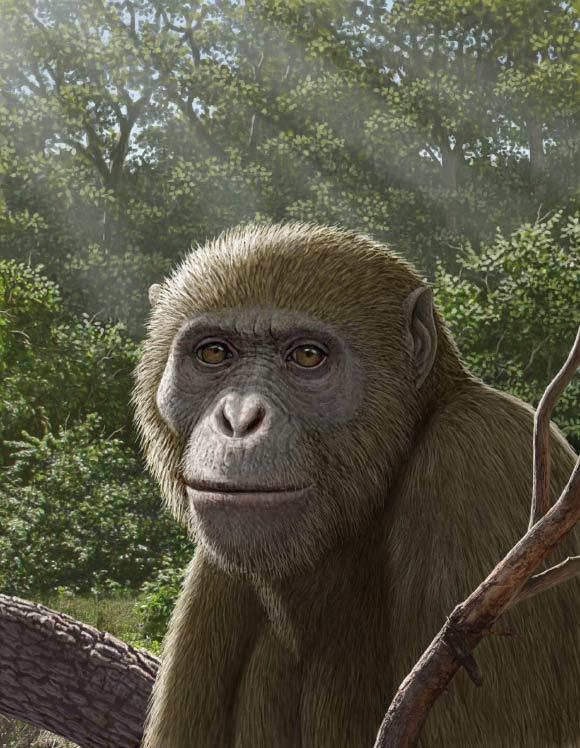
Reconstruction of the life of Masripithecus moghraensis. Image credit: Mauricio Antón.
Today, it is widely accepted that the first apes (stem hominoids) originated in Afro-Arabia in the Oligocene epoch, more than 25 million years ago, and diversified there before spreading to Eurasia approximately 14 to 16 million years ago, in the Miocene.
However, the emergence of modern apes – the group that includes all living species and their last common ancestor – remains uncertain, because fossils from this period are rare, widely dispersed and difficult to interpret.
This uncertainty is compounded by the patchy fossil record in Africa, where discoveries have been concentrated in only a few regions, leaving much of the potential ancient range of Miocene apes unexplored.
“The early Miocene fossil record documenting hominoid evolution has long been limited primarily to sites in East Africa, while contemporary sites in North Africa have yielded only remains of cercopithecoid apes,” said Shorouq Al-Ashqar, a paleontologist at Mansoura University, and his Egyptian and American colleagues.
The newly discovered fossil ape lived 17 to 18 million years ago in what is now the Wadi Moghra region of northern Egypt.
Appointed Masripithecus moghraensisthe species adds to our understanding of the diversity and evolution of early apes at a pivotal moment when Afro-Arabia was connecting with Eurasia, enabling the spread of species out of Africa.
“Although the new fossil material is limited to the lower jaw, it preserves a distinctive combination of features not found in any other ape known from this time,” the researchers said.
“These include exceptionally large canines and premolars, molar teeth with rounded, highly textured chewing surfaces, and a particularly robust jaw. »
“Together, they suggest that Masripithecus moghraensis has been adapted for versatility,” they added.
“The study interprets its chewing anatomy as evidence of a flexible, primarily fruit-based diet, with the ability to process harder foods such as nuts or seeds when needed.”
To determine where Masripithecus moghraensis fits into the evolutionary tree of humans, scientists used a modern Bayesian “point dating” approach, which integrates both anatomical traits and fossil ages to estimate relationships and divergence times.
Their analysis suggests that the new species represents the hominoid strain most closely related to the lineage that ultimately gave rise to all living apes.
The results support the idea that modern apes may have originated in northern Afro-Arabia, the Levant or the eastern Mediterranean.
“We spent five years looking for this type of fossil because when we look closely at the family tree of early apes, it becomes clear that something is missing – and North Africa holds that missing piece,” said Hesham Sallam, a paleontologist at Mansoura University.
The results appear in the newspaper Science.
_____
Shorouq F. Al-Ashqar and others. 2026. A Lower Miocene ape from the biogeographic crossroads of African and Eurasian Hominoidea. Science 391 (6792): 1383-1386; doi: 10.1126/science.adz4102