Earth’s newfound ‘episodic-squishy lid’ may guide our search for habitable worlds

When you purchase through links on our articles, Future and its syndication partners may earn a commission.

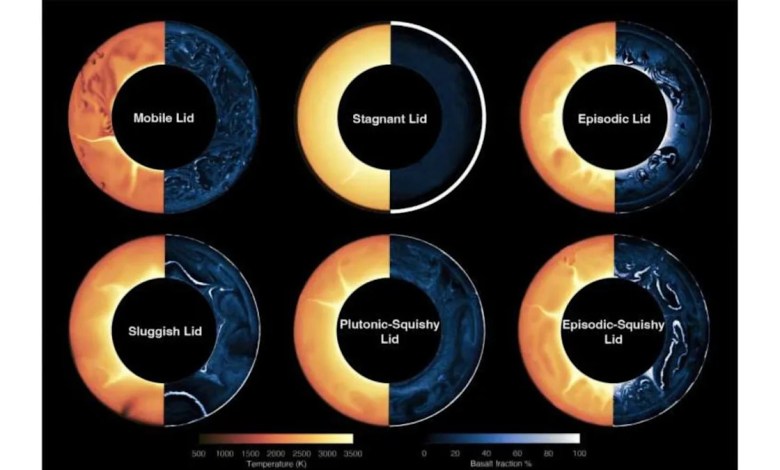
Six simulation snapshots showing different tectonic regimes of terrestrial planets, including the new “episodic-spongy lid”. | Credit: Nature Communications (2025)
A newly identified tectonic “regime” could rewrite our understanding of the evolution of rocky worlds, scientists report in a new study.
The results may help explain why Earth became geologically dynamic while Venus has remained stagnant and torrid, with possible implications for our understanding of what makes a planet habitable.
When researchers used advanced geodynamic simulations to map various planetary tectonics regimes – distinct models that describe how a planet’s outer shell deforms and releases heat under different conditions – they discovered a missing link that they dubbed the “episodic, spongy lid.”
This striking new framework offers a new perspective on how planets transition from an active to an inactive state, thereby reshaping scientific hypotheses about planetary evolution and habitability, the team said in a declaration explaining the study.
Tectonic regimes influence the geological activity of a planet, its internal evolution, its magnetic field, its atmosphere and even its potential to support life. Episodic-spongy lid builds on the traditional division between plate tectonics or moving lid regimes (like modern Earth) and stagnant lid behavior (like March). It describes a state in which a planet’s lithosphere oscillates between relatively quiet periods and sudden bursts of tectonic movement. Unlike a conventional stagnant lid, this regime allows intermittent weakening caused by intrusive magmatism and regional delamination, temporarily softening the crust before it stiffens again.
This intermittent behavior could be a missing link in Earth’s early evolution, the researchers said. Models suggest that Earth may have gone through a sponge lid phase that gradually began its movement. lithosphere for complete plate tectonics as the planet cooled.
The results also help clarify the “memory effect” – the idea that a planet’s tectonic behavior is shaped by its past – by showing that as a planet’s lithosphere weakens over time, like Earth’s, transitions between tectonic states become much more predictable.
By mapping the six tectonic regimes under different physical conditions for the first time, the team constructed a comprehensive diagram revealing likely transition pathways as a planet cools.
“The geological record suggests that early Earth tectonic activity matches the characteristics of our newly identified regime,” study co-author Guochun Zhao, a geologist at the Chinese Academy of Sciences, said in the release. “As Earth gradually cooled, its lithosphere became more prone to fracturing through specific physical mechanisms, ultimately leading to today’s plate tectonics. This constitutes a key piece of the puzzle to explain how Earth became a habitable planet.”
The episodic, squishy lid could also shed light on long-standing mysteries of Venus. Although Venus is about the same size as Earth, it lacks clear evidence of plate tectonics, instead displaying volcanically reshaped terrain and distinctive features called coronas. The new simulations reproduce Venus-like patterns by placing the planet in an episodic or plutonic regime of sponge lids, where magmatism and mantle plumes periodically weaken the surface without generating true plates.
“Our models intimately link mantle convection to magmatic activity,” study co-author Maxim Ballmer, associate professor of geodynamics at University College London, said in the release. “This allows us to view the long geological history of Earth and the current state of Venus in a unified theoretical framework, and provides a crucial theoretical basis for the search for potentially habitable terrestrial analogues and super-Earths outside our solar system.”
Since tectonics govern how water and carbon dioxide flow within and through a planet’s atmosphere, understanding how lithospheres weaken and shift between regimes could help scientists assess which distant worlds might support stable climates, or even life, and guide decisions on observation targets for future missions.
The conclusions were published on November 24 in the journal Nature Communications.