Electronics breakthrough means our devices may one day no longer emit waste heat, scientists say


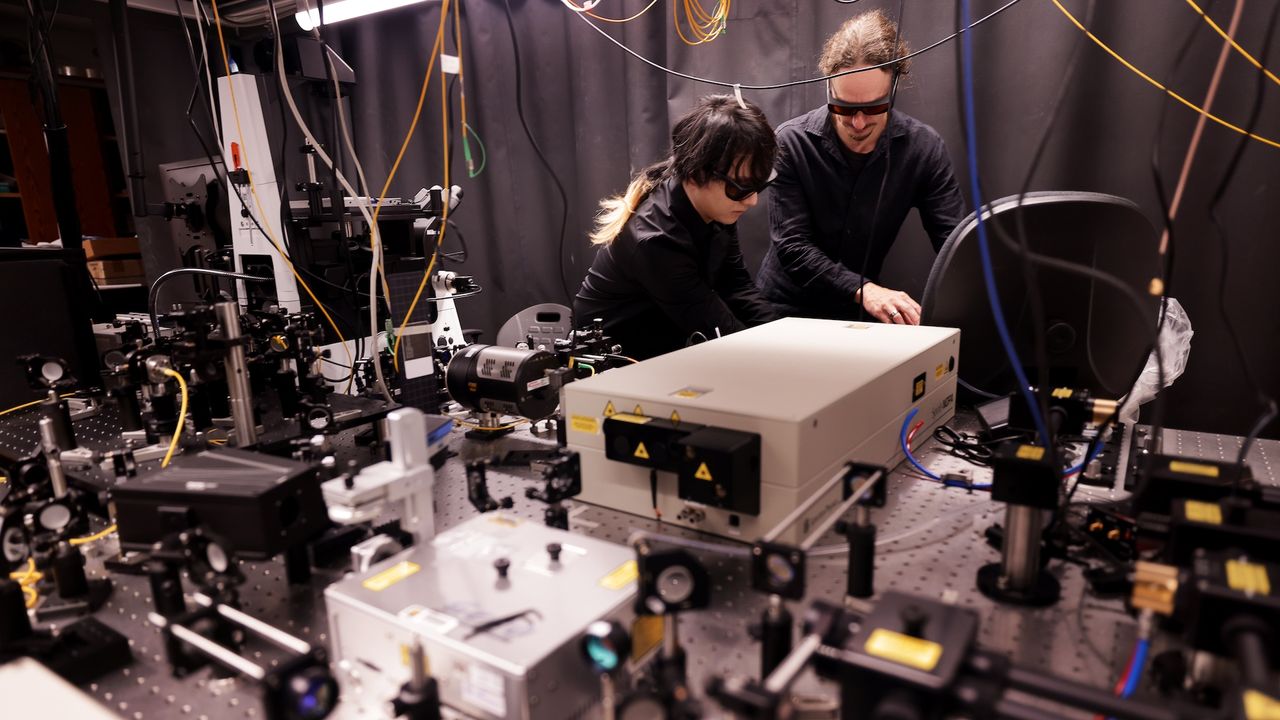
Researchers have developed revolutionary technology that resolves a fundamental limit of electronics.
This new technology, nicknamed an “opto -xteon -” switch, could lead to a new electronics class – ranging from phones and PCs to data centers and quantum computers that can work without generating waste heat.
The new switch works as a conventional electronic switch, which uses an electrical load to control the electron flow in a system. The switches direct the energy flow or control the transmission of signals in a device.
Because these electrons are loaded, they produce “heat of waste”. This is why your laptop is hot when you play a demanding video game and why the massive data centers work at extraordinarily high temperatures.
The new “excitonic switches”, on the other hand, are counting on “excitons” loaded in a neutral manner – a quasiparticles created by an “exciting” an electron in such a way that it is removed from its position in an atom.
These excited electrons leave behind a hole that binds to the free electron. Together, the free moving electron, which now has a negative load, and the hole it leaves behind, which has a positive charge, form a single almost called “exciton” which remains with neutral loaded. As excitons have a neutral load, they do not produce heat when they transfer information.
The power of light
The Breakthrough Research, published on August 31 in the journal Nano ACSThis is the first time that excitons have been used to create a switch that has exceeded the performance of current photonic switches and achieves overall advanced performance.
“Electronics is hot, and it is because electronic devices always have capacitors”, co-author of the study Parag deotoreAssociate professor of electrical engineering, computer engineering and applied physics, told Live Science. “Whenever you store energy or free up this energy, you heat it. An exciton is a new particle neutral load, like a photon, which does not produce this heat.”
The new device uses excitons to overcome the heat problem and improves electronic design by narrowing the switches used to move information by two orders of magnitude.
Deotore said that the long -term objective in the development of these new switches is to create excitonic circuits that work so effectively that IT systems do not need fans and that phones can keep their batteries loaded for much longer periods.
Test “magic thickness”
Although the theory behind the excitonic switches is solid, engineering and the new technology test have presented the biggest challenge for the team. In a conventional electronic system, the electrons are pushed where they must go through an electrical load by raw force. Excritions do not have this option because of their neutral load.
To make excitons where they have to go, scientists have used photons loaded in a neutral manner to order the excitons in a linear network along a one -dimensional – or “crest” plan.
The team created the excitons, then affected them by a specific number of photons, which have been absorbed at the forefront of the crest to create an exciton population, said Deotore. In other words, it is a crowd of grouped excitons and holding motionless at the bottom of a straight line. The team then applied more photons until the excitons start to move. If they have added too many photons, the excitons did not follow the ridge; Too few photons have made the excitons stay.
“Our prediction was that if you push them sufficiently thick, the light coupling to excitons will be such that the thrust will be destroyed. And they could show it. So, basically, it must have a magical thickness”, co-author of the study Mackillo KiraProfessor of electrical and computer engineering, and co -director of the University’s quantum research institute, told Live Science. “”
Because light acts like a wave, the photons have “pushed” the excitons once the magic thickness was made. The observation of this activity confirmed the theories and proved that experience was a success, added Kira. “It’s actually easy to check for experiences, because the color of the exciton will change as you launch the ridge,” said Kira.
Based on the results of the experience, the switch already responds or exceeds the capacities of current technology.
The ultimate objective is to escape these circuits switches which would ostensibly replace the current electronics. According to the researchers, several advances are necessary to achieve this objective, in particular the search for new materials and the development of techniques to manufacture and set up the prototypes of devices used in the experiences of the team. But the team thinks that these challenges could be overcome in a few decades.
Hope is that switches and optoxcitonic circuits could overcome the heat of waste – probably the biggest calculation problem. This would allow massive size reductions associated with exponential performance improvements, scientists said.


