Elephants’ peculiar whiskers help them sense the world around them


February 12, 2026
3 min reading
 Add us on GoogleAdd SciAm
Elephants’ special whiskers help them perceive the world around them
The pachyderm’s whiskers are more flexible at the tip than at the base, allowing elephants to perform delicate tasks with their incredibly strong trunks.
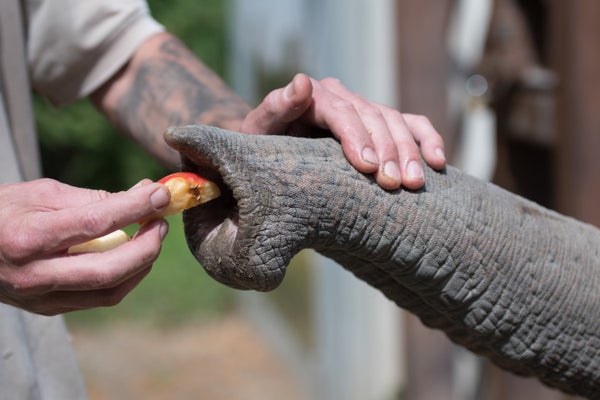
Zookeeper smelling an elephant’s whiskers.
Heidelberg Zoo and Alejandro Posada, Max Planck Institute for Intelligent Systems
Watching an elephant forage for roots to eat reveals how strong and sensitive its trunk is. The more than 40,000 muscles in an elephant’s trunk can topple trees and delicately retrieve fallen fragments. It takes almost a year for baby elephants to master using their trunks in this way, and it has taken humans even longer to figure out how they are able to do it. The secret may lie in the elephants’ whiskers.
Now, researchers who analyzed the whiskers that line the trunks of these animals have discovered a unique structural property that helps elephants perceive the world around them and determine whether a task requires strength or sensitivity. In a study published today in ScienceResearchers reveal that, unlike other mammals’ whiskers, elephants’ whiskers are softer at the tip and stiffer closer to the skin.
This observation clarifies how the unique structure of animals’ whiskers informs elephants’ “umwelt,” or their individual sensory and perceptual experience of the world.
On supporting science journalism
If you enjoy this article, please consider supporting our award-winning journalism by subscription. By purchasing a subscription, you are helping to ensure the future of impactful stories about the discoveries and ideas shaping our world today.
“We found that elephants are like aliens,” says Andrew Schulz, lead author of the study and a haptic intelligence researcher at the Max Planck Institute for Intelligence Systems. “They have these horn-shaped whiskers with a gradient of stiffness…it was confusing.”
Because elephants have such rough, armor-like skin, researchers knew that the whiskers on their trunks likely did important sensory work to allow the animals to delicately interact with the world around them. But to truly understand these tiny filaments, researchers needed to look much closer.
Using a scanner specifically designed for small objects, Schulz and his colleagues created a digital rendering of the elephants’ whiskers to analyze their structure from the inside out. Then, using other imaging and chemical tests, they were able to analyze the structure and hardness of the whiskers in more detail.
The part of the mustache closest to an elephant’s skin is very strong and porous. The tip of the mustache, for its part, is much more flexible and denser. Wanting to understand the mechanics of this unique shape, the researchers 3D printed an oversized version of a mustache with a precise density gradient so they could feel them for themselves.
“I was walking down the hall and hitting things [with the whisker] and I had this real eureka moment,” says Katherine J. Kuchenbecker, lead author of the study and director of the Haptic Intelligence Department at the Max Planck Institute for Intelligence Systems. She noticed that hitting something hard with the dense base of the whisker was much firmer and sharper than hitting something with the duller end. The difference in hardness allowed Kuchenbecker to get a sense of the contours of objects without her skin even touching them.
Elephants use their trunks to breathe, smell, grasp objects, communicate and even perceive objects outside their field of vision. And their mustaches help shape all of these experiences.
“Almost all mammals, not just elephants, have whiskers whose size, shape and material properties are almost certainly adapted to the way the species uses touch in its environment,” says Mitra Hartmann, an engineering professor at Northwestern University, who was not involved in the study.
In addition to providing insight into the perceptual world of elephants, Schulz and his team created a toolbox with their data, hoping that the unique structure of elephant whiskers will inspire researchers in other disciplines. They are particularly interested in seeing how materials with a stiffness gradient, such as an elephant’s whisker, could be applied to robotics. Maintaining the solidity of machines while being flexible enough not to damage the materials with which they interact is a major challenge in robotics.
“This study is a fabulous example of interdisciplinary science,” says John Hutchinson, professor of evolutionary biomechanics at the Royal Veterinary College, University of London. “It’s elegant neuroscience, anatomy and mechanics.”
It’s time to defend science
If you enjoyed this article, I would like to ask for your support. Scientific American has been defending science and industry for 180 years, and we are currently experiencing perhaps the most critical moment in these two centuries of history.
I was a Scientific American subscriber since the age of 12, and it helped shape the way I see the world. SciAm always educates and delights me, and inspires a sense of respect for our vast and beautiful universe. I hope this is the case for you too.
If you subscribe to Scientific Americanyou help ensure our coverage centers on meaningful research and discoveries; that we have the resources to account for decisions that threaten laboratories across the United States; and that we support budding and working scientists at a time when the value of science itself too often goes unrecognized.
In exchange, you receive essential information, captivating podcasts, brilliant infographics, newsletters not to be missed, unmissable videos, stimulating games and the best writings and reports from the scientific world. You can even offer a subscription to someone.
There has never been a more important time for us to stand up and show why science matters. I hope you will support us in this mission.


