‘Life or death’: Supreme Court to weigh Trump tariffs in blockbuster case


NEWYou can now listen to Fox News articles!
The Supreme Court on Wednesday will consider the legality of President Donald Trump’s use of an emergency law to unilaterally impose drastic tariffs on most of the United States’ trading partners – a blockbuster case that experts say goes far beyond questions of economic policy.
At issue before the court is whether the president can use the International Emergency Economic Powers Act (IEEPA) to impose two sets of tariffs on most countries, including a 10% global tariff announced by Trump in April and the higher so-called reciprocal tariffs imposed on nearly 50 countries. Trump said at the time that trade deficits were “the precipice of an economic and national security crisis” enough to trigger his powers under IEEPA.
The two consolidated cases, Learning Resources, Inc. v. Trump and Trump v. VOS Selections, mark the first time in Trump’s second term that the Supreme Court will fully review his policies on the merits, rather than through the so-called shadow docket, where justices have often sided with the administration in granting temporary stays and other emergency measures.
Unlike other cases, this one also focuses on an issue that Trump considers the signature economic policy of his second term.
Trump’s tariff plan faces uncertain future as court battles intensify
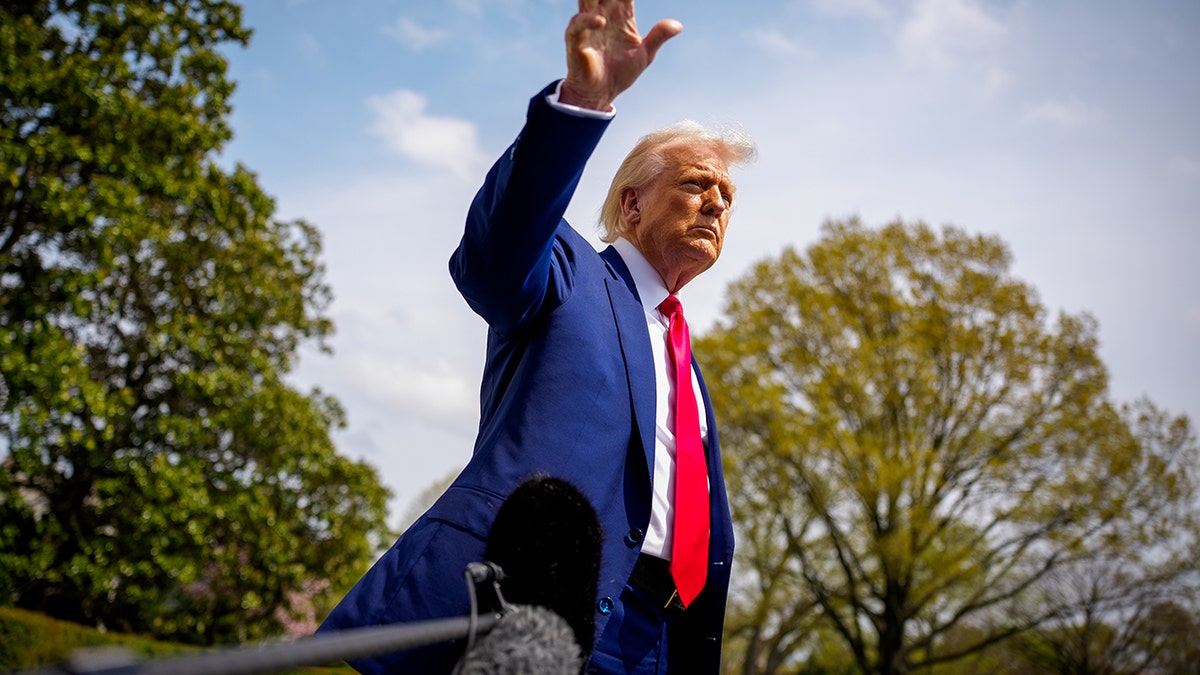
President Donald Trump speaks to reporters on the South Lawn of the White House April 3, 2025, in Washington, DC, shortly after announcing sweeping new tariffs. (Getty Images)
“Tomorrow’s trial in the Supreme Court of the United States is, literally, LIFE OR DEATH for our country,” Trump said in a social media post Tuesday evening, adding that without it, the United States would be “virtually defenseless against other countries that for years have taken advantage of us.”
Trump administration lawyers have argued in lower courts that IEEPA allows a president to act in response to “unusual and extraordinary threats” and in cases where a national emergency has been declared. Trump has claimed that deep and “enduring” trade deficits constitute a national emergency that allows him to invoke IEEPA.
The plaintiffs counter that in the 50 years since its passage, the law has never been used by a president to impose tariffs and that allowing the president to do so would significantly expand his powers to the detriment of other branches of government. They argued in lower courts that Trump’s use of IEEPA to address the trade deficit was illegal, pointing out that, by the administration’s own admission, the trade deficit had persisted for nearly 50 years, which they said undermined any claim of an “unusual and extraordinary” emergency.
US Court of International Trade sides with Trump in tariff case
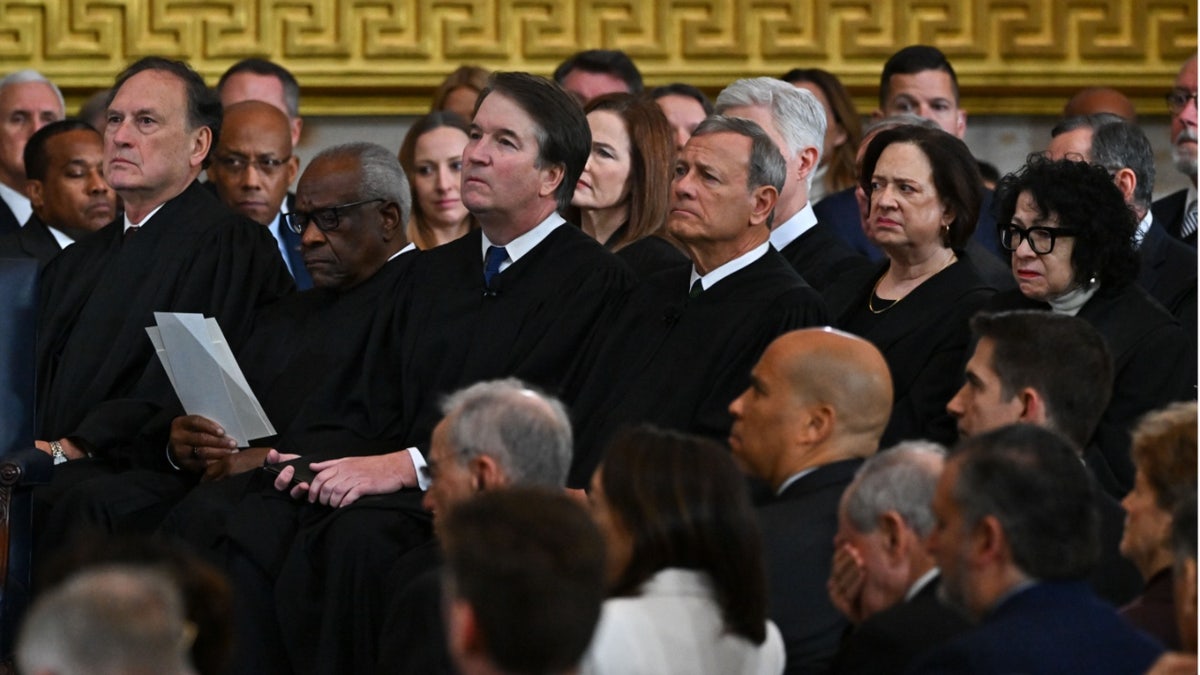
Supreme Court justices attend President Trump’s inauguration ceremony January 20, 2025, at the United States Capitol in Washington, DC. (Ricky Carioti/The Washington Post via Getty Images)
Lower courts have sided with plaintiffs from Democratic states and a small business coalition against Trump, with a three-judge panel of the Court of International Trade ruling this summer that Trump’s powers under IEEPA are not “unlimited.”
Appealing to the Supreme Court, the Justice Department argued that “denying tariff authority would expose our nation to trade retaliation without an effective defense.”
U.S. Solicitor General D. John Sauer said in a court filing that rolling back the tariffs would have “catastrophic consequences” for national security and global supply chains.
Experts say the impact of this case could go well beyond tariffs. A ruling in favor of Trump could set a broad precedent for future administrations, which could then invoke national emergencies as a pretext to act without congressional review on a wide range of issues.
Ultimately, “this is a separation of powers issue,” Jeffrey Schwab, senior attorney at the Liberty Justice Center and an attorney for the plaintiffs in one of the consolidated cases, told Fox News Digital in an interview.
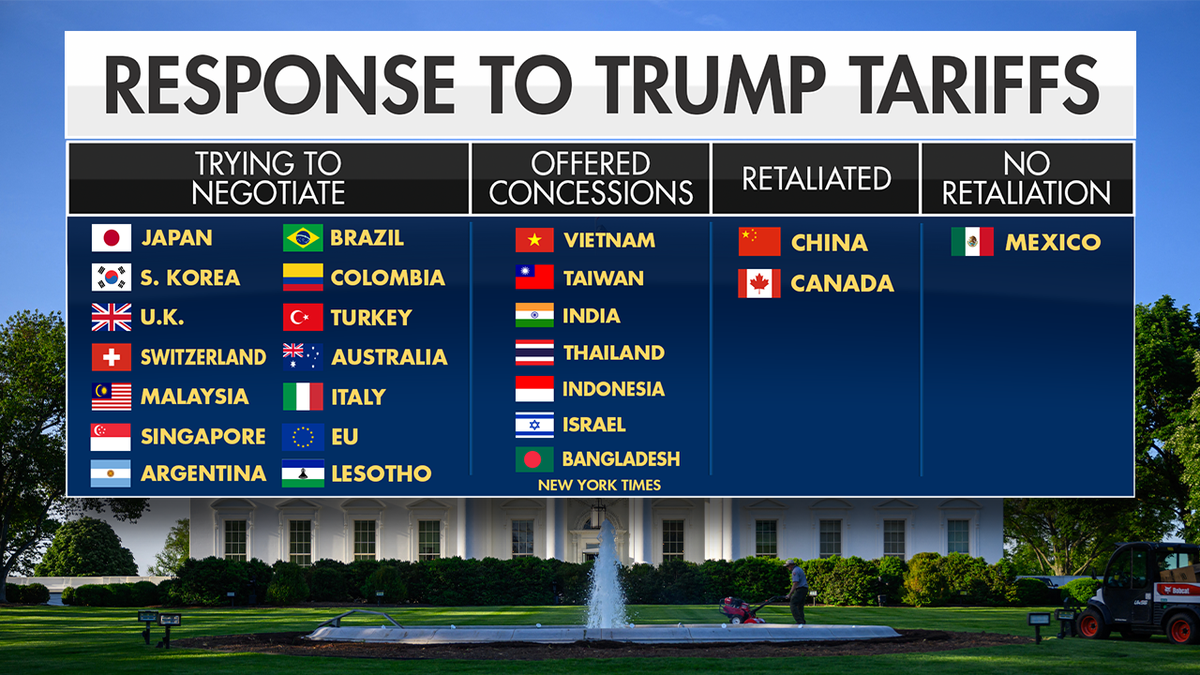
A graphic from Fox News that shows how countries reacted to President Donald Trump’s tariffs. (Fox News / MANDEL NGAN/AFP via Getty Images)
CLICK HERE TO GET THE FOX NEWS APP
“It’s not about this president,” he said on the eve of the oral arguments. “It’s about all presidents and the power they have under the Constitution, and the powers they don’t have under the Constitution, and whether Congress can delegate those powers — and, if so, how extensive can those powers be?”
“Everyone should be worried about this,” he said. “Because even if you like what the president is doing now, you may not like what a future president does with the same power.”


