How Close Are Today’s AI Models to AGI—And to Self-Improving into Superintelligence?


December 6, 2025
5 min reading
 Add us on GoogleAdd SciAm
Are we witnessing the first steps towards AI superintelligence?
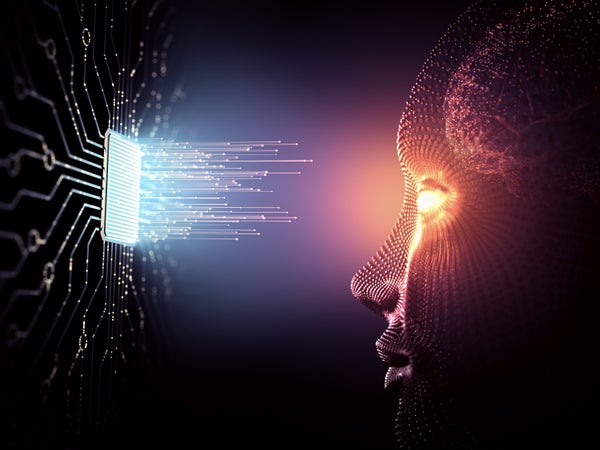
Today’s leading AI models can already write and refine their own software. The question is whether this self-enhancement can one day be transformed into true superintelligence.
KTSDESIGN/SCIENCE PHOTO LIBRARY
The Matrix, The terminator— much of our science fiction is built around the dangers of superintelligent artificial intelligence: a system that outperforms the best humans in almost every cognitive domain. Sam Altman, CEO of OpenAI, and Mark Zuckerberg, CEO of Meta, have predicted that we will achieve such AI in the coming years. Still, machines like the ones depicted as fighting humanity in these films would have to be far more advanced than ChatGPT, not to mention more capable of creating Excel spreadsheets than Microsoft Copilot. So how can we think that we are close to artificial superintelligence?
One answer dates back to 1965, when statistician Irving John Good introduced the idea of an “ultra-intelligent machine.” He wrote that once it became sufficiently sophisticated, a computer would improve rapidly. If that seems far-fetched, consider how AlphaGo Zero, an AI system developed at DeepMind in 2017 to play the ancient Chinese board game Go, was built. Using no data from human games, AlphaGo Zero played itself millions of times, achieving in a matter of days an improvement that would have taken a human a lifetime and allowing it to defeat previous versions of AlphaGo that had already beaten the best human players in the world. Good’s idea was that any system intelligent enough to rewrite itself would create iterations of itself, each smarter than the last and even more capable of improvement, triggering an “intelligence explosion.”
The question then is how close we are to this first system capable of autonomous self-improvement. Although the uncontrollable systems Good describes are not yet here, self-improving computers are, at least in narrow areas. The AI is already running code on itself. OpenAI’s Codex and Anthropic’s Claude Code can run independently for an hour or more writing new code or updating existing code. Using Codex recently, I typed a prompt into my phone while out for a walk, and it created a working website before I got home. In the hands of skilled coders, these systems can do much more, from reorganizing large code bases to sketching out entirely new ways of creating the software in the first place.
On supporting science journalism
If you enjoy this article, please consider supporting our award-winning journalism by subscription. By purchasing a subscription, you are helping to ensure the future of impactful stories about the discoveries and ideas shaping our world today.
So why hasn’t the model that powers ChatGPT quietly coded itself into ultraintelligence? The problem lies in the phrase above: “in the hands of qualified coders”. Despite the impressive improvements in AI, our current systems still rely on humans to set goals, design experiments, and decide what changes constitute real progress. They are not yet capable of evolving independently and robustly, which makes some talk of impending superintelligence seem disproportionate – unless, of course, current AI systems are closer than they seem to being able to improve in ever-broader slices of their capabilities.
One area in which they already seem superhuman is the amount of information they can absorb and manipulate. The most advanced models are trained on far more texts than any human being could read in a lifetime – from poetry to history to science. They can also follow much longer portions of text as they work. Already, with commercially available systems like ChatGPT and Gemini, I can download a stack of books and have the AI synthesize and critique them in a way that would take human weeks. This doesn’t mean the result is always correct or insightful, but it does mean that in principle a system like this could read its own documentation, logs, and code and propose changes at a speed and scale that no engineering team could match.
However, it is in reasoning that these systems lag, even if this is no longer true in certain targeted areas. DeepMind’s AlphaDev and related systems have already found new, more efficient algorithms for tasks like sorting, results that are now used in real-world code and go beyond simple statistical mimicry. Other models excel at higher-level formal math and science questions that resist simple pattern matching. We can debate the value of a particular benchmark – and that’s exactly what researchers do – but there is no doubt that some AI systems have become capable of discovering solutions that humans had not found before.
If systems already have these capabilities, then what is the missing piece? One answer is artificial general intelligence (AGI), the type of dynamic, flexible reasoning that allows humans to learn in one area and apply it to others. As I’ve written before, we continue to change our definitions of AGI as machines master new skills. But when it comes to the question of superintelligence, what matters is not the label we put on it; it’s about whether a system can use its skills to reliably redesign and upgrade itself.
And that brings us back to Good’s “intelligence explosion.” If we build systems with this type of flexible, human-like reasoning across many domains, what will distinguish them from superintelligence? Advanced models are already trained in more science and literature than any human being, have a much larger working memory, and demonstrate extraordinary reasoning abilities in limited domains. Once this missing element of flexible reasoning is in place, and once we enable such systems to deploy these skills on their own code, data and training processes, could the jump to fully superhuman performance be shorter than we imagine?
Not everyone agrees. Some researchers believe that we have not yet fundamentally understood intelligence and that designing this missing piece will take longer than expected. Others speak of achieving the AGI in a few years, leading to progress far beyond human capabilities. In 2024, Altman publicly suggested that superintelligence could arrive “in a few thousand days.”
If this sounds too much like science fiction, know that AI companies regularly run security tests on their systems to ensure they can’t slip into an uncontrolled self-improvement loop. METR, an independent AI safety group, rates models based on how long they can reliably support a complex task before failing. Last November, its testing of GPT-5.1-Codex-Max lasted approximately two hours and 42 minutes. This is a huge step forward from GPT-4’s few minutes of performance on the same metric, but it’s not the situation Good describes.
Anthropic is conducting similar tests on its AI systems. “To be clear, we are not yet at ‘self-improving AI,'” Jack Clark, the company’s co-founder and chief policy officer, wrote in October, “but we are at the stage of ‘AI that improves elements of the next AI, with increasing autonomy.'”
If AGI is achieved and we add human judgment to an immense information base, a vast working memory, and extraordinary speed, Good’s idea of rapid self-improvement begins to seem less like science fiction. The real question is whether we will stop at “merely human” or whether we risk going beyond the limits.
It’s time to defend science
If you enjoyed this article, I would like to ask for your support. Scientific American has been defending science and industry for 180 years, and we are currently experiencing perhaps the most critical moment in these two centuries of history.
I was a Scientific American subscriber since the age of 12, and it helped shape the way I see the world. SciAm always educates and delights me, and inspires a sense of respect for our vast and magnificent universe. I hope this is the case for you too.
If you subscribe to Scientific Americanyou help ensure our coverage centers on meaningful research and discoveries; that we have the resources to account for decisions that threaten laboratories across the United States; and that we support budding and working scientists at a time when the value of science itself too often goes unrecognized.
In exchange, you receive essential information, captivating podcasts, brilliant infographics, newsletters not to be missed, unmissable videos, stimulating games and the best writings and reports from the scientific world. You can even offer a subscription to someone.
There has never been a more important time for us to stand up and show why science matters. I hope you will support us in this mission.


