This Gloriously Weird Fish Has Teeth on Its Forehead for Sex


September 5, 2025
2 Min read
This gloriously bizarre fish has teeth on her forehead for sex
The researchers have finally traced the origin of the bizarre forehead teeth of the spotted tired, which are used for mating
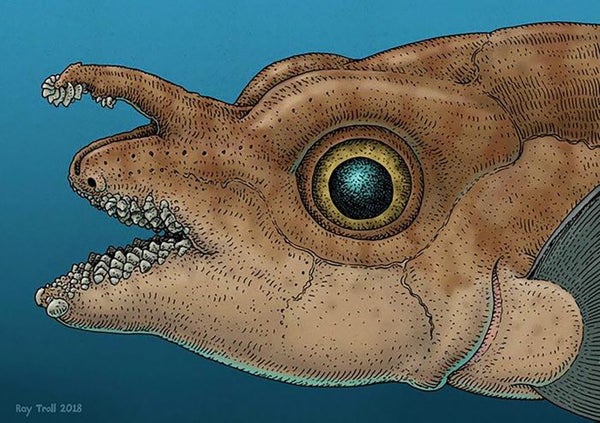
The researchers identified teeth on the tenaculum of ancient parents with modern adults stated with ratfish. This fossil file helped them to establish the historical meaning of this structure, updated by local artist Ray Troll.
The spotted ratfish is a fish two feet long with a large head and a long lean tail that lives in the Pacific Ocean of the Northeast. It belongs to a group of fish called chimaeras closely linked to sharks. (Chimaeras are sometimes called ghost sharks.) Like most vertebrate creatures, he has teeth in his mouth. Unlike other vertebrates, he also has teeth in another place: his forehead. He uses these teeth head -on for sex.
The researchers wondered for a long time from which the teeth of the ratfish front come from. New research, published on September 4 in the Proceedings of the National Academy of Sciences USA, has traced their origin.
RATFISH’s additional teeth border a cartilaginous appendage called a teliculum which, in men, can be erected and deployed to grab a female during coupling. Many fish have tight appendages near the pool they use to hold their companion near the act. The spotted ratfish has the ténaculum in addition to the pelvic clasps.
On the support of scientific journalism
If you appreciate this article, plan to support our award -winning journalism by subscription. By buying a subscription, you help to ensure the future of striking stories about discoveries and ideas that shape our world today.
Scientists know the Tenaculum of RATFISH training for a while. But they did not know exactly how the teeth are from or how they found themselves in this strange place outside the mouth. Many relatives close to the RATFISH – sharks, rays and skates – have dental structures in their skin called denticles which are made of the same material as teeth but which are not real teeth. Are the teeth of the ratfish forehead just modified skin denticles, or do they share their structure and their origin with teeth in the mouth?
To discover it, Karly Cohen of the University of Washington and his colleagues have drawn up the development of the tenaculum of RATFISH using micro-CT scanners and fabric samples, and they compared modern fish with fossil ancestors. The researchers have determined that the teeth of the ratfish front are real teeth – they develop from a structure called dental blade which is present in the jaw but not in skin denticles. The dental blade has never been found outside the mouth so far.
“This crazy and absolutely spectacular characteristic returns the long -standing hypothesis of evolutionary biology that teeth are strictly oral structures,” Cohen said in a press release. Who knows where they will present themselves?
It’s time to defend science
If you enjoyed this article, I would like to ask for your support. American scientist has been a defender of science and industry for 180 years, and at the moment can be the most critical moment of this two -centuries story.
I was a American scientist The subscriber since the age of 12, and that helped shape my way of looking at the world. Sciam Educates me and always delights me, and inspires a feeling of fear for our vast and magnificent universe. I hope that does this for you too.
If you subscribe to American scientistYou help make sure that our cover is focused on significant research and discoveries; that we have the resources necessary to report the decisions that threaten laboratories in the United States; And that we support the budding scientists who work at a time when the value of science itself does not become often again.
In return, you get essential news, Captivating podcasts, brilliant infographics, Maybe not miss newsletters, videos to watch, Difficult games and the best writings and reports in the scientific world. You can even Give someone a subscription.
There has never been more time for us to get up and show why science counts. I hope you will support us in this mission.


