Emus once faced down the Australian army—and won


In November 1932, the scorching southern sun beat down on an empty paddock in Western Australia. The ground is red and strewn with rocks. Three soldiers emerge from the mist: an officer and two artillerymen, their backs straight, their uniforms impeccable. Then their leader raises his hand and orders his charges to be stopped. He saw the cloud of dust on the horizon; a cloud that can only mean one thing.
The officer barks orders. The gunners salute then dug in as best they can, readying their machine guns against the coming assault. These three brave men came to fight for the future of Australian agriculture, to face an enemy the Australian Army has never faced before. Test your courage, dear reader, for they have come to fight…the emu.
The Legacy of a Real War: World War I
Yes, it’s true. As an Australian, I can confirm that my country once waged war against an army of large, somewhat comical, flightless birds. And here is our secret shame: we lost.
The story seems absurd, because it East absurd. But it begins with the bitter legacy of a real war: the First World War, in which almost half a million Australian soldiers, or 38.7 per cent of the male population aged 18 to 44, fought. After the armistice, the return of thousands of wounded and traumatized veterans presented the Australian government with an uncomfortable question: what to do with them?
The response was a “soldier settlement” program, under which veterans were given plots of land – most located in areas where the soil was marginal at best – and encouraged to make a living as farmers, a profession of which relatively few had experience or knowledge. Many of these soldiers ended up in Western Australia, where they grew wheat, a crop which by the mid-1920s was “worth about its weight in gold”.
Unfortunately, things did not stay that way. In the late 1920s, the effects of the Great Depression, combined with an oversupply of wheat, caused prices to plummet. To make matters worse, the Australian federal government promised to subsidize soldiers’ crops – then reneged on that promise when it failed to pass the required bill through Parliament.
The arrival of the emu hordes
Into the midst of this already worrying situation, an unexpected force of feathered enemies marched: the emus. Thousands of them.
In Western Australia, emus migratory patterns take them between the state’s relatively fertile coastal regions and its dry, arid interior. Following this route in the late 1920s and early 1930s, they realized that suddenly there was a lot of farmland in their path.
This didn’t worry the birds much – in fact, it was quite a positive development, signifying an adequate supply of food and water. The emus happily used both, breaking down fences and stirring up crops as they passed.
But for the farmers, it was like the final insult. They were broke and hungry, the promised subsidies had not arrived and now a flock of huge flightless birds were destroying what little remained of their crops. They demanded that the federal government act. The government responded by sending in the army.
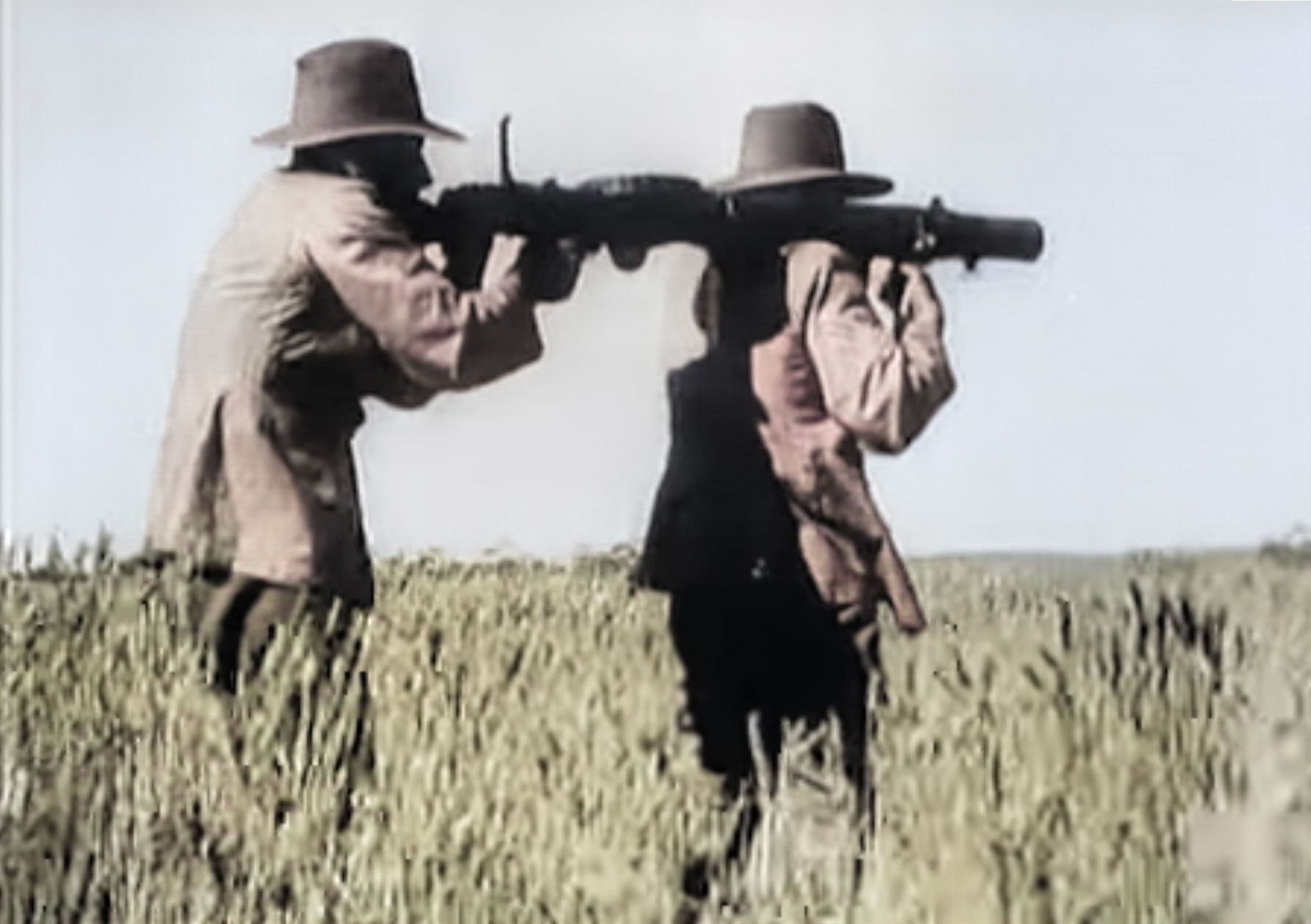
Not the whole army, mind you. No, the force sent to Western Australia to combat a horde of recalcitrant birds consisted of exactly three soldiers, along with two Lewis machine guns and 10,000 rounds of .303 caliber ammunition.
Related Stories “In That Time When”
The First Emu War
And so, we return to 1932 and our three protagonists, preparing for their first encounter with the massive power of the emu swarm.
This didn’t go well.
If you’ve never seen an emu, your first impression will probably be that it looks somewhat ridiculous. But here’s the thing: They’re a lot less fun up close than they are from afar.
Emus are the second largest bird species in the world, after the ostrich, to which they are related. Adults can be over six feet tall and weigh well over 100 pounds. They can’t fly, but they can run and run fast: Their top speed is around 30 mph.
Their powerful paws end in serious claws, which they can use – and do use – to kick anything they find threatening. Although they are not as aggressive as ostriches or as vicious as cassowaries (a flightless bird that roams the rainforests of New Guinea), they are nevertheless fully capable of inflicting serious damage on an adult human.
With all this in mind, perhaps it’s not surprising that three men failed to make much of an impression on a herd of thousands of hungry emus. Their equipment didn’t help their cause either. A gun jammed during an early skirmish, and an attempt to mount it on a Jeep was compromised by roads so terrible that firing the machine in a straight line proved impossible.
The Second Emu War
After a week of frustration, the three-man army retreated hastily. Upon their return east, the commander – a man with the spectacular name of Major Gwynydd Purves Wynne-Aubrey Meredith – spoke in incredibly racist terms about the enemies he and his men had faced. “[Emus] “They can take on machine guns with the invulnerability of tanks,” he said. “They are like the Zulus that even dum-dum bullets couldn’t stop.”
Still, like any good soldier, Meredith wasn’t going to be discouraged by a bunch of invulnerable avian tanks. A week later, he and his men returned to the fray.
After a month of fierce fighting, he said they had killed 986 birds, with another 2,500 at risk of dying from their wounds. The first figure raised eyebrows because the trio used 9,860 rounds, for exactly 10 rounds per casualty, and the second was mostly speculation. In an article published in 2006 in the Journal of Australian Studieshistorian Murray Johnson scorned Meredith’s report:
“There could be no accurate way of knowing how many birds had been injured.” But whatever the exact level of losses, they seemed to make no difference to the emus. In his article, Johnson argued that this fiasco actually made the situation worse: “It is highly probable that the machine gunners actually exacerbated the crop losses, for each time the guns managed to open fire, the birds scattered widely, trampling the ripening wheat as they desperately sought shelter.” »
The aftermath of the battle
Even back then, the war on the emu attracted ridicule. There was strong suspicion that the deployment of Meredith and his two valiant soldiers was more of a low-cost publicity stunt than a serious attempt to cull the emu population.
The decision to send a filmmaker alongside the soldiers did nothing to ease this situation, and the resulting footage certainly has the air of more of a farce than a “serious attempt to save the livelihoods of poor farmers.” (The fact that the music that accompanies it sounds surprisingly Monty Python the theme doesn’t help matters.)

Western Australia wages war on emus
Even in 1932, many thought the Australian military’s war against the giant birds was ridiculous. Video: Western Australia wages war on emus / British Movietone
Today the affair seems like a slightly embarrassing historical footnote, but its legacy lives on in the solution the Western Australian government ultimately found to its emu problem. After decades of failed felling attempts and bounty payments, the state finally shelled out £52,000 (between $1.4 million and $1.95 million in today’s U.S. dollars, depending on which calculation you use) to build 130 miles of fencing around the state’s wheat-growing areas.
The fence has been extended several times since and today stretches nearly 850 miles, spanning much of the state. It has proven effective in restricting the movements of emus, but has also caused incalculable damage to the habitats and migration patterns of other native species. In a country that is finally moving towards a less confrontational approach to its territory, the fence is increasingly controversial; a remnant of a time when Australia preferred to go to war with its wildlife rather than try to live alongside it.
In This time whenPopular Science tells the strangest, surprising, and little-known stories that have shaped science, engineering, and innovation.

The best new PopSci 2025 releases


