Rod Paige, former education secretary and architect of No Child Left Behind policy, dies at 92


Rod Paige, an educator, coach and administrator who implemented the nation’s No Child Left Behind Act as the first African American to serve as U.S. Secretary of Education, died Tuesday.
Former President George W. Bush, who nominated Paige to the nation’s top federal education post, announced the death in a statement but did not provide further details. Paige was 92 years old.
Under Paige’s leadership, the Department of Education implemented the No Child Left Behind policy, which in 2002 became Bush’s signature education law and drew inspiration from Paige’s earlier work as superintendent of schools in Houston. The law established universal testing standards and punished schools that did not meet certain criteria.
“Rod was a leader and a friend,” Bush said in his statement. “Dissatisfied with the status quo, he challenged what we called ‘the soft bigotry of low expectations.’ Rod worked hard to ensure that where a child was born did not determine their success in school and beyond.”
Terry Ashe / AP 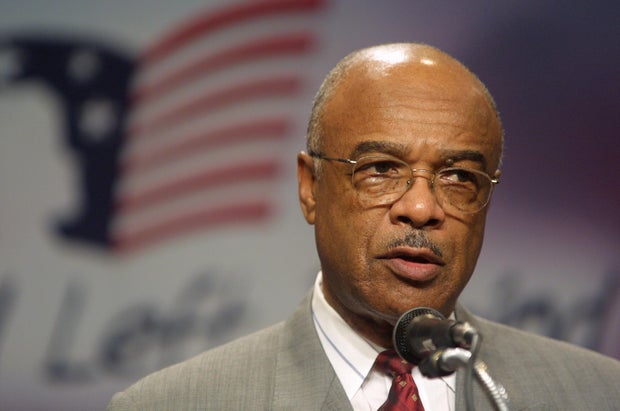
Roderick R. Paige was born to two teachers in the small town of Monticello, Mississippi, population about 1,400. The eldest of five siblings, Paige served two years in the United States Navy before coaching high school and then college football. Within a few years, Paige became the head coach at Jackson State University, her alma mater and a historically black university in Mississippi’s capital.
There, his team became the first — with a 1967 football game — to integrate Mississippi Veterans Memorial Stadium, once an all-white venue.
After moving to Houston in the mid-1970s to become head coach at Texas Southern University, Paige moved from the playing field to the classroom and education – first as a teacher, then as an administrator and ultimately dean of her college of education from 1984 to 1994.
Amid growing public recognition for his pursuit of educational excellence, Paige became superintendent of the Houston Independent School District, then one of the largest school districts in the country.
He quickly attracted the attention of Texas’ most powerful politicians for his sweeping educational reforms in the diverse Texas city. Most notably, he moved to implement stricter measures for student achievement, which became a focal point of Bush’s bid for president in the 2000s. Bush – who would later call himself the “Education President” – frequently praised Paige on the campaign trail for Houston’s reforms which he called the “Texas miracle”.
And once Bush won the election, he appointed Paige as the nation’s top education official.
As Secretary of Education from 2001 to 2005, Paige emphasized her belief that high expectations were essential to childhood development.
“The easiest thing to do is give them a nice little menial task and congratulate them,” he told the Washington Post at the time. “And that’s precisely what we don’t need. We also need to set high expectations for these people. In fact, that might be our greatest gift: expecting them to succeed, and then supporting them in their efforts to do so.”
While some educators have applauded the law for standardizing expectations regardless of students’ race or income, others have complained for years about what they see as a maze of redundant and unnecessary testing and too much “teaching to the tests” by educators.
In 2015, lawmakers in the House and Senate agreed to remove many provisions of No Child Left Behind, reducing the Department of Education’s role in setting testing standards and preventing the federal agency from sanctioning schools that fail to improve. That year, President Barack Obama signed a sweeping overhaul of education law, paving the way for a new approach to accountability, evaluating teachers and pressuring low-performing schools to improve.
After serving as Secretary of Education, Paige returned to Jackson State University half a century after being a student there, serving as interim president in 2016 at the age of 83.
Even at age 90, Paige still publicly expressed deep concern and optimism about the future of education in the United States. In an opinion piece in the Houston Chronicle in 2024, Paige elevated the city that helped propel him to national prominence, urging readers to “look to Houston not only for inspiration, but also for hard-earned lessons about what works, what doesn’t, and what it takes to shake up a stagnant system.”