Enigmatic Fossils Fill Missing Chapters in Story of Earth’s First Fishes


In two separate studies, paleontologists from Australia and China examined the fossilized remains of enigmatic Devonian lungfish with cutting-edge imaging, revealing overlooked anatomical details and deepening our understanding of early vertebrate evolution. Their results appear in the Canadian Journal of Zoology and the magazine Current biology.
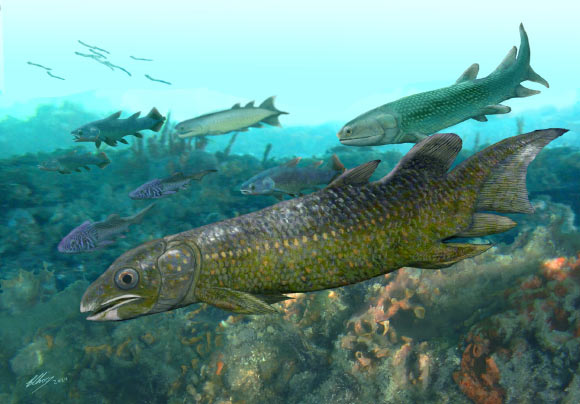
Paleolophus yunnanensisa species of lungfish that swam in the seas of southern China 410 million years ago. Image credit: Brian Choo, Flinders University.
In the first study, Alice Clement, a paleontologist at Flinders University, and her colleagues focused on The Cainocara enigmaan enigmatic fossil known from a single specimen from the Upper Devonian Gogo Formation of Western Australia.
“The new research is slowly adding to the story of the rich diversity of lungfish at the key Australian fossil site, including the re-examination of poorly preserved specimens,” Dr Clement said.
“One of these damaged specimens has provided valuable new clues. It comes from Australia’s first ‘Great Barrier Reef’, the Devonian reef located in the Kimberley region of northern Western Australia.”
“This unusual specimen was so enigmatic that the authors who first described it in 2010 considered that it might be an entirely new type of fish never before seen in science.”
“Thanks to high-tech scanning, this time we were able to create new complete digital images of the external and internal skull, showcasing the complexity of the brain cavity of this fascinating lungfish.”
“In fact, we were also able to confirm that previous prints were likely viewed upside down and upside down.”
“We were able to compare its most preserved inner ear area with other Gogo lungfish,” said Hannah Thiele, a paleontologist at Flinders University.
“This is yet another data point in the amazing collection of lungfish and early vertebrate species.”
“This contributes to a broader understanding of the evolution of these early lobe-finned fishes, both in Gondwana and globally.”
In the second study, Flinders University paleontologist Brian Choo and colleagues described a new species of lungfish from the Devonian of China: Paleolophus yunnanensis.
“Paleolophus yunnanensis gives us an unprecedented insight into a lungfish, between its first appearance and its great diversification a few million years later,” said Dr Choo.
“This was a time when the group was just beginning to develop the distinctive dietary adaptations that would serve them through the rest of the Devonian and into the present day.”
“Lungfish are an incredibly ancient lineage, including the still-living Australian lungfish of Queensland, which have long fascinated researchers because of their close relationship to tetrapods, or backbone animals with limbs, including humans.”
“The exceptional lungfish skull discovered in 410 million-year-old rocks in Yunnan gives us a major insight into the rapid evolutionary diversification between the Lower, Middle and Upper Devonian.”
“The new specimen showed similar and divergent characteristics compared to the oldest and most primitive specimen. Diabolepis fossil in southern China and species such as Uranolophus from Wyoming to the United States and other forms like Australia Dipnorhynchus.”
_____
Hannah S. Thiele and others. Decryption The Cainocara enigma from the Gogo Formation of the Upper Devonian, Australia. Canadian Journal of Zoologypublished online January 28, 2026; doi:10.1139/cjz-2025-0109
Tuo Qiao and others. 2026. A new fossil fish sheds light on the rapid evolution of the first lungfish. Current biology 36 (1): 243-251; doi: 10.1016/j.cub.2025.11.032