I struggled with Android Auto for months, and the fix was something nobody ever talks about


Android Auto can be a finicky system. It might work fine during your morning commute, then inexplicably force shutdown the next day. When technology works well, it’s great. But in the event of a breakdown, it can be a source of distraction on the road. This was my problem, until I realized that there is a simple solution that I found through troubleshooting that more people should talk about.
There are several reasons why this happens, but one stands out
Sometimes we forget that a car is not just a set of gears

Every time my Android Auto disconnected, I usually wasted time unplugging and reconnecting my USB cables or restarting my phone. I’ve also sometimes turned my car’s ignition on at a red light, hoping that a hard restart would restore my maps, just to see nothing change. My main problem was that I didn’t understand the real problem.
Unlike a basic Bluetooth setup that only streams audio, Android Auto requires a complex, high-bandwidth communications chain. Data is constantly moving, checking the device and managing power constantly. If one link in this fragile chain breaks down, the entire system begins to fail.
There are of course external problems that could be the cause. There’s a lot you can do with wired setups, but the mystery may come down to signal strength. While drivers instinctively blame their phone’s software or the car’s screen, connection failure can be caused by microscopic wear and tear inside the USB cable itself. Even though a cable can charge your device, Android Auto needs sustained, high-speed data rates of up to 480 Mbps that cheap or internally damaged cables can’t handle consistently.
If you’re using a wireless connection, the problem might be something else. These connections do not require physical cable, but they add many other invisible radio frequency problems. Wireless Android Auto requires a perfectly timed dual radio link and uses Bluetooth for the initial handshake and 5GHz Wi-Fi, which moves a lot of data. This setup makes your dashboard very open to environmental interference, like your phone retaining your home’s Wi-Fi signal when you back out of your driveway, or signal congestion from nearby dashcams and passing vehicles.
If you’re using a good cable and everything else is working fine, you may have forgotten that your car contains a lot of computer components. Sometimes computers can become outdated, leading to more problems than you think if you focus more on connecting.
All you have to do is let it update
Having a pending update can cause issues
When you get constant stuttering, black screens, or sudden connection drops, it’s not uncommon to instinctively blame your smartphone or change your cables. However, a computer is integrated directly into your dashboard.
It’s easy to forget that Android Auto is primarily a projection tool. The stability of this projection is primarily controlled by the car’s infotainment firmware. From time to time, Google makes important changes to Android Auto’s communication protocols. This means that if your car is not updated, it may take too long for the safety handles to respond. This leads your phone to cut off the connection for security reasons.
Older firmware can also cause annoying display scaling issues. Improper display power interface setting makes navigation cues too large and wastes screen space. Fortunately, the solution is usually as simple as letting your car update its software.
For newer cars, this fix is done via Over-The-Air (OTA) updates. To start an OTA update, you usually just need to connect your car to a secure home Wi-Fi network or use its built-in cellular data connection. You can access the system settings through your infotainment screen and choose “Software Update”.
If your car doesn’t have consistent cellular connections or an OTA deployment fails, you’ll need to manually flash the firmware using a USB drive. Just get a USB drive formatted specifically as FAT32. An 8 GB should be enough, as older head units can’t read modern file systems. Go to your manufacturer’s official owner portal, such as Ford Support or Toyota Update Site, and enter your 17-digit vehicle identification number (VIN) to download the exact firmware files created for your make and model.
After placing these files directly into the main directory of your USB drive, plug it into your car’s data port that you would use for Android Auto. Be sure to avoid any ports with a lightning bolt symbol, which are only for charging. Once the car recognizes the drive, the screen will ask you to start the installation.
Whichever you choose, the process can take between fifteen and forty minutes. During this manual flash, it is very important to keep the engine idling in a well-ventilated area. This way the system does not lose power or block the unit.
There might be other issues that you are not aware of.
Sometimes the problem can be resolved with a little time and care

While updates might be the hidden issue causing your problems, everyday problems can arise if you’re not careful. The USB cable you use isn’t just a power cord; this is a high-speed line prone to signal problems and electromagnetic interference in the noisy environment of a car. Using a short, good quality cable is a great way to avoid disconnections that occur with poorly protected cables.
You should look for a USB-IF certified cable that has a twisted pair design. This naturally helps cancel out outside electromagnetic noise and stop data packet loss. Additionally, length is very important for signal quality. Cables longer than three to six feet can significantly weaken the signal, degrading the digital data bits needed for screen mirroring.
If you dedicate a short, certified data transfer cable just for your car, you are one step closer to solving your problems. Be sure to clean the USB ports on your phone and the main unit with compressed air or a wooden toothpick to remove dust and lint; you will get rid of a lot of interference.
If you are using a wireless connection, you will encounter other problems. Since this process happens entirely in the background, your phone needs permission to manage these radios. If your wireless connection often drops or won’t start, check that all necessary permissions, such as Location, Contacts, Microphone, Phone, SMS, and Notifications, are allowed.
Besides permissions, aggressive battery optimization settings can get in the way. You need to go to your phone’s app settings and change Android Auto’s battery usage to “Unrestricted” or “Don’t optimize” to prevent the phone from cutting the connection and save power.
If you’ve done all of this, but you’re still having issues, you simply need to clear the Android Auto app cache. Corrupted temporary files can really mess up your connection. Just go to your storage settings, clear the cache, and you’ll notice how much faster your phone is overall.
Always update your computers
It’s easy to forget that cars have changed every day to become more like computers. While there’s some debate about how much work you can now do on your car, it makes a lot of things more convenient. Unfortunately, this means that expected fixes and maintenance rarely include things like checking your firmware. This is something I do at least twice a year, just to be safe. It doesn’t take long and you can find it in your settings. This way, you won’t have to wonder if it’s a physical or software problem.
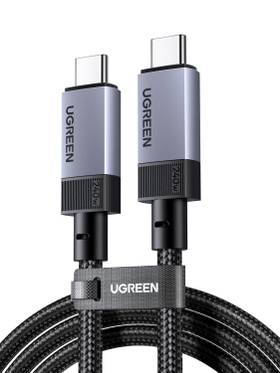
- Brand
-
UGREEN
- Cable type
-
USB-C
- Length
-
3.3 feet
- Data transfer rate
-
10 Gbps


