Chinese scientists create multicolored glow-in-the-dark succulents that recharge in sunlight


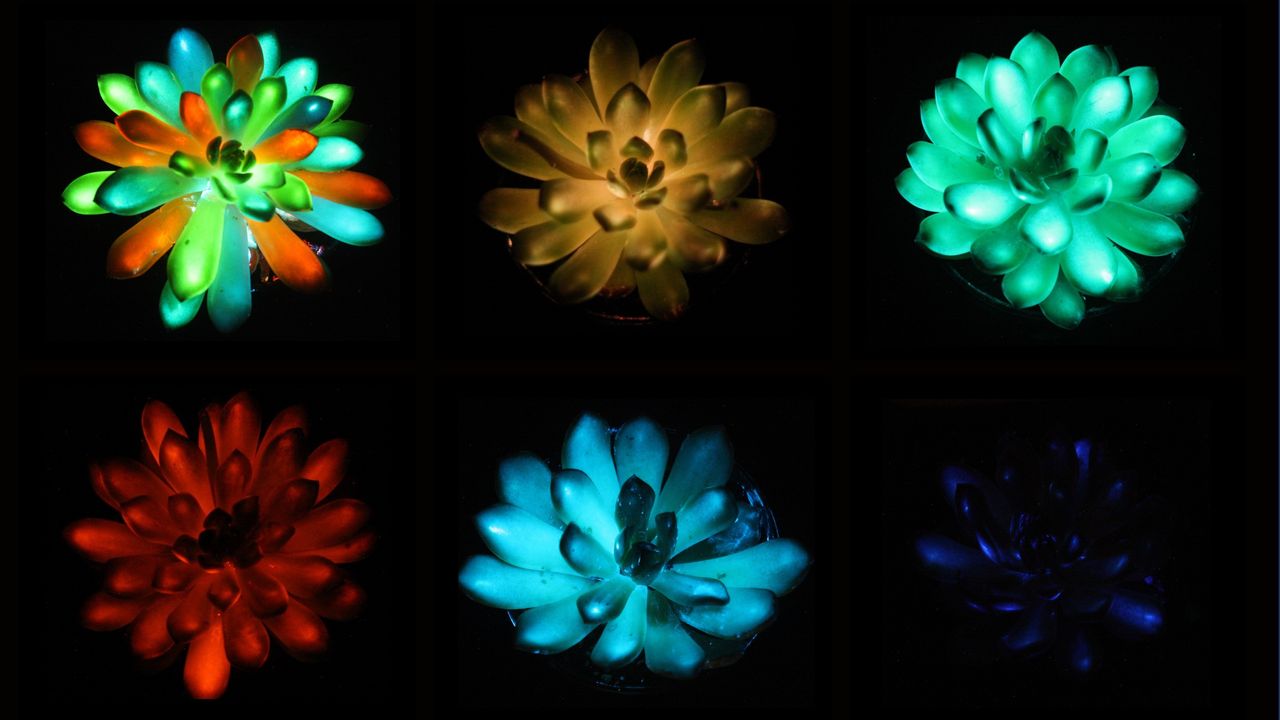
Chinese scientists have created succulent rainbow plants, shiny in the dark by injecting colorful “persistence” particles in the leaves that absorb, then gradually free themselves, light.
Succulent luminescent plants shone up to two hours, surpassing similar and designed plants, according to a new study. The invention opens the way to lasting and plant -based lighting to shed light on outdoor and interior spaces, the researchers said.
“Imagine brilliant trees that replace the lamps”, the main author of the study Close liuA researcher at the South China Agricultural University, said in a statement. “The particles were released in a few seconds, and the whole succulent leaf shone.”
The researchers have already made luxurious plants in the dark, both in genetic engineering and in materials engineering. Genetic engineering approaches exploit biolumine genes that already exist in certain plantsLike phytoplankton – but these genes have a range of limited colors, mainly green, depending on the study. Material engineering techniques involve the injection of particles raising light in vegetable leaves to make them shine, but these methods have so far only generated a light light.
For a strong luminescence, the electroluminescent particles must be small enough to diffuse through the tissues of a plant, but also large enough to emit a visible glow. Previous experiences Using nanoparticles derived from the Luciole Luciole, the enzyme that Creates a bioluminescence in firefliesproduced only a slight glow which fell strongly after 30 minutes.
For the new study, Liu and his colleagues used emitting phosphorus particles which were roughly the width of a human red blood cell (6 to 8 micrometers). The particles the size of a micron were large enough to produce a strong glow while traveling freely through the plants, said Liu. “The smaller and nano-tail particles move easily in the plant but are darker,” she said.
In relation: Scientists invent the photosynthetic “living” material sucking the atmosphere of the atmosphere
The researchers published their results Wednesday August 27 in the journal Matter.
Micron size particles have worked for succulent plants but not for other plants tested in the study, including Bok Choy (Brassica Rapa Chinensis) and the golden pothos (Epipremnum aureum). Researchers used Fare The “Mebina” succulent plants, which have blue-green leaves with red spikes. Unlike Bok Choy and Golden Pothos, these succulent plants have relatively important gaps between their cells, which means that micron size particles can travel through the plant, depending on the study.
Researchers injected phosphorus particles into the leaves of Fare “Mebina” and loaded the plants in the sun or in the inner LED light for a few minutes, obtaining the same effect of remanence in the two experiments. The green particles produced the longest glow, the plants emitting light up to 2 hours and competing with a small night lamp to their brightest, according to the study.
The team produced the first multicolored luminescent plants in the world by injecting blue, green, red and blue-purple phosphorus in the leaves of certain succulent plants. Scientists also built a succulent 56 plant wall that produced enough light to see nearby objects and read text in the dark, according to the declaration.
“I just find an incredible that a micro-scale material for human manufacture can meet so transparent with the natural structure of a plant,” said Liu. “The way they integrate is almost magical.”
Succulent luminescent could one day be a low carbon lighting solution, depending on the study. Researchers hope to produce the same effect in other plants, which could be exposed to the sun and loaded like batteries to provide decorative and practical lighting.
“The process is simple and profitable and performs luminescence in 10 min, opening the way for practical applications in plant lighting,” wrote researchers in the study.


