Ethiopian volcano erupts after 12,000 years: What we know

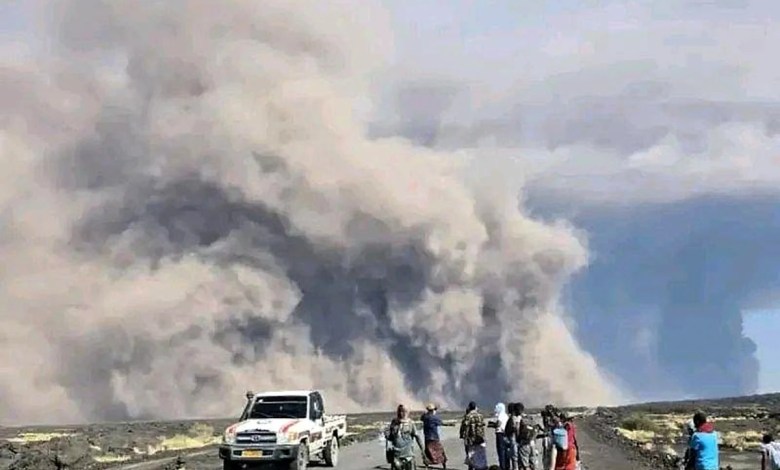
A long-dormant volcano in northern Ethiopia unexpectedly erupted on Sunday, sending up plumes of volcanic ash and dust, which have since spread across continents and disrupted flights in India and the United Arab Emirates.
No casualties have been reported in Ethiopia following the eruption, but local government officials told reporters they were concerned about the impact of the eruption on local communities and their livestock in the Afar region, where the volcano is located.
Ethiopia has 50 known volcanoes, according to the Smithsonian, several of which have been dormant for thousands of years.
The Ethiopian Rift Valley, home to many volcanoes, extends from Afar southward through neighboring countries. It was formed by the movement of tectonic plates, which separated to form the continental masses of Africa and Arabia, and is one of the most important geological sites in the world.
Here’s what we know about Sunday’s volcanic eruption and its local and international impact:

In this photo released by the Afar Government Communications Office, ash escapes from an eruption of the long-dormant Hayli Gubbi volcano in Ethiopia’s Afar region, Sunday, November 23, 2025. [Afar Government Communication Bureau via AP]
What happened?
Hayli Gubbi, part of the Erta Ale volcanic range in Ethiopia’s northern Afar region, erupted around 11:30 a.m. local time (08:30 GMT), according to an advisory issued by the Toulouse Volcanic Ash Advisory Center (VAAC) in France.
After the eruption, residents told reporters that they noticed light smoke coming from the volcano about three days before. However, no scientific predictions have been published regarding the eruption.
The volcano never erupted during the current Holocene, which began about 12,000 years ago at the end of the Ice Age, according to the Smithsonian Institution’s Global Volcanism Program.
Satellite images shared on social media show the eruption seen from space, with a mass of ash visibly rising and spreading eastward toward the Red Sea. Images captured from the ground also showed huge mountains of ash rising into the sky above the mountain range, covering the horizon.
The VAAC reported that the massive waves of emitted volcanic ash plumes reached approximately 45,000 meters (148,000 ft) in height at the time of the eruption and that the ash was moving primarily northwestward.
How have local communities been affected?
Local Ethiopian media reported that plumes of ash covered areas around the volcano, including hilly villages that are well-known tourist attraction sites. In the nearby village of Afdera, a resident told The Associated Press that he heard a loud noise at the time of the eruption.
“It was like a sudden bomb was thrown with smoke and ashes,” Ahmed Abdela told the AP. He added that on Monday the village was still covered in ash and tourists and guides heading to the nearby Danakil Desert were stranded.
Afar TV reported that moderate vibrations and shaking were felt in Ethiopia’s Wollo region, northern Tigray region, and as far away as the neighboring country of Djibouti.
Immediately after the eruption, dark smoke, rather than white ash, enveloped the area, plunging it into near darkness, residents said.
Concerns remain over how the eruption has affected air quality in nearby villages.
Local administrator Mohammed Seid also told the AP that the eruption could have economic implications for the local community, where most are pastoralists and rely on fodder (plants eaten by animals) for their livestock. Much of this area is now covered in a thick layer of dust. “Although no human lives or livestock have been lost so far, many villages have been covered in ashes and as a result their animals have little to eat,” he said.
What do we know about the Hayli Gubbi volcano?
Hayli Gubbi, a shield volcano – named so because it has a low profile and resembles a shield from above – is located about 800 km (500 miles) northeast of Addis Ababa, the Ethiopian capital.
Hayli Gubbi, which rises to 500 meters (1,640 feet), is the southernmost volcano in the Erta Ale Range, a chain of low-lying shield volcanoes in the Afar region. There have been no known eruptions for 12,000 years.
The Erte Ale volcano, one of the most active in Ethiopia, is also located in this range, itself located in the Rift Valley. Erte Ale, whose name means “smoking mountain” in Afar, last overflowed with lava in January 2023, according to the Smithsonian Institution’s Global Volcanism Program.
Where did the ashes travel and how were flights affected?
Clouds of ash crossed the Red Sea, first into Yemen and Oman, then into Pakistan and India, according to the monitoring site Flightradar24.
Volcanic ash clouds contain abrasive particles that can penetrate and damage aircraft engines, contaminate airfields and reduce visibility, making flying dangerous.
The eruption has therefore caused significant travel disruptions in neighboring countries and continents, although so far no flight delays have been reported in Ethiopia, which is one of Africa’s largest air hubs.
India
In India, ash reached the western region of Rajasthan on Monday evening, then moved northeast, according to local newspaper The Hindu.
The ashes prompted several airlines, including national carriers Air India, IndiGo and Akasa, as well as Dutch carrier KLM, to cancel flights as a precaution. Air India canceled 11 flights on Monday and Tuesday while Akasa scrapped flights scheduled for the same day to Jeddah, Kuwait and Abu Dhabi, according to Reuters news agency.
The country’s Directorate General of Civil Aviation (DGCA) on Monday issued advisories urging airlines to avoid affected altitudes and regions, and warning that volcanic ash could damage aircraft engines, according to The Hindu.
The agency also advised airlines to carry out precautionary checks on planes that have previously flown over affected routes and to report any suspected ash impacts on engine performance, or any smoke or odors in the cabin. Airports have also been ordered to inspect runways for contamination.
The plumes were reported to have spread across the states of Rajasthan, Maharashtra, Delhi, Haryana and Punjab. India is expected to have clear skies on Tuesday at 1400 GMT as the ash cloud moves towards China, according to the India Meteorological Department (IMD).
Pakistan
In Pakistan, the country’s meteorological department reported that the ash cloud was seen 60 nautical miles (111 km) south of the port city of Gwadar on Monday, according to local newspaper Dawn.
Gulf
Air Arabia canceled several flights from Sharjah, United Arab Emirates, on Tuesday.
In Oman, the Environment Authority activated its emergency response to monitor ash clouds, but reported no immediate impact on air quality, according to the Times of Oman.
When did volcanic eruptions cause travel chaos in the past?
Severe volcanic eruptions causing widespread disruption like this are rare.
The last reported incident was in 2010, when the Eyjafjallajokull volcano in Iceland erupted continuously between March and June, sending plumes of volcanic ash across large swaths of Scandinavia, the United Kingdom and other European countries. The eruption ejected ash up to 11 km (seven miles) into the atmosphere. These ashes contained small, sharp particles of glacial debris, as the eruption occurred beneath glacial ice.
In April that year, the UK was forced to close its entire airspace for six days, during which time some 95,000 flights were cancelled. According to the Center for Economics and Business Research, the UK airline industry lost $1.45 billion during the extended shutdown. Spain, Portugal, Italy, Austria and Germany were also forced to close their airspace in May.
Air traffic across Europe during this period was severely restricted, as many countries continued to intermittently close their airspace. Around 1.2 million passengers were stranded each day in what was the largest air traffic shutdown since World War II.


