Two and a half years after Eugene put two slates of Renter Protections into place, the city “continues to face significant rental housing challenges,” according to a new report.
Renter protections have softened the blow of a difficult market for some renters, but ultimately did not move the needle on the major challenges of Eugene’s rental market. These findings come from a study by the city and consultant EcoNorthwest, which looked at the impact of legislation City Council passed in 2023.
The report found rental costs and evictions both increased despite the renter protections, and development of new rental housing has held steady.
“Renters are (still) experiencing increasing instability and high housing costs relative to their income,” the report concluded.
Despite these trends, the report was still positive on the renter protections overall saying they provided “needed relief for the most vulnerable renters.”
The 2023 rules capped rental application fees at $10, banned landlords from charging more than two month’s rent for security deposits, required landlords process applications in the order received, and required landlords pay to relocate tenants if they evict them for no-cause or landlord-based reasons.
Eviction rates climbed despite relocation assistance requirement

Eviction filings in Eugene and peer cities from 2016 to 2024. Data shows a large decline in all cities when Oregon and Washington had COVID-era eviction moratoria in effect from spring 2020 to late 2021. Eviction filings in Eugene reached new heights in 2024.
The biggest change passed in the renter protections was the new requirement that if a landlord evicts a tenant for a reason on the landlord’s side, the landlord must pay “relocation assistance” worth two months’ rent to the evicted tenant.
The new requirement seemed to do little to deter evictions. Eviction proceedings filed in court climbed from approximately 1,000 in 2022 to approximately 1,200 in 2023 and nearly 1,600 in 2024, according to the report.
These numbers don’t represent total evictions because some tenants are evicted without going to court and not all eviction court proceedings result in an eviction, but they still show an increasing trend in Eugene.
Looking specifically at households earning less than half of Eugene’s median income, 6% of these low-income renters faced court eviction proceedings in 2022, 8% in 2023 and 10% in 2024.
Unpaid rents made up 88% to 90% of these evictions. This is a tenant-based reason and therefore isn’t subject to the relocation assistance requirement.
From August 2023 to October 2025 landlords made 84 relocation assistance payments to former tenants. Most months saw one to six such payments, with a spike of 17 payments in June 2025. Of these evictions, 70% were served on month-to-month leases and 30% were fixed-term leases.
In 98 instances, landlords cited one of the law’s 11 exemptions to not pay relocation assistance. Most commonly landlords cited the 11th exemption, “Fixed term tenancy where the tenant was notified at the time the rental agreement was executed.”
Rental development remains steady

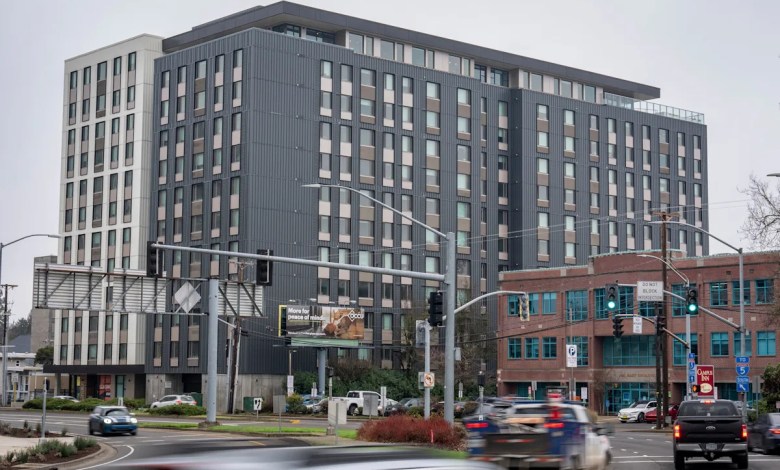
Planning and Development Director Denny Braud, Developer Jim Atkins and Mayor Kaarin Knudson cut the ribbon for the Portal apartments in Eugene’s River District on Sept. 9, 2025.
The renter protections had little effect on rental unit construction, the report said. Around 750 new rental units were permitted in 2022, this dipped to under 500 in 2023 and went back near 750 in 2024.
As Eugene considered its renter protections in 2023, local landlords warned the regulation would lead to small-scale landlords selling to large, out-of-state property management companies. The report’s authors said they weren’t able to test this claim.
The report said in 2024, 74% of rentals in Eugene were run by professional property managers and 26% were small-scale landlords. The authors did not have data on what these numbers were before the renter protections went into effect.
Rent still expensive in Eugene

Jim Adkins, co-owner of Adkins Dame, LLC., Mayor Lucy Vinis and Denny Braud, director of the City of Eugene’s Planning and Development department, cut the ribbon for the opening of the Heartwood on June 13, 2024. The Heartwood is the River District’s first residential building.
The renter protections require landlords to pay relocation assistance if they price out a tenant after raising rent more than 7% over inflation. This requirement didn’t seem to deter rent increases.
In 2024, the median prices for a month’s rent in Eugene were $1,362 for a one-bedroom and $1,641 for a two-bedroom. These represent 18% and 19% increases, respectively, since 2020.
Rent was already higher than most comparable cities, and rose faster. Elsewhere increases ranged from 13% to 19%, according to the report.
Rental experience has improved

Ember Woodruff, a tenant of the East Blair Housing Co-op, speaks to a Register-Guard reporter about improvements to her apartment on August 21, 2025, in Eugene.
While these big trends were negative, the rental protections still improved the experience of renting in Eugene, the report said.
The report noted a rental applicant who applies for 10 units, which is common among applicants with a conviction history or who are supported by rental subsidies, saw their application cost decrease from $500 to $100.
The report also included testimonies from several local nonprofits in support of the protections. These organizations said the renter protections have improved housing access and stability, improved fairness and accountability, and “mitigated the disruption of an unplanned move” for their clients.
Council reaction and next steps

The East Blair Housing Co-op on August 21, 2025, in Eugene.
The report didn’t seem to persuade city councilors away from their previous positions on the rental protections.
Councilors who supported the measure before said ultimately, the rules protected tenants, particularly because of the cap on application fees, and construction continued despite landlord warnings.
Councilors who opposed the renter protections were skeptical largely because of the ambiguity in the data on who manages rentals. They also noted that given construction timelines, it’s possible the rules will deter construction in the future and the city just hasn’t seen it yet.
The city is starting to study a “phase 3” of the renter protections. Eugene will consider the potential for a new slate of regulation to:
-
Ban landlords from considering medical and educational debt when screening applicants.
-
Ban landlords from using a mandatory credit score above 500 as a requirement for applicants.
-
Ban landlords from denying a rental application based on a monthly income requirement that exceeds twice the monthly rent.
-
Implement a local moratorium on no-cause evictions.
In addition, Councilors told staff to study possibly becoming a “Tenant Opportunity to Purchase Act” city. This would mean if a landlord wants to sell a rental property, they will have to give their tenants an opportunity to buy it before putting it on the open market.
City Council also advanced recommendations that staff described as “minor fixes” to the renter protections which will be next heard at a future public hearing. The proposed changes would:
-
Clarify that a pet deposit doesn’t count toward the security deposit cap.
-
Establish a 48-hour enforcement deadline for landlords violating the $10 application fee cap.
-
Redefine “affordable housing” which is exempt from the relocation assistance requirement, as housing affordable to those making 80% of Area Median Income, instead of 60%.
-
Add a clearer definition of a “vacation dwelling” which is exempt from the relocation assistance requirement.
-
Explicitly state the “habitability standards” required under Eugene Code are the responsibility of the landlord. According to staff, this is already implied under state law.
Alan Torres covers local government for the Register-Guard. He can be reached by email at atorres@registerguard.com, on X @alanfryetorres or on Reddit at u/AlfrytRG.
This article originally appeared on Register-Guard: Eugene renter protections: Evictions, rent still rise


