Europa’s Spider-Like Feature is Analogous to Earth’s Lake Stars, Planetary Researchers Say


Jupiter’s icy moon Europa is an ocean world that is a prime candidate in the search for potential extraterrestrial habitability and life beyond Earth. Europa’s surface is home to many features believed to originate from brine sources within its icy shell, which may represent the most accessible bodies of liquid water in our solar system. One possible and fascinating example is the asterisk-shaped “spider” at the center of Manannán Crater, identified by NASA’s Galileo mission. Planetary scientists now present a new hypothesis for the formation of this spider-like feature, based on morphological analysis and preliminary analog modeling. They suggest that this feature could come from a process similar to that which forms dendritic “lake stars”, seasonal features found on Earth’s frozen ponds and lakes.
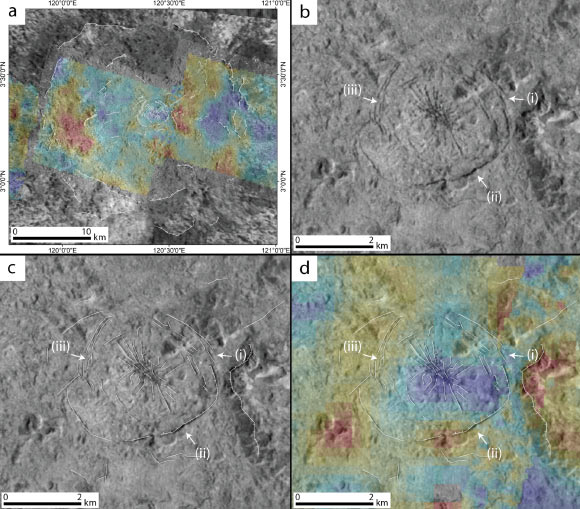
Geomorphological map Damhán Alla de Manannán. Image credit: Mc Keown and others., doi: 10.3847/PSJ/ae18a0.
“This spider-like structure could have formed as a result of the eruption of molten brines following the Manannán impact,” said Dr Elodie Lesage, a researcher at the Planetary Science Institute.
“This would mean it could tell us about the properties of the subsurface and the composition of the brine at the time of impact.”
Dr. Lesage and his colleagues also study Martian “spiders,” which are branched, tree-like features that form in regolith near Mars’ south pole.
They applied this knowledge to other planetary surfaces, including Jupiter’s icy moon Europa.
While Martian spiders form when dust and sand are eroded by gases escaping beneath a seasonal layer of dry ice, the Europa team’s work claims the “asterisk-shaped” feature may have formed after the impact.
“Lake stars on Earth are radial, branching patterns that form when snow falls on frozen lakes and the weight of the snow creates holes in the ice, allowing water to flow through the snow, melt it and spread in an energetically favorable way,” said Dr. Lauren Mc Keown, a researcher at the University of Central Florida and NASA’s Jet Propulsion Laboratory.
“On Europa, we believe an underground brine reservoir could have erupted after an impact and spread through the porous surface ice, producing a similar pattern.”
Researchers informally named Europa’s feature Damhán Alla, Irish for “spider”, to distinguish it from Martian spider formations.
To test their formation hypothesis, they also conducted field and laboratory experiments, observing lake stars in Breckenridge, Colorado, and recreating the process in a cryogenic glove box, using Europa ice simulants cooled with liquid nitrogen.
“We flowed water through these simulants at different temperatures and found that star-like patterns formed even at extremely cold temperatures (minus 100 degrees Celsius or minus 148 degrees Fahrenheit), supporting the idea that the same mechanism could occur on Europa post-impact,” Dr Mc Keown said.
Scientists modeled the behavior of a brine pool beneath Europa’s surface after this impact, and the team created an animation illustrating the process.
Observations of Europa’s icy structure have been limited to images from the 1998 Galileo spacecraft, but the authors hope to resolve this question with higher-resolution images from the Europa Clipper mission, a NASA spacecraft expected to arrive at the Jupiter system in April 2030.
“Although the lake stars provided valuable information, conditions on Earth are very different from those in Europe,” Dr Mc Keown said.
“Earth has a nitrogen-rich atmosphere, while Europa’s environment is extremely low in pressure and temperature.”
“In this study, we combined field observations with laboratory experiments to better simulate Europa’s surface conditions.”
Looking ahead, the team plans to study how low pressure affects the formation of these elements and whether they could form beneath an icy crust, in the same way that lava flows on Earth to create smooth, ropy textures called pahoehoe.
Although geomorphology was the primary focus of this study, the results offer important clues about subsurface activity and habitability, which are crucial for future research in astrobiology.
“Using numerical modeling of the brine reservoir, we obtained constraints on the potential reservoir depth (up to 6 km or 3.7 miles below the surface) and lifespan (up to a few thousand years after impact),” Dr Lesage said.
“This is valuable information for future missions searching for habitable environments within icy shells.”
The team’s results were published in the Journal of Planetary Sciences.
_____
Lauren E. McKeown and others. 2025. Lake Stars as Earth Analogue for Europa’s Manannán Crater Spider Feature. Planet. Sci. J. 6, 279; doi: 10.3847/PSJ/ae18a0


