Astronomers are racing to study our solar system’s newest ‘interstellar visitor.’ Here’s why.


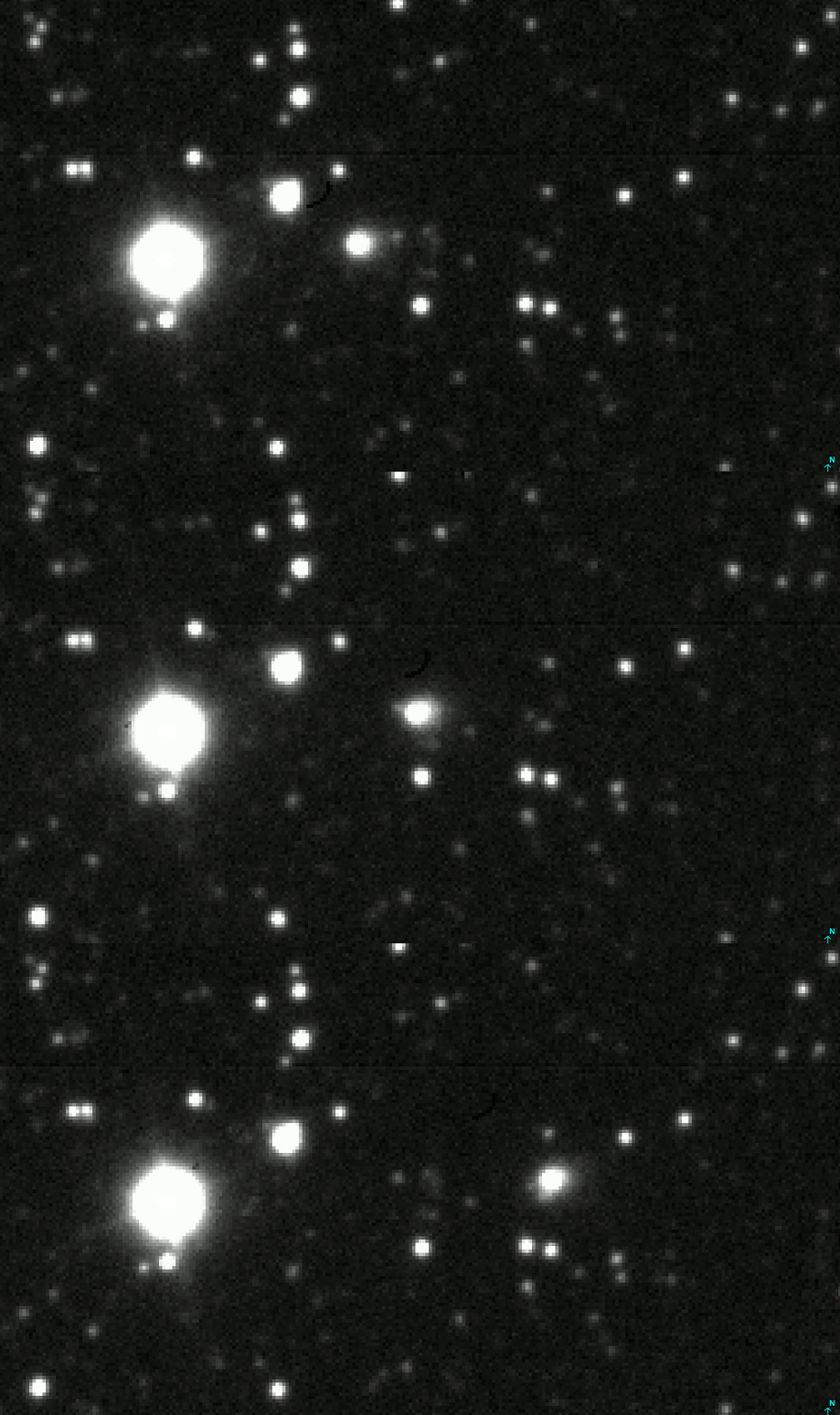
The astronomical community is in the process of focusing on a newly discovered “interstellar object”, only the third of its kind never seen, which is currently pulling towards us during a one -way trip through the solar system.
The race is now underway to study the extraterrestrial interlop, named 3i / AtlasBefore leaving forever.
“We have only one blow on this object, then let’s go forever”, ” Darryl SeligmanAn astronomer from Michigan State University and the main author of a new article on the object, told Live Science. “So we want as much information from all our observatories as possible.”
In relation: Look at the recently discovered 3i / Atlas “interstellar visitor” head towards us in First Livestream
Experts say that the 3i / Atlas study could potentially tell us about extraterrestrial star systems and how exoplanets are formed – and we can even be able to trace it at its origins.
Initial discovery

3i / Atlas was discovered on July 1 Based on the data collected by the latest asteroid terrestrial impact alert system (Atlas) and immediately stung the interests of researchers because of its trajectory and extreme speed, which exceeds 130,000 MPH (210,000 km / h). Within 24 hours following its discovery, NASA had confirmed that it was an interstellar object.
A day later (July 3), a group of more than 40 astronomers, led by Seligman, had downloaded the first article describing the extrasolar entity to the prior database arxiv. All data so far indicate that 3i / Atlas is a large comet Surrounded by a cloud of ice, dust and gas up to 15 miles (24 kilometers) in diameter.
Before this discovery, only two other interstellar objects (ISO) had been identified: 1i / ‘Oumuamua, a Space Rock discovered in 2017; and 2i / Borisov, a comet spotted in 2019. This makes the comet newly discovered particularly attractive for astronomers.
However, there is a limited window to study 3i / Atlas. The comet, which is currently about 4.5 times further from the sun Whether the earth will reach its point closest to the sun, or Périhelion, on October 30, before starting its journey out of the solar system, when it will become much more difficult to spot. It will also be out of sight between the end of September and early December, when it is positioned on the other side of the sun to the earth.
Observe an interstellar visitor

In the coming weeks and months, researchers will try to use “all telescopes” that they can make observations of 3i / Atlas, Sean RaymondA planetary scientist from the University of Bordeaux in France, told Live Science in an email.
This will be particularly true for observatories in the southern hemisphere, which will have a better view of the comet more and more brilliant, Aster TaylorA student graduated from the University of Michigan and co-author of the Arxiv study, told Live Science in an email.
Experts are particularly enthusiastic about the possibility of 3i / Atlas imaging with the VERA C. Rubin Observatory – the most powerful optical telescope in the world, which Recently published his first images. The observatory, located in Chile, has already proven to be able to imagine Asteroids never seen And will undoubtedly target the interstellar comet when it is entirely online in a few months.
THE James Webb space telescope (JWST) and the Hubble space telescope, meanwhile, could help reveal the chemical composition of the effort because of their ability to study the object in several wavelengths of the electromagnetic spectrum Pedro BernardinelliA planetary scientist from the Dirac Institute of the University of Washington, told Live Science in an email.
Some researchers also proposed to use Mars Rovers de la Nasa to take photos of the comet because it makes a narrow pass by the red planet a few weeks before reaching the perihelion. The robots have previously was used to spying on dangerous sunscreen Hidding on the distant side of the sun of the earth.
Another intriguing option is to Send a spacecraft to collect 3i / Atlas samples. However, the general consensus among experts is that it is unlikely that such a mission occurs
Extraterrestrial star systems
The 3i / Atlas study offers us a rare opportunity to glean information on extraterrestrial star systems and potential exoplanets.
“Interstellar objects are probably the remains of the formation of exoplanets,” said Raymond. “Studying them can open a window on understanding the training and evolution of other planetary systems.”
In this way, ISOs like 3i / Atlas “also connects the solar system to its galactic environment”, ” Amir SirajA doctoral student at Princeton University who previously studied ISO, told Live Science.
Although it is not yet clear where 3i / Atlas comes from, it is possible that we can identify its origins, especially if researchers can determine its age, Wes FraserAn astronomer of the National Research Council Canada, told Live Science in an e-mail. And while the comet reaches the periHelion, the amount of ice and other “volatile” substances that burn themselves from the order will help us reduce this, added Fraser.
However, even then, “we will probably never be able to pinch it to a unique star system,” said Taylor.


