Every ant is a queen in this parasitic species — and they reproduce by cloning themselves and hijacking other ant colonies


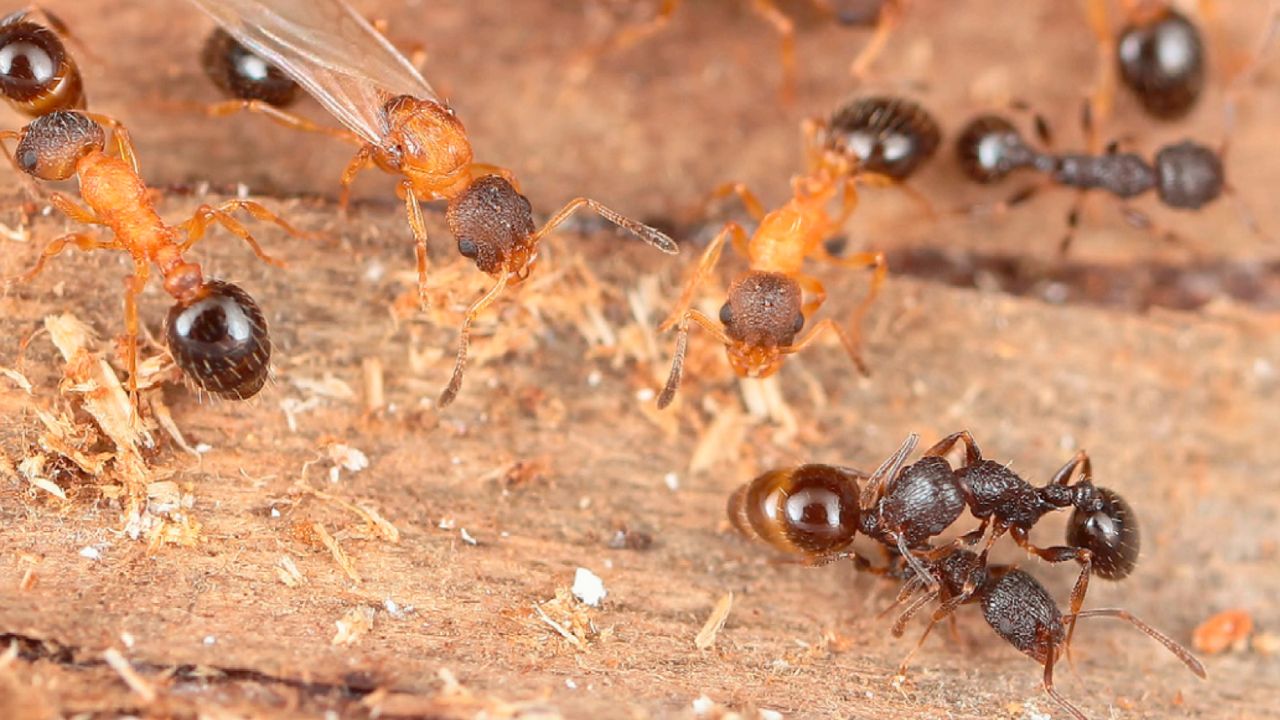
A rare species of ants in Japan has no males or workers – only queens, scientists have discovered. These queen ants live parasitically in the nests of another ant species and reproduce asexually to create clone queens that will take over other nests.
The parasitic ant, Temnothorax kinomuraiis the “first known species with only queens,” said Jürgen Heinzebiologist at the University of Regensburg in Germany and co-author of a new study describing the findings.
But there is also parasitic queens that infiltrate colonies of other species and invade themoften forcing the workers to serve them and raise their offspring until their own brood takes over.
Keiko Hamaguchibiologist at the Kansai Research Center in Kyoto, Japan, and colleagues studied T. kinomuraiwhich has only been found in nine locations in Japan. It was suspected that the ant functioned differently and produced only queens, with no workers or males, but we weren’t sure.
Young T. kinomurai queens invade the nests of a related species, Temnothorax makorastinging the host queen and the more aggressive workers trying to stop the coup. If the takeover works, the surviving workers raise the alien queen’s young.
“T. kinomurai needs the host workers for foraging and brood care and cannot produce offspring without them,” Heinze told Live Science via email.
To understand what’s going on, Hamaguchi’s team collected six colonies led by T. kinomurai queens and kept them in nest boxes in the laboratory. From these colonies, they raised 43 offspring, none of which were males, according to examination of the genitals, nor workers, which would be smaller. They were all queens.
When presented with a new potential host T. makora colonies, seven of the 43 offspring, who had never mated, succeeded in a coup attempt. This corresponds to the generally high failure rate of the risky business of founding a parasitic colony. The seven queens produced a total of 57 offspring, all of whom were also queens. The results were published on February 23 in the journal Current biology.
The queens of certain ant species can clone themselves through asexual reproductionknown as parthenogenesis. Other ants exploit social parasitism, diverting labor from independent colonies to raise their own offspring.
“Yet, until now, no species has successfully merged the two strategies, despite the intuitive evolutionary logic behind such a combination.” Jonathan Romiguieran evolutionary biologist at the University of Montpellier in France who was not involved in the work, told Live Science by email.
“Given that there are more than 15,000 species of ants, this is quite unusual,” added Daniel Kronauerbiologist at Rockefeller University in New York who was not involved in the study.
The benefits of sexuality and asexual reproduction are normally finely balanced, he said. Asexual reproduction can allow an organism to maximize its own genetic contributions to the next generation by producing genetically identical daughters, and asexual species can often outperform their sexual counterparts because they do not have to invest energy and resources in finding mates and producing males.
But sexual reproduction produces genetically diverse workers, which can be beneficial to an ant colony when it comes to defense against pathogens and the division of labor.
However, given that T. kinomurai queens no longer produce workers, so those benefits are gone, Kronauer told Live Science. “This could tip the scales in favor of asexual reproduction and ultimately lead to the loss of males,” he said.
Hamaguchi, K., Kinomura, K., Kitazawa, R., Kanzaki, N., and Heinze, J. (2026). A parthenogenetic parasitic ant with only queens and no workers or males. Current biology, 36(4), R123 to R124. https://doi.org/10.1016/j.cub.2025.11.080


