Taste tagines and traditions in Morocco’s Atlas Mountains

This article was produced by National Geographic Traveler (UNITED KINGDOM).
A motor-mouthed vendor zooms past pushing a wheelbarrow full of pumpkins and pomegranates, snapping me out of my disbelief. I take another look at the man in question. Today, at least, his talents seem confined to the barbershop chair. As I wander through the market of Asni, a small town at the foot of Morocco’s High Atlas Mountains, I am gradually engulfed by its unfiltered chaos. It’s the kind of place where teenagers carrying slabs of beef wander among stray cats and men sitting in cafes, exchanging news over syrupy mint tea. The narrow lanes are filled with locals testing the ripeness of tomatoes, scooters passing stunned mules, and vendors gathering on tiny stools for their second breakfast of the day. “We eat a lot here in Morocco,” says Hamid, from the rural town of Aghbar. “It’s usually five meals a day, one after each call to prayer.”
On this balmy October morning, we are joined by Hassan Ait Mbarek, a local farmer whom, with Hamid’s interpreter, I am beginning to know a little better. Hassan is from the nearby village of Tikhfist, where we will head later for a traditional tagine lunch with his wife, children and parents. Like most families in these mountains, Hassan and Hamid are of Berber ethnicity – the indigenous people of North Africa who lived here long before the Arab conquest of North Africa in the 8th century. The term “Berber”, meaning “barbarian”, was imposed on them by the Romans, but they call themselves “Amazigh”, meaning “free people” in the local Tamazight dialect. The name refers to a nomadic past, where home was where their livestock chose to graze. That changed about a century ago, when Hassan’s grandfather settled in Tikhfist and built the family’s current home.

The weekly market in Asni is the meeting place for all kinds of trades, crafts and local delicacies. Photography by Jonathan Stokes

Hassan’s family owns 10 sheep in their village of Tikhfist. Photography by Jonathan Stokes
In recent years, many residents have moved to the cities, but for Hassan – whose family was one of only two to stay behind – it is important to preserve what sets his people apart. “We are not Arabs, we are different,” he says, inspecting a bunch of red grapes. “We have our own traditions which vary from one tribe to another: our food, our clothes, our music, our language, our dialects. »
We move deeper into the Saturday market and the heady scents of saffron and cumin linger in my nostrils long after I’ve passed the spice stalls. Hundreds of people from surrounding villages crowd the alleys, stocking up on fruits, vegetables, spices, clothes, school books and cleaning products. For many, this is the only opportunity to gather supplies for the week.
Although he grows much of his own produce, Hassan is there for the few ingredients he can’t get at home. For today’s tagine, we collect carrots and green beans before heading to the butcher’s section for the final ingredient: a choice cut of goat meat.
“This place is not just for buying things, it’s also for socializing, sharing news and spending time,” says Hamid as he walks around the blacksmith donkey towards the exit. “The connection with the community is very important in our culture. »
The road to Tikhfist
The 45-minute journey from the market to Hassan’s house follows a series of winding dirt tracks. As our 4×4 climbs higher into the mountains, the pink valley of Ouirgane reveals itself in slow, theatrical stages. Its wooded slopes, covered with olive trees, oaks and junipers, are dotted with occasional hikers or elders grazing their flocks. The summit of Toubkal, the highest mountain in North Africa, is barely visible in the distance. Then the Ouirgane reservoir appears, a lifeline for the surrounding villages, its glassy surface reflecting the mountains that surround it.
The trills and drumbeats of ahidous – a haunting style of Amazigh music – echo from the radio as we pass goat shelters and groups of white hives. Eventually the soundtrack fades to the cries of children and a flock of scribbling roosters as we arrive at Tikhfist.

The vast Ouirgane valley is covered with olive trees, oaks and juniper trees. Photography by Jonathan Stokes
Perched at about 6,000 feet above sea level, the village feels like another world compared to the hubbub of Marrakech, the nearest major city, about 40 miles to the north. A handful of flat-roofed houses cling to the hillside, built of rust-colored clay bricks and lined with rickety balconies draped in colorful prayer rugs. As we get out of the car, Hamid tells me that the dirt road from Ouirgane, both the nearest town and the name of Hassan’s tribe, wasn’t built until 2002. Electricity came even later; until 2007, the entire village depended on candlelight.
We are greeted at the door by Hussein, Hassan’s 80-year-old father, dressed in a brown gandoura (a light tunic) and a white kufi (a cylindrical hat without brims). Before entering the house, he bows to kiss his father’s right hand – a gesture of respect for elders adopted throughout Morocco. “Here, parents are even more respected than wives or children,” explains Hamid. “They are like your hands: your mother is on the right, your father is on the left. And you can’t do anything without your hands, can you?”
Placing my right foot first – as is the custom when entering a Muslim house – I enter. A small courtyard unfolds before us, where laundry hangs in shimmering rays of sunlight. In the stone-walled kitchen, Hassan’s wife, Aïcha, shapes tafarnout (a traditional Amazigh flatbread), rhythmically kneading the dough in front of a wood-fired terracotta oven sunk into the ground. Their three children: Khadija, one; Fatima, five years old; and Imran, 11, play together while Hassan’s mother stands by the sink, rinsing a piece of goat with quiet concentration.
Tagine, both the name of the dish and the cone-shaped clay pot in which it is cooked, is so central to life here that Aïcha sometimes prepares it twice a day. It is a simple combination of simmered meat and vegetables, the specifics of which vary from region to region. Here in the High Atlas Mountains, it’s generally goat, vegetables whatever the season.
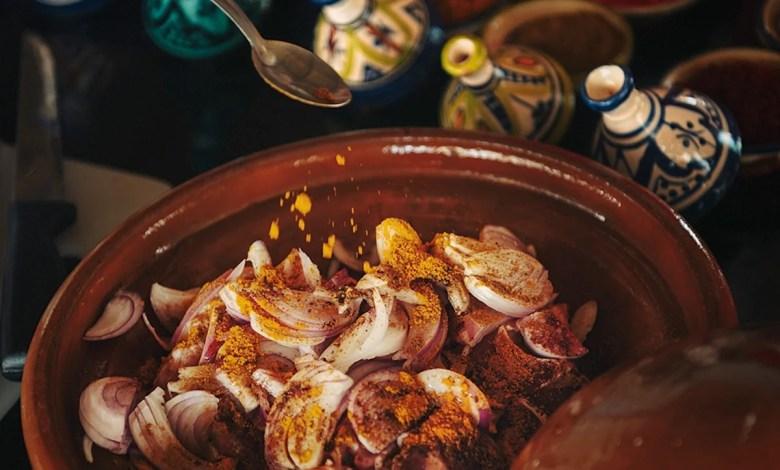
Aïcha mixes chopped garlic, red onion, coriander, parsley, house-pressed olive oil, salt, paprika and turmeric, then spreads the mixture in the tagine to caramelize. Within seconds, the air is thick with spices, mingling with the hiss of the teapot bubbling over the fire. At 2 p.m., the muezzin’s wavering call sounded through the window, calling the villagers to prayer. Zahra murmurs prayers as she layers gourd, green beans, potatoes, carrots, green pepper and goat cheese in the tagine before letting it simmer for two hours.
In the meantime, we meet around a round coffee table in the kitchen. Hassan pours mint-infused green tea, lifting the teapot as high as possible to cool and aerate the water. Wearing her perpetual smile, Zahra tears off a piece of piping hot bread, tops it with a walnut plucked from the tree in their garden, and gestures for me to try it. As she does so, I ask her if she has ever been tempted to move away from the village. “Modern, easy city life is not for me,” says Zahra, her eyes wide with black eyeliner. “I want to look out the window, open my eyes and see land and mountains, not buildings. »

Green tea is often infused with fresh mint and served with most meals. Photography by Jonathan Stokes

Tagines, like the one Hassan and his family make with goat cheese, are meant to be shared. Photography by Jonathan Stokes
After all, the land is their lifeline. It’s where they care for their 10 sheep and, despite droughts, grow fruits and vegetables so organic that, according to Zahra, the family never needs to see a doctor. In the summer, they all sit on rugs outside and talk until the early hours, often over a barbecue on the go. “Here, people don’t need much to be happy,” Hamid told me. “Here, our wi-fi is a conversation.”
When it’s time to eat, we head to the main dining room and sit at a table near a large window, where the cool mountain air streams in and the land spreads out in a seemingly endless field. Aïcha places the tagine in the center, alongside a simple tomato and onion salad and a pile of flatbread. There are three rules here, Hamid tells me: “The eldest eats first, you only eat with your right hand, and when it comes to tagine, the vegetables first, then the meat. »
Zahra lifts the lid of the tagine, releasing a plume of steam and revealing a kaleidoscope of perfectly cooked vegetables. Tearing bread for everyone at the table, she says “Bismillah” (“in the name of Allah”), a blessing said before meals. I scoop up the creamy stew, which melts as soon as it hits my mouth, juices running down my chin. When the goat cheese follows, it’s incredibly tender – warm, rich and slightly tangy from cumin.
For a few minutes, no one speaks. I use silence to reflect on the resilience of the Amazigh people – from Hassan and his neighbors to the multi-talented barber at the market. Despite the temptations of the modern world, they cling to family, community and conscious simplicity. “No one wears a watch here,” says Hamid, pointing to the tangle of hands picking up the tagine. “But they will always have time.”
Published in the 2026 Culinary Collection by National Geographic Traveler (UNITED KINGDOM).
To subscribe National Geographic Traveler (UK) click here. (Available in certain countries only).