Abandoned coal mine drainage identified as a significant source of carbon emissions


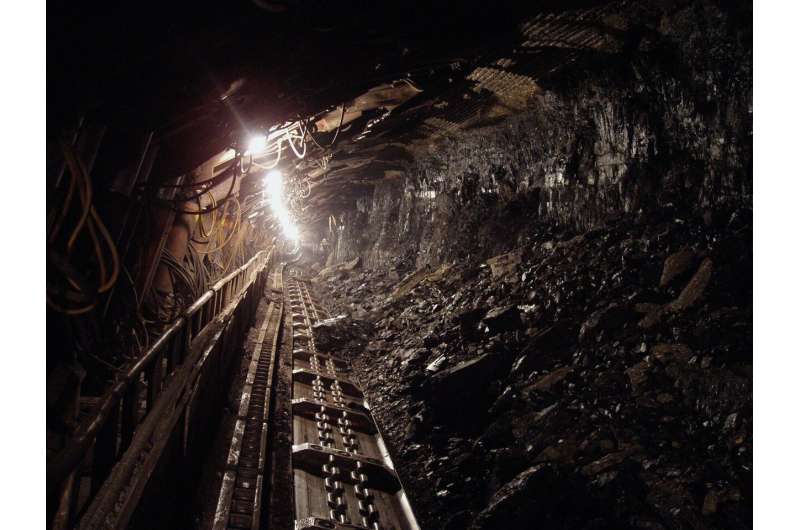
Credit: Pixabay/CC0 Public domain
For the past 250 years, people have mined coal industrially in Pennsylvania, United States. In 1830, the city of Pittsburgh used more than 400 tons of fossil fuel each day. Burning all that coal contributed to climate change. Additionally, unremediated mines – particularly those operating before Congress passed regulations in 1977 – have leaked environmentally harmful mine drainage water. But this may not be the end of their legacy.
In research presented last week at GSA Connects 2025 in San Antonio, Texas, USA, Dr Dorothy Vesper, a geochemist at West Virginia University, found that these abandoned mines pose another risk: ongoing CO2.2 emissions from escaping water even decades or centuries after mining has stopped.
Hidden climate impact of mine drainage
In a 2016 study, Vesper and colleagues found that water flowing from just 140 of these mines in Pennsylvania added as much CO2 into the atmosphere each year in the form of a small coal-fired power plant. Because officials and scientists don’t know the number of abandoned mines in Pennsylvania, much less elsewhere, the impact of these mines represents an unresolved and important part of understanding the sources of human-caused climate change.
“We would like to have a much better idea of the magnitude” of these carbon emissions, Vesper says. “A lot of the problem is just not even knowing where the discharges are. And it’s not just Appalachia. It’s all over the country. It’s all over the world, actually, these mine waters.”
How Acidic Mine Water Releases CO2
Mine water, laden with sulfuric acid as a byproduct of coal geology, breaks down carbonate rocks like limestone associated with coal seams. Part of this rock is ancient CO2 which was locked away when the rock was formed millions of years ago. Acidic water dissolves carbonate rocks, releasing carbonate ions (CO3) which then turn into CO.2 or other forms of carbon in water. Once the reject leaves the mine and is exposed to the air, any CO2 present in water can “outgas” and be released into the atmosphere.
Before the work of Vesper, CO2 emissions from mine drainage degassing had not been widely quantified. Part of the problem is the large number of abandoned mines and the fact that they are not well documented. Often, Vesper and his students would scour the woods to measure a reported mine and find no trace of the opening or that the flow was no longer flowing.
Measure extreme CO2 with creative tools
Another problem is that standard field instruments cannot measure extremely high CO concentrations.2and Vesper discovered that some mine drainages contain up to 1,000 times more CO2 than would be expected in normal water. To make his measurements, Vesper therefore had to turn to an unexpected source for a measuring device.
“It’s basically the soda industry. Bottling plants and breweries have them,” Vesper says. The beverage instrument is “designed to be carried around the brewery and connected to these giant tanks, so it’s truly portable and can handle very high CO levels.”2“.
Specialized instrument in hand, Vesper, accompanied by her students and collaborators, tracks down old mines to measure CO2 carried out by water drainage. The results of some mines were comparable to those of CO2 released by hydrothermal vents and much higher than the water flowing from typical natural limestone caves. In addition, the quantity of CO2 at each site has changed over time depending on the hydrological conditions around the mine.
Future Research and Possibilities for Remediation
In the future, Vesper hopes to measure more mines over longer periods and under different conditions, add methane to its analysis suite, and explore how different remediation techniques could prevent CO emissions.2 to be released into the atmosphere and contribute to climate change.
“I think even small things in sanitation design could make a difference, like keeping discharges underground in pipes and feeding them into treatment wetlands from underground,” says Vesper. “So it’s all good. It’s not going to off-gas as easily into the environment.”
More information:
172-8. CO2 releases from abandoned coal mines in Pennsylvania and West Virginia, gsameetings.secure-platform.co… 49/application/10087
Provided by the Geological Society of America
Quote: Abandoned coal mine drainage identified as a significant source of carbon emissions (November 1, 2025) retrieved November 1, 2025 from https://phys.org/news/2025-11-abandoned-coal-drainage-significant-source.html
This document is subject to copyright. Except for fair use for private study or research purposes, no part may be reproduced without written permission. The content is provided for informational purposes only.