Extra-strong nicotine pouches packaged like children’s sweets


Disclosure of the BBC

 Bbc
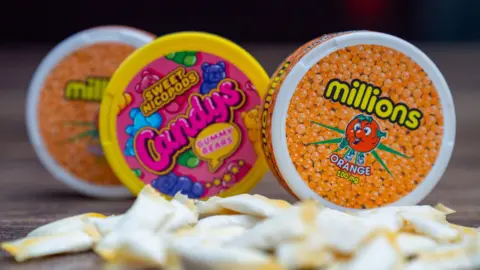
BbcExtra -Fort nicotine products designed to please children – some of whom have torn the logos of popular sweet brands – are openly sold in stores, found BBC Scotland.
A disclosure journalist, turning under cover, bought nicotine sachets that imitate the name and the brand of well -known “millions” sweets in a boutique at the eastern end of Glasgow.
The worker of the shop who sold the sachets said he contained 100 mg of nicotine, which would make the strength of a cigarette about 10 times.
The tests later showed a level lower of 17 mg, which would always be defined as very strong by most legitimate manufacturers.
Negotiation standards said they were concerned about products with “worrying children’s attraction” as well as flavors and “catchy packaging” that imitated candy.
However, there is no law restricting the age of the sale for the pockets of nicotine, so that any child can legally enter a store and buy addictive products.
No strength restriction
The sachets are small pillow bags that contain nicotine – a chemical found in tobacco which acts like a stimulant.
There is no restriction on the force of nicotine in the sachets.
They are placed under the upper lip, against gum and deliver a nicotine stroke which can be stronger than cigarettes or vapes.
The sachets are much less harmful than cigarettes, and because chemicals do not enter the lungs, they can have less risks than vapes.
Some people use them as a way to quit smoking, although they are not recommended by the NHS.
Kate Pike, of the Chartered Institute of Trading Standards, said that it was “scandalous” that products imitated popular popular brands in order to target children.
For the BBC disclosure documentary, Nicotine Socches: What is the problem ?, A journalist was secretly filmed by buying a bathtub of millions of orange sachets for £ 7.50.
The boutique worker who sold the product said to him: “They are special.”
The product did not have all the required risk warnings, nor the manufacturer’s traceable details.
The design on the bathtub included photos of the millions of candies, made by the Scottish confectionery manufacturer Golden Casket Ltd.
They told the BBC that they had no connection with the pockets of nicotine and were “dismayed” that their brand image was used in this way.
Another brand called “Candys”, with photos of gumboles, was also for sale.
The creators of the Candys brand did not respond.
Ms. Pike told the BBC: “Millions of candies are clearly a product for children and there is no reason to connect them to nicotine sachets unless you want to attract children.
“If it was alcohol, there would be a outcry. A child who finds himself who would think that it is for them and nicotine is a very addictive substance.
“Retailers should be more responsible for what they offer in their communities.”
Professor Crawford Moodie, from Stirling University, is doing research on the marketing of tobacco and nicotine products for years.
He said, “It makes you ask you what these companies are trying to do. I mean, clearly, they do not have the consent to do so.
“But the fact that companies put them on the market and retailers are very happy to sell them shows that we are not in the right place with regard to the control of the nicotine pocket market and the protection of young people in particular.
“There is very little in the packaging to tell you that they are not candies and the potential for abuse and the harmful effects for young people are clearly there.”
Contacted by the BBC, the retailer said that he had now removed the product from millions of his shelves.

The disclosure program spoke to young people who said they used sachets.
Alex started taking them two years ago at the age of 15 at school two years ago and became addicted.
He said he had never tried smoking or vaping before.
It is the packaging, how the different flavors were announced and seeing his friends take the sachets, which made him want to try them himself.
He said, “I think it was just something different.
“It went from a day to three a day to my highest – I probably used 15 per day.
“If I didn’t take them, I would just make withdrawals and I would just feel demotivated and as I didn’t want to do anything before taking another.”
Nicotine covers are currently not regulated and can be sold legally under 18.
The Tobacco and Vape Bill goes through the House of Lords, but there are calls for government to accelerate legislation to prevent gaps.
The bill will prohibit the sale of nicotine covers to under 18 and will restrict things like where they can be positioned in stores as well as the limitation of flavors, forces, packaging and how they are announced.
“We receive widespread reports across the United Kingdom that these pockets of nicotine are sold to children,” said Pike, principal of tobacco and vaping negotiation standards.
“Parents come into contact by assuming that we can act and be shocked when we tell them that we cannot.
“For the moment, it’s perfectly legal and we can’t do anything.”
The BBC has contacted several of the largest manufacturers of nicotine sachets and all supported future legislation.
American British tobacco said that its covers “should never be used by these minors”, the manufacturer Phillip Morris said that nicotine sachets had proven “a huge success” for adults to leave cigarettes, and Japan Tobacco International said that “minors should never use or access nicotine products”.


:max_bytes(150000):strip_icc()/Health-GettyImages-2083352111-b3a0344f44bf412cb7f0dd5483284dad.jpg?w=390&resize=390,220&ssl=1 "Taking Zinc for a Cold? 4 Potential Side Effects To Know First")