How climate change fueled wildfires in Georgia and Florida

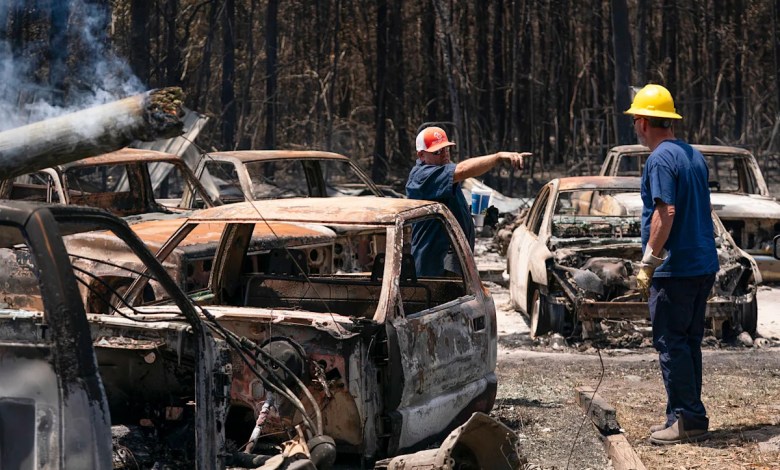
Wildfires raging this week in southern Georgia and northern Florida have been fueled by a combination of hot and windy conditions, severe drought and desiccated vegetation from past hurricanes, all fueling the fires.
It’s a combination that climate scientists have been warning about for decades as the planet warms.
“It’s not normal at all, but it fits with what we’re worried about with climate change,” said Kaitlyn Trudeau, a climate scientist at the nonprofit scientific research group Climate Central. “All of this shows how much we are really changing our climate. »
Thousands of acres are on fire in both states, with a fire in Atkinson, Georgia, already destroying about 90 homes since it broke out Monday.
Several counties in both states have enacted burning bans — including Georgia’s first burning bans — and Gov. Brian Kemp declared a state of emergency for 91 counties on Wednesday.
Widespread drought in the Southeast is largely to blame for the fires, but their spread has also been fueled by debris from past hurricanes that swept through the region — a problem that also has links to climate change.
In particular, Hurricane Helene in 2024, which made landfall as a Category 4 storm in Florida’s Big Bend region, left behind downed trees, branches and other vegetation ready to burn.
“The hurricane took out a bunch of trees and kind of knocked them all down in the area,” Trudeau said. “They sat in the sun to dry, and the fattier trees can be extremely flammable when they dry.”
She added that this type of desiccated vegetation exacerbates the risk of wildfires, helping them grow and become more destructive when they break out.
Scientists say devastating wildfires will become more frequent in a warming world, and studies have shown that fires will not only be more frequent, but also more destructive, due to climate change. The results have enormous environmental, financial and health consequences for communities across the country and around the world.
Even in humid places like the Southeast, which doesn’t appear to be as prone to wildfires as the western United States, regional risks are changing in a warming world, according to Trudeau.
“This is what we expected with climate change,” she said. “Parts of the Southeast have been extremely, very dry. And we’ve seen in those places, even though the weather is wetter, climate change is making the atmosphere thirstier. As it gets hotter, the amount of moisture extracted from the landscape or sucked from plants and soils also increases.”
Wildfires need two main ingredients to burn: fire-friendly weather conditions—dry conditions accompanied by lightning and wind, for example—and “fuel,” which consists of dead trees, dried leaves, and other flammable vegetation.
As temperatures rise due to climate change, the atmosphere can more efficiently extract moisture from trees and the ground. When a region simultaneously experiences persistent drought, there is not enough precipitation to compensate, paving the way for destructive wildfires.
The entire state of Florida is currently experiencing some form of drought, with most of the Panhandle region experiencing “extreme” or “exceptional” drought, according to the U.S. Drought Monitor. Similarly, 71% of Georgia is facing “extreme” or “exceptional” drought, including large swathes of the southern part of the state.
For Trudeau, this week’s wildfires are another sign that climate change is wreaking havoc on natural ecosystems and increasing fire activity across the country, including in historically wet landscapes.
“That’s why we’re seeing such crazy conditions right now,” Trudeau said. “It’s kind of like a perfect storm type situation.”
This article was originally published on NBCNews.com


