‘Fear of Flying Clinic’ helps anxious travelers back into the skies : NPR


Fear of Flying Clinic participants climb the boarding stairs and board a 787 as part of a four-day course aimed at relieving their anxiety about air travel. Being exposed to the sights and sounds of airplanes is part of this training.
Evan Roberts
hide caption
toggle caption
Evan Roberts
There are 20 minutes left before Alaska Airlines Flight 626 takes off from San Francisco International Airport bound for Seattle. Colette Vance closes her eyes and calms herself with a rosary, hoping her claustrophobia doesn’t trigger a panic attack.
This happened the year before, when she was heading back to North Carolina for college. She suffered from intense anxiety and felt like she was about to die.
“If I’m in a car, I can stop, open my door and relieve myself,” she says. “But when I’m on a plane, there’s no escape.”
After graduating, she avoided flying and returned home to California. The inconveniences of a cross-country road trip inspired him to confront his fear of flying.

Colette Vance prays with a rosary on a recent flight to Seattle. His claustrophobia makes traveling difficult.
Evan Roberts
hide caption
toggle caption
Evan Roberts
That’s how she found herself on this commercial flight with a group of other anxious passengers. They’re all on board for the final leg of a training called Fear of Flying Clinic, held at San Francisco International Airport.
Fear of flying affects approximately 25 million Americans, and many psychologists say that to overcome a fear, you must confront it gradually. But that’s often difficult to do with air travel if you’re alone, in public, surrounded by strangers. That’s where the Fear of Flying Clinic comes in: over four days, participants can be slowly exposed to the experience of flying, as well as training and support from mental health and aviation professionals.
More information from insiders is very helpful
Fran Grant and Jeanne McElhatton, both licensed pilots, founded the clinic in 1976. They created an educational program to help Grant’s husband overcome his anxiety about turbulence so he could travel with them.
Today, the workshop is organized by volunteers, many of whom have been through the clinic themselves. It is one of the few programs of its type in the country.
Participants are afraid of flying for a variety of reasons: recent plane crashes and a shortage of air traffic controllers, traumatic experiences that flying reminds them of (like experiencing an earthquake), or a fear of heights.

The first part of the training is designed to give nervous travelers more information about flight safety. Working pilots, air traffic controllers, flight attendants and aircraft maintenance technicians introduce themselves to the group and answer their questions – on everything from advances in aviation technology to safety protocols for pilots during thunderstorms.

Retired pilot Keith Koch shows participants a 787 engine. He is one of several volunteer aviation professionals who help teach aviation safety to Fear Pilot Clinic participants.
Evan Roberts
hide caption
toggle caption
Evan Roberts
Reconfiguring the Fear Response
The second major part of the training uses cognitive behavioral therapy (CBT) to help participants change distorted thought patterns that equate the presence of adrenaline with the presence of a real threat.
Using what’s called the “ABC model,” volunteer psychotherapist Paula Zimmerman writes the letter “A” on a large sheet of paper placed at the front of the room. “A” represents an “activating event” – the thing that triggers the fear – such as, for example, turbulence.
She then adds “B,” for belief – let’s say someone believes that every time they experience turbulence, it means the plane is going to crash.
Finally, she writes “C”, the consequence of this belief, which could be something like a panic attack.
If you think turbulence means the plane is going to crash, it makes sense that you would be terrified. However, turbulence is a normal part of flying and does not necessarily mean anything is wrong.
Zimmerman explains all of this so that when travelers get scared during an actual flight, they can go through this process for themselves and try to correct their thinking errors. With the example of turbulence, she offers a reframing tool: instead of saying “turbulence scares me”, she suggests saying to yourself: “I get angry when there is turbulence”.
Face to face with a 787
The other major technique the clinic relies on is slowly exposing participants to the sights and sounds of airplanes.
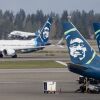
On the second day of training, participants visit a maintenance hangar and gather under the tail of a 787.
Just seeing the outline of the emergency exit door triggers a feeling of dread in Vance, who practices Zimmerman reframing.
“It’s just a plane,” she told herself. “Planes don’t hurt anyone.”

Clinic participants visit an aircraft maintenance hangar and are exposed to the sights and sounds of an aircraft that could trigger their fear response. The idea is to practice overcoming this fear before a real flight.
Evan Roberts
hide caption
toggle caption
Evan Roberts
One by one, the participants climb inside. Vance sits in a window seat, which is more likely to trigger her claustrophobia. She starts to feel sick and lays her head on her mother’s shoulder. But after a few deep breaths and a talk with her mother and Zimmerman, she felt better. Eventually, she is well enough to visit the cockpit.
This lower level of exposure is a dress rehearsal for what comes next: the commercial flight to Seattle.
Graduation in the sky
Vance and the other participants meet at the airport early on a Sunday. Vance goes through security, boards, and sits in a window seat. Three other clinic volunteers, including a retired pilot and a psychotherapist, are also there to support anxious passengers.

Graduates from previous years of the Fear of Flying Clinic send postcards from their vacations from here and abroad.
Evan Roberts
hide caption
toggle caption
Evan Roberts
The flight starts out a little rough for Vance, but she focuses on her breathing and overcomes the wave of anxiety. She says the support of everyone around her makes things easier.
“I feel really safe on this flight,” she says, “I’m really hopeful that I’ll be able to do a lot more things like this.”
When the wheels hit the track in Seattle, the clinic group erupts in cheers and congratulations.
On the flight home later that day, Vance opens the fortune cookie she received with her airport lunch.
“You will be traveling to many exotic places over the next few years,” he says.


